















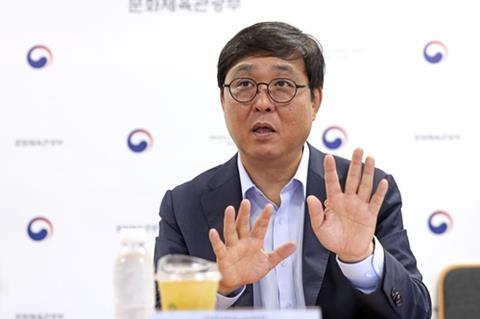
South Korea’s government has moved to cap actor fees under 10% of the production budget for mid and low-budget films that have received state support.
The agreement, signed by the Korean Film Council (KOFIC) and Ministry of Culture, Sports and Tourism, is aimed at building a healthier production environment as rising fees for actors have increased costs for films.
Leading talent agencies BH Entertainment, Management SOOP and the J-WIDE Company participated along with officials representing the Korean Film Producers Association (KFPA) and the Producers Guild of Korea (PGK).
The parties involved agreed to form a private-sector-led council to discuss further improvements that can be made in a bid to effect change across the industry, which has struggled to fully recover post-pandemic.
Under the agreement, government-subsidised films with net production costs between $1.36m (KRW2bn) and $5.5m (KRW8bn) will be urged to keep actors’ fees below 10% of those costs.
However, as the agreement is not legally binding, it remains to be seen how effective this initiative will prove in the long-term and is dependent on the willingness of star performers.
Actors represented by BH Entertainment include No Other Choice and Squid Game star Lee Byung-hun. Management SOOP oversees acting talent such as Cannes award-winning actress Jeon Do-yeon (The Housemaid). J-WIDE Company manages actors including TV drama stars Kim So-yeon and Bae Jong-ok.
The initiative has been met with wariness by some in the industry who point to the issue of actors’ fees being more of an issue in big-budget commercial films with budgets in excess of $7bn (KRW10bn) and high-end drama series by streaming giants.
It is also the latest of moves in Korea to revive the film industry post-pandemic. Last year, Kofic introduced the Mid-Budget Film Production Support Program, allocating nearly $7m to support local features with budgets from $1.4m to $5.6m. This year, the government increased this amount to $31.8m across two rounds of funding.
“We will spare no policy support to ensure that the government’s financial backing and the film industry’s commitment to mutual growth generate a synergistic effect, enabling Korean cinema to rebound,” said Chae Hwi-young, South Korea’s minister of culture, sports and tourism.
On July 8, the government released 2.05 million cinema coupons – each worth $4.04 (KRW6,000) – to help boost attendance at the summer box office. It was the second such giveaway this year.
There have been signs of recovery with attendance figures for local films in South Korea increasing by 75% in the first half of 2026, boosted by Yeon Sang-ho’s Colony and period drama The King’s Warden.
This month, Na Hong-jin’s Hope delivered Korea’s biggest box office opening of 2026, becoming the third highest grossing film of the year to date after just two weekends on release.





No comments yet