





The 2008 police killing of a teenager in Athens informs Jacqueline Lentzou’s audacious Venice Horizons title
Dir/scr: Jacqueline Lentzou. Greece/Germany/France. 2026. 88mins
In her second feature, Greek director Jacqueline Lentzou turns the notorious 2008 police killing of a teenage boy in Athens into a strange, audacious film that uses a death to celebrate a life. A Day In The Life Of Jo could not be further from the kind of solemn accusatory drama we might expect the material to generate. It’s far closer to the likes of Jonathan Glazer of Under the Skin or the Gus Van Sant of Last Days than it is to what is perhaps the closest obvious reference point, Ryan Coogler’s Fruitvale Station, which also follows the life of a victim of police violence in the hours leading up to his death.
A strange, audacious film that uses a death to celebrate a life
The film premieres in Venice Horizons and will next play New York and London; further berths are likely. Bouyed by strong word of mouth and critical support, the film has the potential to do well with arthouse audiences hungry for fresh, original content.
The murder of Alexandros Grigoropoulos and the countrywide riots it sparked may be the inspiration, but it’s not necessary to know anything about it to appreciate a film that proves a fresh, quirky, challenging slice of world cinema. To classify this as just another ‘Greek Weird Wave’ film in the mould of Athina Rachel Tsangari or early Yorgos Lanthimos would, however, be a mistake. A Day In The Life Of Jo’s highly experimental form comes from a place of warmth and compassion, one of identification rather than distance. It’s this glow – sweetness, even – that will carry audiences through passages that include more than six minutes of (rather beautiful) abstract shadows and light.
Lentzou’s first territory-marking move is to change the gender of her main character. Her second is to let the look, the sound and the rhythm of the film hew to the colour of Jo’s moods, the flavour of her dreams and what is left of her spirit after her vital functions have shut down. The writer-director’s first full-length feature, 2021 festival favourite Moon 66 Questions, styled itself as a film about ’love, movement, flow, and the lack of them’. This follow-up declares that it will speak of ’breath, hands and solitude, and their absence’.
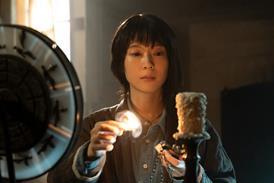
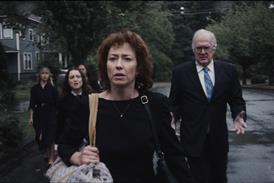
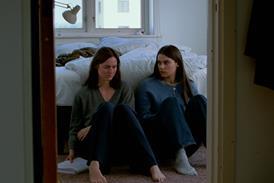
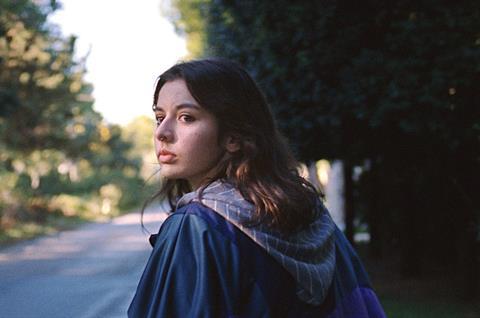
It’s impossible to summarize the plot without making the film sound like a teen movie. And in a way, held aloft by a raw, highly relatable performance by young actress Evita Andriopoulou, that’s exactly what it is. It’s about a girl at a confusing time of life who is adrift, and about the day when she catches at a new thread that may lead her out of the labyrinth. Jo, we learn, ended up with her stressed, unhappy but not uncaring mother (Eleni Vergeti) after her parents’ divorce. She hangs out with a fast set, has an older boyfriend and isn’t much good at anything at school except basketball. Then she hears a bespectacled, bookish classmate called Phaedra (Anastasia Gouliamou) sing an old torch song, ’The Rose Tattoo’, in music class, and is suddenly moved – and smitten.
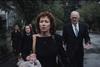
Though the time structure is established by the film’s title, Jo’s day feels amorphous and permeable; her father gives his daughter a lift to school, a group of much younger girls show her a tortoise they have found. Spaces and points of view drift and merge too. We see Jo’s mother going ballistic on the dance students she teaches before dancing herself to the point of collapse. The camera flies slowly away from her supine body over the polished wooden hall of the dance class venue… and suddenly it’s a school basketball court where Jo and her friends are training. At other times, while characters are talking, the camera lets itself gets distracted, wandering to chart a play of sunlight reflecting off a window. The camera takes an almost god-like, omipotent view – and, with classmates called Phaedra and Hermes, Jo is never far from that older Greek world of myths and legends.
But A Day In The Life Of Jo’s boldest formal move comes almost an hour in, when the lens is literally removed from the camera. What follows will challenge some audiences. Yet for all its abstraction, this third act is shot through with humour and tenderness. Colin Stetson’s evocative soundtrack of long-held metallic notes that overlap and accrete merge with the spectral sound design before the film returns slowly to something like the real world, in a valedictory ending with a powerful emotional charge.
Production companies: Avion Films, Atalante Productions S.A.
International sales: Lucky Number hello@luckynumber.gr
Producers: Annabelle Aronis, Ioanna Bolomyti, Jacqueline Lentzou
Production design: Laura Anna Lucas
Editing: Gabriel Gonzalez, Jacqueline Lentzou, Nikos Vavouris
Cinematography: Grimm Vandekerckhove
Music: Colin Stetson
Main cast: Evita Andriopoulou, Eleni Vergeti, Anastasia Gouliamou. Ektoras Lygizos