










Nargiza Bakayeva gives a strong performance in Botir Abdurakhmanov’s Busan competition debut

Dir/scr: Botir Abdurakhmanov. Uzbekistan. 2026. 87mins
On her family’s meagre smallholding in Uzbekistan, 23-year-old Hilol fills her days tending to the animals and caring for her father, who has been injured in the car accident that opens the film. Isolated and antagonistic, she’s also wrestling with an identity crisis; while her father raised her like a son following the death of her mother, including coaching her to become a Taekwondo champion, her older sisters all expect her to follow in their footsteps, marry and raise children. Nargiza Bakayeva gives an empathetic central performance, and writer/director Botir Abdurakhmanov layers the film with rich geographical detail, but ultimately Hilol proves somewhat narratively inert.
The film’s commitment to emotional ambiguity means it begins to lose its dramatic impetus
The film is Abdurakhmanov’s fiction feature debut following shorts and documentaries including Train (2023) Ballon (2021) and Mama (2017), and is an extremely slow-paced experience that is likely to frustrate some viewers when it premieres in Busan competition. While it may well struggle to break out internationally, there are some pleasures to be found in its meditative rhythms, and in Abdurakhmanov’s evocative use of the striking surroundings of his home country.
When we meet Hilol, she is hanging upside down and counting; a practice that endures from her days training as a Taekwondo champion. Counting is a repeated leitmotif, something which – like the waxing and waning of the moon – both denotes the passing of time and the monotony of Hilol’s days. “I’ve been waiting,” she says towards the end of the film, but for what she doesn’t know. Buffeted by the wishes of her conservatively-minded father (Alisher Yuldashev), with whom she has a fractious relationship, and her older sisters, who want to marry her off, she has never really contemplated what exactly she wants. A reunion with childhood friend Doniyor (Asliddin Amrullayev) initially seems to offer an opportunity, but soon brings with it further complications.
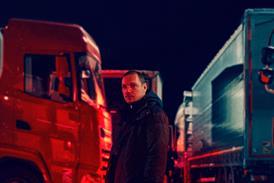
Cinematographer Diyor Ismatov takes every chance to capture Hilol within her Uzbek landscape, which, in this part of the country at least, is being reshaped by industry. The camera conveys the emotions that Hilol is unable to express; she is often dwarfed by scaffolding or a passing freight train, or framed as a lone figure standing high atop a hill of dirt. Colours – of the endless grey gravel, dull skies, Hilol’s muted, shapeless clothing – are often so washed out as to appear monochrome.
More vivid are Hilol’s often-explosive interactions with her sisters, who are all facing their own problems; one is married to an abusive man, another is heavily pregnant with her husband largely absent from the home. But still, they insist, getting married is the best bet for security and happiness. Hilol’s determination to fight against tradition marks her out within her family, even if she doesn’t quite know what rebellion looks like.
Hilol’s struggles with her gender identity manifest in her cropped haircut, her masculine clothes – there is never the suggestion that she might be transgender, just that she has been shaped by the expectations of her father. Even her name, as opening on-screen credits explain, is traditionally a man’s name, although it could also be a shortened version of the female Hilola.
Bakayeva imbues this closed-off character with a compelling mix of strength and vulnerability, her almost aggressive independence clearly a mask for her loneliness and insecurity. But just as Hilola continually strides off alone, only to repeatedly come back to the only home she knows, the film’s commitment to emotional ambiguity means it begins to lose its dramatic impetus before it strikes its final tentative note of hope.
Production company: Cinematography Agency of the Republic of Uzbekistan
Contact: Cinematography Agency of the Republic of Uzbekistan khurshidalikhodjaev@gmail.com
Producer: Khurshid Alikhodjaev
Cinematography: Diyor Ismatov
Production design: Shamshetdin Ibrayimov
Editing: Jasurbek Turobkhuja
Music: Maryam Pulatova
Main cast: Nargiza Bakayeva, Alisher Yuldashev, Asliddin Amrullayev