


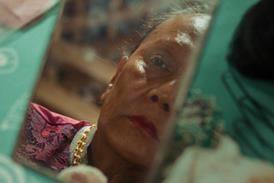










Ayushita Nugraha also stars in Eddie Cahyono’s Busan competition title
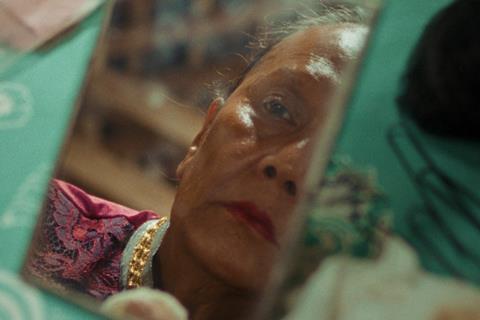
Dir/scr: Eddie Cahyono. Indonesia/Japan. 2026. 96mins
Economic privation, labour abuses, generational disconnect and patriarchal rigidity lay the foundations for Indonesian director Eddie Cahyono’s Ibuku, a raw and almost mystic meditation on the bond between mothers and daughters and the scourge of migrant work. The ibuku (or ‘mother’) of the title is a sixty-something village woman on a mission to travel from Indonesia to Saudi Arabia to see her daughter, who’s sitting on death row after a murder conviction. While the film can be narratively murky and occasionally gets lost in its own non-linear time construction, Ibuku nonetheless lulls viewers into its singular rhythms.
Hakim is the glue that holds the story together
World premiering in Busan competition, Ibuku moves between past and present, reality and fantasy, while establishing a documentary tone for a story about separation, displacement and loss. It shares themes of women doing what they have to, and men punishing them for it, with Cahyono’s 2014 sophomore feature Siti, which won awards at Singapore and Shanghai. There’s also a spiritual connection, in its dark corners and overgrown natural environment, with Devashish Makhija’s 2017 drama Ajii, and could attract a similar audience. Prospects are strong for further festival play, and the film may also be distinctive enough secure an arthouse theatrical release.
Villager Sumiati or Sum (Indonesian superstar Christine Hakim, from Cut Nyak Dhien biopic Tjoet Nja’ Dhien and HBO’s The Last of Us) is a traditional Javanese Jathilan performer living alone after the suicide of her husband Wagiman (Nano Asmorodono). Her daughter Sri (Ayushita Nugraha) fled to Saudi Arabia to escape an alcoholic, abusive husband; Wagiman sold her into the marriage as payment for his gambling debts. Working in Saudi Arabia, Sri defends herself against a threat of sexual assault and her employer ends up dead; Sum subsequently discovers that her daughter – who she hasn’t spoken to in five years – is now on death row.
While Sum agonises over what to do about Sri and how to raise the funds to get to her — which may entail selling her ancestral land — she’s also wrestling with the drought conditions that are affecting the entire village. Sum is determined to build a well to help them all so, when she’s not actively working on a way to see Sri, she’s underground, digging a hole. The two narrative threads come together eventually, for a bittersweet passing of the torch.
Cinematographer Muhammad Firdaus’ 16mm film photography goes a long way to making IBUKU’s themes as lyrical as they are urgent. The film is an effective examination of the social conventions and unspoken mores that keep women in forced marriages, and compel mothers to downplay their more forward-thinking daughters’ concerns over equality and abuse. Cahyono shirks blatant displays of the events that led Sum and Sri to the positions they’re in, letting the dreamy visuals drift in and out of time, and drop enough cues along the way to paint a full picture
Hakim is, unsurprisingly, the glue that holds the story together, turning in a finely calibrated performance that’s infuriating and heartbreaking, but also entirely understandable. If there’s a missed opportunity, it was in seeing more of Sri’s life in Saudi Arabia, and in seeing Nugraha bring the bond between the two women, with all its imperfections, into sharper relief. It’s Sum’s story, but it’s nothing without Sri.
Production companies: Talenta Media, Knockonwood
International sales: Asian Shadows, maria@chineseshadows.com
Producers: Tika Bravani, Shin Yamaguchi
Cinematography: Muhammad Firdaus
Production design: Luki Janarko
Editing: Greg Arya, Eddie Cahyono
Music: Krisna Purna
Main cast: Christine Hakim, Ayushita Nugraha, Landung Simatupang,Tika Bravani, Udik Supriyanta, Sriwidiyanti