






Yesim Ustaoglu’s distinctive feature premieres in San Sebastian, and will be released in Turkey by Mubi
Dir. Yesim Ustaoglu. Turkey/Luxembourg/France/Bulgaria 2026. 126mins
In Yesim Ustaoglu’s What Remains, the protagonists go in search of Turkey – and, it goes without saying, of themselves. They also head in different directions, as a couple – a poet and a musician – independently seek elusive reconciliation with their stresses and their pasts. The peripatetic, digressive structure doesn’t make for immediacy, but the film’s vivid leads, visual beauty and immersive sense of elastic time contribute to a distinctive, involving piece of slow-burn cinematic poetry.
Both leads give fine, sensitive performances.
The film premieres in San Sebastian, where writer-director Ustaoglu previously won top prize the Golden Shell with her 2008 film Pandora’s Box; other works include 1999’s Journey to the Sun and this year’s co-directed documentary On the Dry Rock. Mubi will release What Remains in Turkey, and the film should also expect further attention at festivals and among niche outlets.
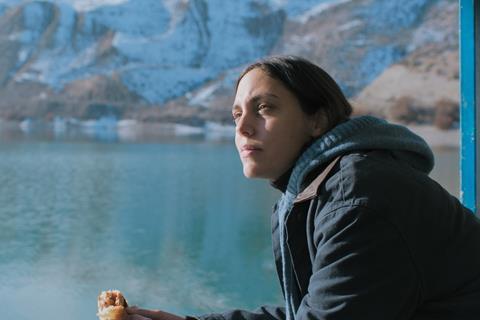
The film begin in Istanbul, home to a youngish creative couple. The woman – seen in a striking opening shot, gazing ahead in what seems like utter despair – is Elif (Öykü Karayel), a successful poet currently facing a creative impasse and feeling overwhelmed by home life with young son Selim (Ali Kayra Kul) and partner Mehmet (Metin Akdülger). Ustaoglu gives us some of her poetry – written in fact by the acclaimed poet Birhan Keskin – in Elif’s bookending voice-overs.
Mehmet, meanwhile, is a musician and composer – a member of an experimental rock/jazz outfit, a teacher of improvised music at a university and a solo explorer of twangs, bangs and feedback. But when he learns that his university department is being axed, Elif’s lack of concern shows how burned out she is; as do her late night solo walks around the city. Eventually, she gets in her car and leaves, heading across the country on a long drive which will take her through many different terrains and eventually to the village of her roots, in Turkey’s mountainous northeastern region. Mehmet stays behind tending to and bonding with Selim – this film offers a rare cinematic model of a sensitive, attentive father – until he too heads north with the boy, to the Black Sea town of Trabzon, where his elderly father (İlyas Salman ) is ill.
The film zigzags between Mehmet’s and Elif’s journeys, although hers is more varied, and more unpredictable – punctuated by encounters with various women and occasional accidents, notably an experience of migraine at the wheel, intensely evoked in some discreetly mind-bending visual effects. Among her new acquaintances are a doctor who turns out to be a devoted fan of Elif’s poetry; a village woman who was a neighbour of Elif’s late grandmother; and a woman who drives a minibus. Elif joins the latter’s Arabic-speaking passengers as they are dropped off at a makeshift camp for migrant workers, one of the film’s several understated but evident touches of political commentary.
Elif engages with these various people and places but also, as a poet, observes and absorbs the new landscapes around her – a watcher just as Mehmet is a listener, both adept at creatively transforming their input into more or less abstract creative output. Among the terrains Elif visits are a vast, bleak ravine; majestic snow-covered mountain ranges; and a contrasting, and thematically charged, pair – a former lake dried out to flatlands and a demolished village now submerged in water.
Both leads give fine, sensitive performances. Akdülger is warm, downbeat, laid-back, but reaches a crescendo of intensity in a confrontational moment of truth with his father. But both he and Karayel are especially good when allowing their characters to simply be present – something that is of the essence in the case of Karayel’s Elif, an observer who has largely put words aside pending new inspiration. Ali Kayra Kul is a natural as the wide-awake, quizzical Selim, clearly enjoying a very relaxed rapport with Akdülger, with whom he’s mostly seen.
Kirill Prodanov’s photography is intensely atmospheric, often quite dazzling, whether capturing vast landscapes with sculptural precision – Elim as a tiny silhouette on the edge of a rocky basin — or giving them a heady impressionistic glaze, with washes of sunlight turning mountains and plains into quasi-abstract colour fields. He also makes Karayel’s alert, quizzical face, often framed in tight close-up, an enigmatic landscape in itself. Composer Sevket Akinci gives us a vivid flavour of Mehmet’s off-mainstream creativity, not least in an improv teaching session that yields vigorously unpredictable dynamics. Unpredictability, taking the road less travelled – musically, experientially, geographically – is the spirit of this film.
Production company: Ustaoglu Film
International sales: Match Factory sales@matchgfactory.de
Producers: Yesim Ustaoglu, Anna Maria Aslanoglu, Behrooz Hashemian
Screenplay: Yesim Ustaoglu
Cinematography: Kirill Prodanov
Production design: Osman Özcan
Editing: Mathilde Muyard
Music: Sevket Akinci
Main cast: Öykü Karayel, Metin Akdülger, Ali Kayra Kul, Ilyas Salman