












German writer and director Felix Randau returns to the Locarno Film Festival’s Piazza Grande tonight (August 7) for the world premiere of his historical drama I Is Another, starring Claes Bang.
It marks Randau’s second time launching a film on the Piazza Grande, which seats up to 8,000 people, after his 2017 feature Iceman. His directing credits include The Calling Game, which premiered at San Sebastian in 2008. He has also written films and TV series including 2016’s Eden, directed by Dominik Moll and co-created by Edward Berger.
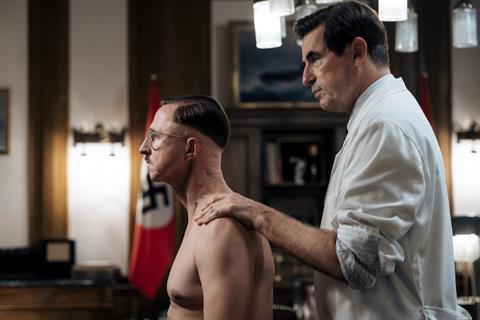
In I Is Another, Bang plays Felix Kersten, the former massage therapist to SS leader Heinrich Himmler, whose claims to have saved thousands of lives during the Second World War are probed by a journalist investigating whether he is a self‑mythologiser who reframed his own guilt as heroism. Valerie Pachner and Susanne Wuest also star.
I Is Another is produced by Marcel Lenz and Claritta Kratochwil of Germany’s ostlicht filmproduktion in a co-production with Austria’s Wega Film, backed by MDR, Arte and BR, and is supported by öFI+, MDM, DFFF, FFA, Filmfonds Wien and Thüringer Staatskanzlei. International sales are handled by Beta Cinema. Port au Prince Pictures is handling German distribution.
How are you feeling about the Piazza Grande premiere?
I’m excited because it’s huge. I was in Locarno nine years ago [for the premiere of Iceman], but that day it was raining cats and dogs, and unfortunately we had to move to another, smaller venue.
How did you come across the story of Felix Kersten?
Some years ago, I got an offer from a French production company to shoot a part of a TV series about Felix Kersten. It was a hero story: the premise was something like Felix Kersten is better than Oskar Schindler. I went back to Berlin and started my own research, and found out that this guy is a bit shady. I didn’t know if he was an impostor, a hero, or something in between. I told the French guys, ”Of course, let’s shoot this as a movie, but in a completely different way”, and they didn’t want to do it. They wanted to stick to the hero story. So I started from scratch and wrote a wrote a script for a movie.
What drew you to telling the story as a film?
On the one hand, it’s a period movie, but it has a lot of connections to our present time, particularly in terms of questions about truth - and what exactly the truth is.
After making the film, what is your verdict on Kersten?
In the end, I think he did good things. I’m sure he saved people’s lives, but not thousands, maybe 20 – which is still a lot. But he did these good things for the wrong reasons: not because he was a good guy, but to save his own life. He was so deeply into all the Nazi shit. He was a member of the SS. On his farm, there were guys working from the concentration camps.
How was it casting and financing the film?
The casting was really easy. I sent the first draft to Claes, and he wanted to do it right from the start. But the finance part was really tough – it took four years. A lot of the film funding commissions in Germany said something like, “You cannot provide a stage for a bad guy like Himmler”. To me, that is completely ridiculous. You cannot conceal or cancel evil. Evil is part of our life. If you try to hide it, it grows somewhere in the dark. But the TV stations, like Arte, liked it right from the start in Germany and gave us money.
Where did you shoot the film and what kind of budget were you working with?
80% was shot in East Germany, in Leipzig and Weimar. Then we shot one week in Vienna because it was a German-Austrian co-production. The budget was about €3m – it wasn’t huge [for a period film]. So you have to prepare very, very well. It was a tough schedule. We had 23 days. But we were well prepared, and the actors were great. We just did it.
What are you working on next?
A project about near-death experiences. I’m really interested in transcendental questions, and I think movies are a good place to ask them. It asks all the big and important questions: who we are, why we are here, and what happens to us when we die. I just finished the first draft and am talking to some producers about it.
What is the story about?
It is about a couple losing their only daughter, and who are struggling with it all. And then one day the wife has an accident. She nearly dies, but comes back to life and says to her husband that she has seen their daughter in this space between life and death. Of course, he doesn’t believe her. That’s the start of it.



No comments yet