









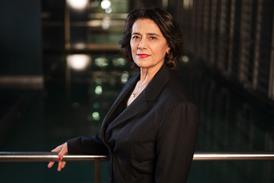

“There is a tension in society, and I think that confirms the film is very much of its time,” says French cinematographer -turned-director Marine Atlan of her feature debut La Gradiva.
The film about a group of teenagers on a school trip took on a political dimension when it was released in France on October 21 amid nationwide unrest.
It is now playing in competition at the Geneva International Film Festival (GIFF) and will go on to feature in competition at The American French Film Festival (TAFFF).
Since picking up the top prize in Cannes Critics Week, La Gradiva has emerged as one of the year’s breakout French films. It has screened at more than 50 festivals worldwide, including Toronto, New York, BFI London and Busan, and has garnered over 20 prizes plus four nominations for the Gotham Awards.
The film was also shortlisted for the European Film Awards and is France’s submission for the best international feature Oscar.
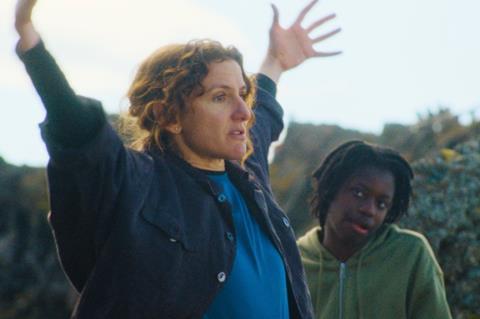
The French-Italian coming-of-age drama follows a group of teenagers on a school trip to Naples and Pompeii, navigating desire, friendships, rivalries and questions of identity against the backdrop of a region buried by a volcanic eruption.
The experience, says Atlan, exposed her to social inequalities and growing anxiety for the future amongst young people. “If it resonates with young people, that gives me enormous joy,” says Atlan, a La Fémis graduate whose cinematography credits include The Rapture, Queens Of Drama and César-nominated The Girl In The Snow.
For her directing debut, which took five years to develop, Atlan wanted to explore how seemingly everyday moments can take on an almost existential significance during adolescence.
“I wanted to start with something seemingly mundane and show how the banal can become extraordinary and transformative,” she says. “At that age, everyone can find themselves confronted with existential questions.”
Atlan was equally drawn to the contrast between the fleeting intensity of adolescence and Pompeii’s ancient ruins, as well as to nearby Naples, a city repeatedly destroyed and rebuilt in the shadow of Mount Vesuvius.
The title, meanwhile, comes from Wilhelm Jensen’s novella Gradiva. “I discovered it through Freud, who saw Pompeii as a place that could represent the subconscious,” Atlan explains. “I liked the mysterious Latin resonance of the title and how it contrasted with the film’s realism.”
Back to school
To capture contemporary adolescence, Atlan returned to her suburban high school, interviewing around 20 students about their relationships, mental health and futures. Their experiences informed the screenplay, co-written with Anne Brouillet, with dialogue adapted to reflect how teenagers speak. The pair also accompanied a school trip to Naples and Pompeii, observing friendships, romances and tensions unfold.
“In just five days, away from their everyday lives, teenagers can experience so much — love stories, break-ups, friendships, even a change in how they see the world,” she says. “There were dramas, tears, fights. It felt like months.”
She and casting director Julie Sokolowski spent two years assembling the predominantly non-professional ensemble, scouting outside schools, on social media and at demonstrations.
“We wanted different energies, contrasts and, above all, faces you don’t usually see in French cinema,” she says.
Colas Quignard, who plays protagonist Toni, was discovered during the research field trip, while Atlan says she met another lead actor, Mitia Capellier-Audat, during a protest march.
Filming took place largely on location in Italy, with four days in France near Clermont-Ferrand and the opening travel scenes shot aboard a real train.
Atlan deliberately embraced her own discomfort of filming Naples as an outsider, mirroring lead character Toni’s own relationship with the city. “Naples is a city of layers, where all eras are visible,” she says. “I wanted to understand what it meant to film as a foreigner.”
From cinematography to directing
Atlan says her cinematography background made her writing process inseparable from visual storytelling. “I’m used to translating screenplays into images, accompanying directors and finding ways to bring words into locations, settings and shots,” she explains. “When I write, I’m already thinking about atmosphere and rhythm.”
New York-based 1-2 Special has acquired North American rights and plans a December 18 release, while Metis Films will release the film in the UK and Ireland on December 26. Mk2 Films handles international sales.
Having recently wrapped cinematography on Maïté Sonnet’s Tu Feras Tomber Les Rois, Atlan hopes to balance future directing projects with her work behind the camera. “Immersing myself in other people’s stories is a pleasure I don’t want to give up,” she says. “For me, filmmaking is a collective art. I love stepping outside my comfort zone.”



No comments yet