





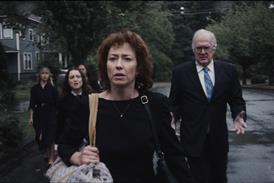











The overall tally of Indigenous films at this year’s Toronto International Film Festival (TIFF) has dropped fractionally year on year – but don’t read that as a step backward.
Three Indigenous titles have landed in TIFF’s Platform, the festival’s competitive strand for auteur voices and bold directorial visions, up from one in 2025 and none the year before. The rise signals that TIFF is treating Indigenous cinema as a pillar of international auteur filmmaking, not a subset of Canadian cinema.
The wider numbers are more mixed. In 2025, eight features backed by Canada’s Indigenous Screen Office (ISO) screened at TIFF, an unprecedented showcase for Indigenous work at a single festival. This year the ISO-supported projects at TIFF include five feature films, one short and two immersive films across the festival’s strands. But the dip comes alongside a strong Indigenous presence at TIFF’s inaugural industry market, backed by a $16.7m (c$23m) investment from the government of Canada via Telefilm Canada, a sign the sector is still building, not stalling.
Making space
Founded in 2017, ISO is an independent national advocacy and funding body serving First Nations, Inuit and Métis creators. In 2025, its funding programmes disbursed $8.3m (c$11.5m) directly to recipients, creating 1,941 jobs for Indigenous people across eight programmes.

“Indigenous creators have been incredibly persistent about making space for themselves and telling our stories. Organisations like the ISO and our many partners and allies are trying to build an ecosystem that can keep pace with that ambition,” says ISO vice president of industry, partnerships and growth Melanie Nepinak Hadley.
A member of Minegoziibe Anishinabe, Nepinak Hadley joined ISO in 2025 from Warner Bros Discovery, where she oversaw the company’s Canadian screen industry initiatives and investments. She previously held a network executive role at Aboriginal Peoples Television Network (APTN) and worked in film and television development and production at CBC.
Beyond direct funding, ISO builds partnerships across the public and private sectors to open doors for Indigenous storytellers. In 2020, it launched the Netflix Apprenticeship and Cultural Mentorship programme, and has since developed ties with the Directors Guild of Canada, Amazon MGM Studios, MIT, Sundance Institute, YouTube and Banff World Media Festival. In June this year, it launched the ISO x Paramount Rewrite Lab.
“There is more funding, more interest and more partnerships than there were even a few years ago,” says Nepinak Hadley. “But I don’t think we should mistake progress for having arrived. There is still a lot of headway to make, particularly when it comes to sustained careers, senior-level opportunities and ensuring Indigenous creators are part of the broader industry, not operating in a separate lane alongside it.”
Jean-Francois O’Bomsawin, ISO’s Montreal-based director of communications and Francophone initiatives and a member of the Abenaki community of Odanak, Quebec, notes that streamers have opened up further opportunities and shown a genuine global appetite for Indigenous stories.
“Indigenous filmmakers have been telling their own stories for generations, and the sector grew through decades of advocacy, community-based production and the work of organisations such as APTN and the Indigenous Screen Office,” says O’Bomsawin. “Platforms have created additional opportunities for Indigenous creators to reach audiences in Canada and internationally, and they have demonstrated that there is an appetite for Indigenous stories.”
Between ISO, APTN, imagineNATIVE and other advocacy groups, he points out, more Indigenous projects are crossing desks, more creators are getting into the room, and more decision-makers are seeing what Indigenous filmmakers have to offer.
Raising the Platform

Of the three Platform titles, two are international and one is Canadian, and all are world premieres.
Angh, from London-based, Nagaland-born writer/director Theja Rio, is shot on 16mm and is set in the remote jungles near the Indo-Burma border in the early 1960s. It follows Anghba, the last surviving chief of an abandoned Naga village, living in isolation with his ailing wife and mute young son after being deserted by his people.
Brace Your Heart, from Amanda Kernell – born in Sweden to a Sámi father and Swedish mother – is billed as a quietly devastating portrait of love, resilience and the endurance of Sámi women.
Rounding out the strand is In The Heart Of The South, the second feature from Igloolik-born filmmaker Nyla Innuksuk. It follows an ambitious Inuk multimedia artist living far from her Nunavut upbringing, whose life spirals when an estranged childhood friend resurfaces. Elevation Pictures is the Canadian distributor, with rights secured via Vortex Media and Photon Films. International rights are currently available for key territories.
Outside Platform, Tongan Kiwi filmmaker and podcast producer Alex Liu’s feature debut God Bless You, Mr. Kopu is a Centrepiece selection. The Auckland-based filmmaker’s film follows a meek and desperate Tongan man drawn into a high-risk partnership with a charismatic salesman. Radiant Films handles most international sales, with Anonymous Content Independent repping North America and Umbrella Entertainment overseeing Australia/New Zealand.

Liu hopes greater support will let Indigenous filmmakers work on their own terms.
“It needs to be more widely understood that Indigenous filmmakers and their films will not always fit into a prescribed checklist or box,” he says. “My advice for Indigenous filmmakers is to try and make the film you want to see in the cinema, not the one you think will be easy to fund or that ticks boxes to be the ‘safe, accepted’ option.”
Métis filmmaker Justin Ducharme’s Seventeen has its world premiere in the Discovery section, and follows three young queer Indigenous people whose lives intersect over 17 hours in downtown Vancouver. Ducharme was raised in the Métis community of St Ambroise on Treaty 1 Territory. Also premiering is Turtle Island Rap, the verité-style documentary debut from Cree, Lubicon Lake Nation filmmaker Alexandra Lazarowich, bowing in TIFF Docs. The story follows three aspiring Indigenous hip-hop artists chasing success.

“If Canadian content is going to be globally competitive, one of our greatest strengths is telling stories that are distinctive, authentic and difficult to replicate anywhere else. Indigenous storytellers have an enormous role to play in that,” says Nepinak Hadley. “There is far more talent and ambition in the sector than there are resources available to support it.”
At the market, the Indigenous Cinema Alliance (ICA), a coalition of international Indigenous festivals, commissions and institutes, is presenting 14 titles spanning features, documentaries and shorts, including the projects by Innuksuk, Liu, Ducharme and Lazarowich.
“No matter what you do, you’re going to get hate from some people,” says Liu. “We can’t be afraid of that. We are all standing on the shoulders of those who came before us and smashed through a layer in the ceiling.”






No comments yet