














Guy Pearce and Claire Foy also star in this seductive, high-energy portrait of ambition and media disruption
Dir: Danny Boyle. UK/France/US. 2026. 116mins
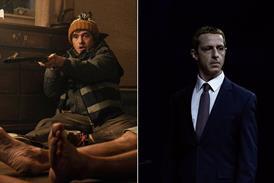
Jack O’Connell is a charming devil in Ink, which charts the rise of notorious The Sun newspaper editor Larry Lamb during late 1960s and 1970s. Based on James Graham’s play, Danny Boyle’s crackling entertainment offers a seductive look at Lamb’s relationship with brash Sun owner Rupert Murdoch (Guy Pearce), who encouraged his new hire to turn the floundering paper into the toast of England – which Lamb did, sometimes to his boss’s horror. Gripping performances, including Claire Foy as Lamb’s trusted lieutenant, anchor a film that feverishly chronicles how an ambitious man with a chip on his shoulder disrupted traditional media, creating today’s cynical, sensation-driven world.
Boyle wields his usual stylistic flourishes to position Ink as an unexpected underdog story
Opening Venice Film Festival in Competition, Ink travels to several other festivals including Toronto and London before opening in the US on December 11. Netflix streams the picture in the US and Latin America starting January 8, with the UK theatrical release planned for the same day. Boasting major stars and a juicy premise that may remind viewers of another portrait of an arrogant disruptor, The Social Network, the film could be an awards-season player.
In 1969, up-and-coming media magnate Murdoch meets with Lamb (O’Connell), who is tired of waiting for a promotion at the prestigious but stiff Daily Mirror. Given the keys to The Sun, which Murdoch has recently purchased, Lamb sets out to revive the paper’s dismal reputation and meagre sales, determined to vanquish the Mirror. Lamb recruits dogged journalist (and frequent lover) Jules Davies (Foy) – a fictionalised character – to help gear The Sun towards readers’ interests that are not being covered by the other papers, including sex, celebrity and scandal.
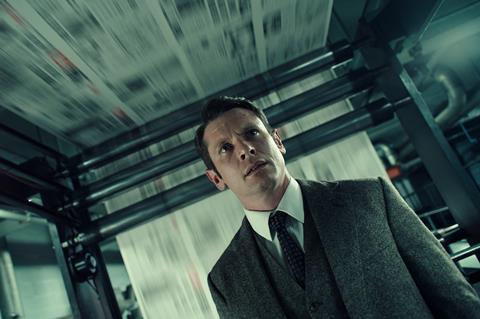
Boyle wields his usual stylistic flourishes to position Ink as an unexpected underdog story. Working from Graham’s screen adaptation, he is probably safe in assuming that his target audience will have negative feelings about Lamb, Murdoch and the rash of ugly English tabloid journalism they helped birth – which is why Boyle’s decision to render his main characters as plucky misfits with a dream is wickedly clever. Boyle and cinematographer Alwin H. Küchler shoot Ink’s breathless early scenes like a heist movie as Lamb assembles his crack team. And the canted angles and vibrant colours only add to the electric storytelling, getting the viewer hooked on the mad rush of The Sun’s bold ideas and initial success.
Also crucial to Ink’s kinetic approach is O’Connell’s winning portrayal of an ambitious newspaperman who wants to prove himself, despite his humble origins. Lamb is presented as a likeable populist who opposes the sober sanctimony of the English press, convinced that his cliquish rivals are ignoring everyday people’s deep-seated desires. Hardly viewing himself as a hack or smut-peddler, Lamb merely wants to craft a tabloid that accurately reflects ordinary people’s lives; an irreverent attitude embodied by the actor’s irresistible showmanship.
Eventually, of course, The Sun’s cheeky innovations – including shocking headlines and photos of scantily clad models – will result in a reckoning, which Ink dramatises by focussing on Muriel McKay (Lucy Russell), the wife of one of Murdoch’s top executives who was kidnapped in 1969 by men who mistook her for Murdoch’s wife. Suddenly, Lamb’s blithe declaration that The Sun will never shy away from a big story is challenged by the equally flamboyant Murdoch’s concern that the paper’s indelicate handling of the kidnapping could get Muriel killed. The incident also puts Lamb at odds with Davies, who has supported his strategy but now has second thoughts.
Understandably, Ink loses its caffeinated buzz once the story turns tragic. And Boyle’s scolding side emerges in the film’s final reels, which seek to underline just how noxious Lamb’s thirst for higher and higher circulation became. Whereas Ink initially lures the audience into becoming complicit in Lamb’s exhilarating ascension – essentially arguing that the general public was susceptible to The Sun’s brand of tawdry provocation – the film subsequently adopts a moralistic tone. Ink’s last moments draw an unsubtle link between Lamb’s reign and the crassness of modern social-media and clickbait; while the connection is indisputable, it comes across as heavy-handed rather than bitterly bracing.
If O’Connell’s slow reveal of Lamb’s ruthlessness is magnetic, Pearce expertly captures Murdoch’s cadence and icy smugness. Foy delights as one of the few women allowed into The Sun’s creative team, proving to have elbows just as sharp as her male colleagues. Like Lamb, Davies is married, which has not stopped them from engaging in a years-long affair. Ultimately, however, she ends up very much feeling like a composite of real individuals – a writerly construction designed to guide the viewer’s sympathies rather than being allowed to be as deliciously complex as her frequent bedmate.
Production companies: StudioCanal, Media Res, House Productions
International sales: StudioCanal, Chloe Marquet, chloe.marquet@canal-plus.com
Producers: Tracey Seaward, Danny Boyle, Tessa Ross, Michael Ellenberg
Screenplay: James Graham, based on the play Ink by James Graham
Cinematography: Alwin H. Küchler
Production design: Gareth Pugh and Carson McColl
Editing: Fin Oates
Music: Daniel Pemberton
Main cast: Jack O’Connell, Guy Pearce, Claire Foy





No comments yet