








Ádám Tompa stars in director Gábor Reisz’s follow-up to 2023 Venice Horizons winner Explanation For Everything
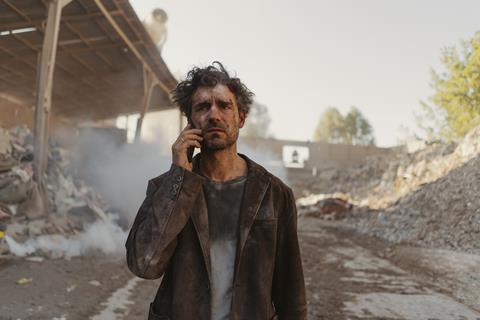
Dir. Gábor Reisz. Hungary/Italy 2026. 108mins
Mixing anarchy with control, absurdism with political protest, Gábor Reisz’s satirical comedy Ground Floor builds from deadpan mundanity to knockabout frenzy verging on the apocalyptic, to sustained but overstated effect. Set almost entirely in a decrepit Hungarian apartment block, the film premieres in Venice Spotlight following Reisz’s Horizons best film win for Explanation For Everything in 2023 which went on to have a healthy festival and theatrical run. Energy and accessibility should give Ground Floor similar international traction, notwithstanding its somewhat overextended farcical trajectory.
Builds from deadpan mundanity to knockabout frenzy
Kristóf (Ádám Tompa, recently seen in Sophy Romvari’s art-house hit Blue Heron), an office worker who has abandoned his vocation as an artist, rushes home to prepare for his imminent holiday with wife Vera (Bettina Jósza). While getting ready in their ground floor flat, he makes an unwelcome chance discovery – a patch of black mould behind a cupboard. Arriving home, Vera announces that she is pregnant – which persuades Kristóf that it’s all the more urgent to solve the mould problem. But the building manager Balázs (Rodrigo Crespo) is elusive, and another resident official, Mr Posszauer (György Gazsó) is singularly unhelpful.
When Kristóf does track down Balázs, he proves a silver-tongued, bullish, extremely obstructive character who makes it clear that the building is his personal fiefdom and that Kristóf will only get his problem attended to if he plays the obedient citizen, getting on board with Balázs’s pet project; a lift installation. Pursuing his mission, Kristóf encounters other residents, including Saci (Julia Kindl), a flirty Balázs hanger-on; and Mrs Matiz (Éva Tímár), an elderly resident who knows the score. Kristóf must also contend with a drunken ‘House Doctor’ and an old alpha male friend who awakes his sexual jealousy over Vera.
The mood, as Kristóf explores the building’s mysteries and its foundations of anti-logic, is altogether Kafkaesque – as if The Trial had been transplanted into the world of minor structural repairs. The casting is strong overall, notably Crespo’s increasingly hostile and domineering smoothie, and an acidic and not a little scary Tímár. And Tompa nicely modulates his hero’s frazzled demeanour as he embarks a quixotic journey of self-realisation, from weary sad sack to rebel with a cause, and battle scars to show it.
Reisz modulates the action from slow-building enigma to a slapstick frenzy towards the end, although the score (András Kálmán and Gábor Reisz) is too insistently eccentric, from coy pizzicatos at the start to the culminating frenzy, set to a deranged rendition of Liszt’s Hungarian Rhapsody No. 2.
That national touch underlines the reading of the film as very much a state of the nation allegory, with Balázs standing in for recently defeated Hungarian Prime Minister Viktor Orbán. Balázs could also, of course, be any one of numerous populist national leader or corporate head who exorbitantly feathers their own nest at the expense of their country or workforce.
Meanwhile, as the cliché goes, the building itself is a leading character, as Kristóf’s sleuthing gradually unearths its secrets. Meticulously, inventively mapping every corner, production designer Zsófia Tasnádi makes the place both realistic and labyrinthine, while DoP Kristóf Becsey makes its space unsettlingly elastic (and throws in tricks like whip pans between characters to heighten the tension).
Production companies: Proton Cinema, All At Once
International sales: Films Boutique contact@filmsboutique.com
Producer: Julia Berkes
Screenplay: Gábor Reisz, Éva Schulze
Cinematography: Kristóf Becsey
Production design: Zsófia Tasnádi
Editing: Gábor Reisz
Music: András Kálmán, Gábor Reisz
Main cast: Ádám Tompa, Rodrigo Crespo, Bettina Józsa, Tünde Bacskó