
















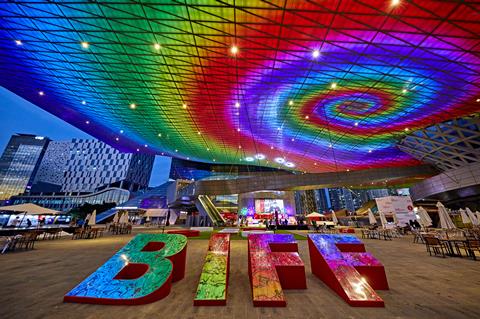
While Busan International Film Festival (BIFF, October 6-15) has changed considerably over the past three decades, last year’s 30th edition was particularly transformative in ways that pushed the festival to new heights.
What started out as the dream of South Korea film professionals and academics has evolved into one of Asia’s most significant film events, expanding from 173 titles in 1996 to 246 this year — its biggest programme since 2019. Recent editions have proved challenging, as festival organisers endured everything from political storms and leadership changes to a worldwide pandemic.
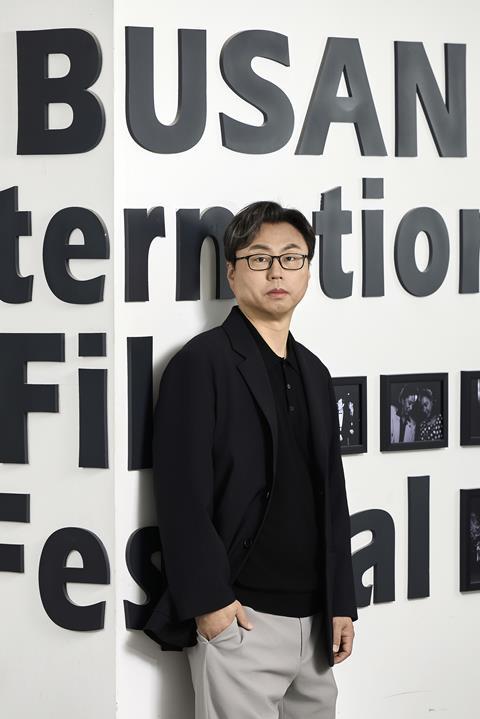
But BIFF turned a corner last year with the appointment of festival director Jung Hanseok, who brought stability and renewed purpose to the festival at large. The fruits of this long search for new leadership became apparent immediately with the introduction of the festival’s first-ever Competition section, which awarded its inaugural trophy to China-born Korean filmmaker Zhang Lu for Gloaming In Luomu.
Rather than simply continue in the same vein, Jung says he wants to innovate with further changes designed to “achieve both long-term stability and continued growth”.
“Because last year’s festival took place in September, I had only about five months to prepare,” recalls Jung. “There was simply no time to look closely at administrative issues; all our energy had to go into delivering the festival itself.
“As soon as the 2025 edition was successfully completed, the first thing I turned to was what I would call an administrative overhaul. We reorganised the structure, made personnel changes, and created new departments where necessary. I felt this kind of administrative groundwork was essential.”
The benefits have already become apparent. In March, BIFF gained A-list festival status from the International Federation of Film Producers Associations (FIAPF), officially joining Cannes, Berlin, Venice, Sundance and Toronto as a global cinema leader. What is especially notable is that FIAPF’s reformed accreditation system assesses festivals including BIFF on their achievements over the previous two years.
“BIFF’s international standing and value have long been widely recognised,” says Jung, “but without a formal benchmark, that could still have sounded to some like a claim made by the festival itself. This recognition gives us clear and tangible external validation.”
This year’s selection includes 95 world premieres and 10 international premieres. Among them, 13 films will vie for the top award in the Competition’s sophomore edition, and already, Jung says this newfound A-list status has made a positive impact on both the number and quality of submissions.
“Films and filmmakers invited to A-list festivals can receive particular attention when it comes to subsequent public support,” says Jung. “That naturally gives filmmakers an added reason to target such festivals, and Busan is now among them.”
This year, there is an extra edge to Competition as the winner of the Busan Award for best film will qualify for submission to the Academy Awards in the best international feature film category. BIFF is the only Asia-based festival to offer such an incentive, which Jung sees as “another meaningful confirmation” of BIFF’s international standing.
“Key industry figures have been noticeably more proactive and receptive towards BIFF’s Competition than they were last year,” reveals Jung. “Some filmmakers may now be able to imagine a longer-term path that begins with the Busan Award for best film and continues into an Oscar campaign.”
Given the growing importance of the Competition strand in its second year, Jung’s priority has been “stability and consolidation”, making sure “the section is firmly established and can grow sustainably”. From “thousands” of submissions, Jung and his team narrowed the category down to 13 features with a “larger number of films featuring major stars from across Asia”.
“Last year, I felt there was a somewhat wider gap in quality between the Competition titles,” adds Jung. “This year, the lineup feels much more consistent, with the overall quality noticeably higher.
“The section has developed more clearly into the kind of platform we envisioned from the beginning, where established masters and gifted newcomers can stand side by side.”
Titles in the running include Between Two Lovers from Hirokazu Koreeda protégé Nanako Hirose, Midday Meal from Cannes and Berlinale regular Majid Majidi, and The Sea Speaks His Name from Locarno award-winner Yosep Anggi Noen.
Star power
BIFF 2026 opens with the world premiere of Kim Jong-kwan’s The Table: Day And Night, which has an ensemble cast that includes Shim Eun-kyung of Locarno 2025 Golden Leopard winner Two Seasons, Two Strangers and Kim Minha from Apple TV series Pachinko.
“I believe the actors in this ensemble are among those who will carry Korean cinema into the future,” says Jung. “I cannot remember the last time I saw such an impressive group of actors brought together in one film.”
The same can be said for the talent that comprises this year’s guest lineup. They include Oscar-winning Malaysian actress Michelle Yeoh who receives the Asian Filmmaker of the Year award on opening night and will see her latest feature, Bai Xue’s It’s My Time, screen at the festival.
Further guests include Isabelle Huppert, Ann Hui, Charlotte Gainsbourg, Maggie Gyllenhaal and Fan Bingbing — “figures who have had, and continue to have, a profound influence on cinema and society” — who will attend in varying capacities.
So too will filmmakers Lee Chang-dong, Koreeda, Na Hong-jin, Zhang Yimou and Alfonso Cuaron, the latter of whom “responded very warmly to our invitation” following a recommendation from his friend and fellow director Guillermo del Toro, who hosted a masterclass last year alongside Colony helmer Yeon Sang-ho (the latter returns to BIFF with his second film of the year, Paradise Lost).
The festival will also feature a focus on Japanese animation that hosts anime master Rintaro of Metropolis fame alongside Kohei Kadowaki, Ryo Katanosaka, Shingo Natsume and Yoshitoshi Shinomiya, representing the medium’s next generation of filmmakers.
“We all saw the extraordinary global impact of KPop Demon Hunters last year,” says Jung. “In Japan and China, the highest-grossing films of 2025 were animated features, and in Korea there were also signs that animation had reached an important turning point.”
In response to this broader surge, BIFF will present “animation across a number of other sections as well” to “help sharpen audiences’ sense of where contemporary cinema is moving”.
Signs of recovery
This is further proof of the festival’s ongoing commitment to “discovering Asian films and supporting the growth of Asian cinema” on a global stage, a commitment that was part of its foundations from day one. Yet even with this increased international focus, the festival still helps shape the local film industry after a challenging few years for both institutions alike.
“The fact this is our largest programme since 2019 is meaningful,” says Jung. “It suggests that the industry is gradually moving beyond the effects of the pandemic and finding greater stability.
“There are encouraging signs of recovery in the Korean film industry in some of the numbers, in the overall mood, and in the renewed activity around film policy.” Yet he suggests it is too early “to make a definitive judgment at this stage”.
The festival’s attendance figures are also positive, following last year’s landmark edition, which drew a record footfall of 238,697 people — an increase of around 20,000 from the previous year.
By starting this year’s edition on a Tuesday, rather than its traditional Wednesday, more opportunities have been created for visitors to see films before the weekend, further reflected in the choice to expand daily screenings from four to five between Thursday and Sunday. “The response suggests it was the right decision,” says Jung.
His final word to those attending is to approach this year’s Competition films “with an open and generous eye”, adding: “If you do, I am confident you will find among them some of the brightest moments in contemporary Asian cinema.”






No comments yet