









The Train to Busan director explores grief through virtual reality in an uneven high-concept mystery

Dir: Yeon Sang-ho. Korea. 2026. 101mins
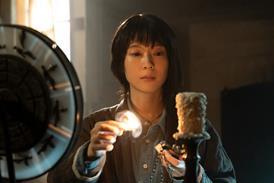
Yeon Sang-ho’s Paradise Lost is an awkward, frustratingly inert blend of underdeveloped ideas about AI and familiar thriller mechanics. It concerns single mother So-young (Kim Hyun-joo, Hellbound), who spends nine years grieving the sudden disappearance of her son Sun-woo, only for him to mysteriously reappear as an adult. When he returns, he learns that in the ensuing years, So-young, desperate and alone, replaced him with a virtual reality version of himself. The returned Sun-woo, however, also has secrets of his own. Psychologically unconvincing and narratively muddled, Paradise Lost lacks the insight to make the most of its potentially provocative premise.
Lacks the insight to make the most of its potentially provocative premise.
In the decade since Yeon Sang-ho’s Train to Busan became a smash-hit zombie movie, he’s largely pursued high-concept work, like Jung_E and this year’s Colony (which premiered at Cannes) or mystery-thrillers, such as Revelations and The Ugly. Based on Oh Seong-eun’s 2025 novel Black Inferno, Paradise Lost falls into the latter category. Half of the director’s films have also found a home on Netflix, and the streamer could be interested in this latest feature – which shares a thematic sensibility with Hirokazu Koreeda’s recent Cannes competition title Sheep In The Box – following its Toronto Special Presentations premiere
When So-young sends her son Sun-woo (as a child, Yu Ji-wan) on a camping trip with his 12 other classmates, her biggest worry is letting his teacher know about his seafood intolerance. But when his yellow bus is found abandoned near Musan, her fretting turns to terror and then devastation. Within a short montage efficiently edited by Park Ju-ae, it’s explained that authorities eventually track down the bodies of five children and the remains of the purported culprit: the children’s bus driver. The other kids, including Sun-woo, are thought to be in a local mineshaft, but excavating it proves impossible after tunnel conditions became too dangerous.
In the midst of So-young’s deep grief, an AI company approaches her (and other parents) with a singular opportunity. The tech firm can take data about the kids and create virtual reality versions of them that can be visited every day by donning a pair of glasses. These kids are not simple simulations. They are entities capable of advanced conversation, apparently able to express emotion – and they will always be stuck in their child form. So-young buys into the device, becoming a faithful user for nine years. But on the anniversary of Sun-woo’s disappearance, a ’miracle’ occurs: Sun-woo (Bae Hyeon-seong) turns up alive, now a moody adult.
It’s not clear what the script penned by Yeon and Ryu Yong-jae wants to say. Sun-woo is understandably upset to find himself replaced by a formula masquerading as a son. So-young is equally confused. Should she let go of the virtual Sun-woo, knowing that he will be deleted? Why is she determined to think about virtual Sun-woo’s feelings over those of her real son? Yeon’s visual language doesn’t do the work to answer these questions; at one point he juxtaposes a virtual Sun-woo bathed in ethereal lighting with the actual one soaked in shadow.
Yeon appears to suggest that the latter is a foreshadowing device. Upon Sun-woo’s return, a local boy goes missing and a reporter begins snooping around his story. Bae also gives the returned Sun-woo a volatile, sometimes menacing quality. But if the contrast is intended primarily as foreshadowing, why does the AI iteration of Sun-woo look so benign? Why doesn’t Yeon more rigorously interrogate the very idea of forming such an attachment to a virtual program?
Those questions lead into a frustrating final act that offers few substantial answers. Yeon wants to interrogate the ethics of AI technology, but the film struggles to articulate a clear perspective on the subject. He also wants to consider the disruption that can occur when closure isn’t possible. Instead, the film gives itself over to its genre components, lessening the premise’s impact in return for conventional melodrama. The final scene, a visit to the AI firm, strikes a particularly jarring note, reaching for a kind of heartfelt ending that feels unearned after a film that has struggled to engage fully with the difficult questions it raises.
Production company: Wowpoint
International sales: CJ ENM filmsales@cj.net
Producer: Yoomin Hailey Yang
Screenplay: Yeon Sang-ho, Ryu Yong-jae, based on the novel Black Inferno by Oh Seong-eun
Cinematography: Song Hyun-suk
Production design: Lee Mok-won
Editing: Park Ju-ae
Music: Chae Min-ju
Main cast: Kim Hyun-joo, Bae Hyeon-seong





No comments yet