Alicia Vikander, Luca Marinelli and Susan Sarandon star in London-set Venice competition title

The Echo Chamber

Source: Venice Film Festival

‘The Echo Chamber’

Dir: Andrea Pallaoro. Italy/Belgium. 2026. 123mins

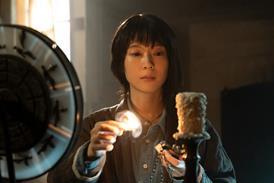
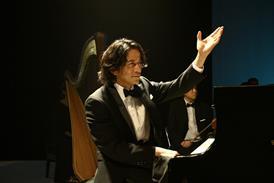
In a large airy London mansion flat, Italian music producer Leo (Luca Marinelli) suffers a drug overdose, his distraught girlfriend Anne (Alicia Vikander) calling the ambulance that saves his life. When Leo returns after rehab, the pair are no longer together – but Anne secretly spends time in the flat when Leo’s not there, seemingly desperate to stay connected to him. Andrea Pallaoro’s fourth feature comes from a screenplay by the late Bernardo Bertolucci, and returns to that filmmaker’s hallmark themes of art, pain, control and obsession. Set entirely in the single apartment, The Echo Chamber is a technically precise human drama which is almost entirely undone by its outre denouement.

Returns to Bertolluci’s hallmark themes of art, pain, control and obsession

With dialogue in both English and Italian, the film premieres in competition at Venice, where Pallaoro has debuted all of his previous features. Both 2022’s Monica and 2017’s Hannah played in competition, the latter winning the best actress award for star Charlotte Rampling, while 2013 debut Medeas bowed in Horizons. That Bertolluci connection and strong cast, which also includes Susan Sarandon, should help The Echo Chamber’s onward prospects; it will release in Italy on September 26 before playing London, and has sold to multiple territories including Spain, Australia and Taiwan with more likely to follow.

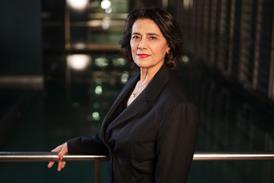
When Leo returns home, his relationship with Anne clearly hasn’t survived and he seems to have lost his musical mojo. He is working on a project with throaty-voiced singer Ava (Sarandon), who occasionally visits the flat to record or to chat over cups of tea. Leo is also in near-constant pain with back problems and that – we see in the first of many flashbacks which blur the story’s chronology – is how he met Anne, a physiotherapist with whom he developed an attraction which spills over into sex and then a relationship of sorts.

That Anne supplies Leo with opiates to manage his pain – to which he becomes increasingly reliant – adds some ambiguity to their coupling; it’s no coincidence that he calls her when he needs more pills. “I can’t sleep next to someone,” he says, following one of their early trysts, ushering her out of his bed. In the present-day sequences, Anne seems to be wrestling back some control as she takes ownership of Leo’s space without his knowledge. Initially, as she takes care not to leave any trace, the film plays like a ghost story set amongst the living, Anne haunting Leo’s life as he is also consumed with memories of her. Later, she begins to leave behind messages – a broken mug now fixed, scent on a pillow – and the film builds to an inevitable reunion.

Both Marinelli and Vikander balance their characters well, allowing their bond to develop as their characters’ interactions play like vignettes across this non-linear chronologyl; sometimes transactional, sometimes tender. Through Paola Freddi’s careful editing, threads of dependency and attraction, intimacy and obsession weave themselves almost imperceptibly through the pair’s burgeoning relationship. In contrast, Leo’s friendship with Ava is on a more even keel, their mutual artistry and platonic affection allowing for somewhat indulgent discussions about ageing, love and legacy. Their conversation about an echo chamber she once encountered at a recording studio – a room which adds an echo to a prevously recorded track – gives the film its name and thematic identity.

This is the first time that Pallaoro has directed a narrative he did not write himself, although he did work with Bertolluci collaborators Ilaria Bernadini and Ludovica Rampoldi to hone the screenplay. (It was at second draft stage at the time of Bertolluci’s death.) Shooting in Rome (standing in, somewhat unconvincingly, for London through the apartment windows), he and cinematographer Diego Garcia play with the high-ceilinged space, moving through the apartment with easy familiarity before lingering in long takes on empty rooms, leaning into the silence of divided lives. Time feels suspended, then seems to loop in cycles. The opening and closing of the front door becomes its own dramatic punctuation. Lighting and production design turn the flat into, by turns, a warm sanctuary and something of a prison for both Leo and Anne.

Filmmaking and performances are focused throughout – until, that is, the story takes a bold swerve in its final scenes, entirely changing the dynamic of the two central characters and the tone of the film. It is perhaps intended as a definitive underscoring of the narrative’s central themes – the ebbs and flows of desire, care and control – but plays like an implausible (even laughable) step too far; those patient viewers who have stuck with the film up until this point may well be entirely lost. That being said, Bertolucci was always one to play with audience expectations, to push against boundaries, and Echo Chamber is nothing if not loyal to that spirit.

Production companies: Indigo Film, Rai Cinema

International sales: Paradise City sales@paradisecity-films.com

Producers Nicola Guiliano, Francesa Cima, Carlotta Calori, Viola Prestieri, Paolo Del Brocco, Jacques-Henri Bronckart, Tatjana Kozar

Screenplay: Bernardo Bertolucci, Ilaria Bernardini, Ludovica Rampoldi

Cinematography: Diego Garcia

Production design: Gaspare De Pascali

Editing: Paola Freddi

Music: Clement Ducol, Emile Gassin

Main cast: Alicia Vikander, Luca Marinelli, Susan Sarandon