















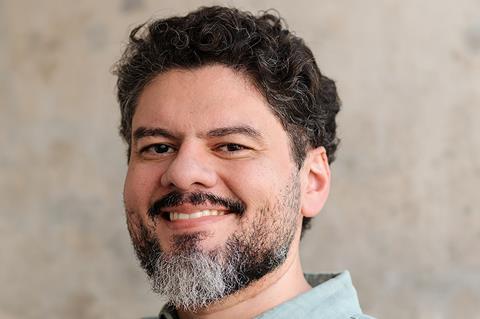
With Brazilian Oscar entry Gugu’s World, Allan Deberton is happy to embrace the archetype of the underdog fighting giants.
“What we offer is a small, heartfelt film about identity, belonging, and dreams,” says Deberton, who is making a stop at Festival do Rio (October 1-11) in his campaign to secure an Academy Award nomination for best international feature film.
In the coming months, Deberton anticipates a battle in the classic David-versus-Goliath mould for his film, which will screen out of competition on October 6 in the Nova Geração of Première Brasil, a section tailored for young audiences and families.
With a modest budget of $1.7m (BRL 9m), the drama about an 11-year-old queer boy who dreams of becoming a professional football player will have to compete against heavyweight Academy Awards contenders.
Fighting giants
“We know we’re fighting for space with giants,” he says, likely referring to La Bola Negra, Spain’s entry, with a budget of more than $15m and US distribution through Netflix. Other heavy-hitters include France’s submission Minotaur ($7.5m, at MUBI for North America, Latin America, UK & Ireland, Germany and Austria), and Romania’s candidate Fjord, budgeted at more than $5m and distributed by Neon in North America, UK, Australia & New Zealand. At press time Gugu’s World was still without a US distributor.
“I understand the challenges ahead and also the expectations of the Brazilian people,” says Deberton, who acknowledges the pressure of his country’s recent awards season track record. Walter Salles’s I’m Still Here made history when it became the first Brazilian film to win the international feature film Oscar in 2025. Then, last March, Kleber Mendonça Filho’s The Secret Agent earned a nomination only to see the Norwegian entry, Joachim Trier’s Sentimental Value, come out on top. I’m Still Here was distributed in the US by Sony Pictures Classics, and The Secret Agent by Neon.
“What works in our favour is that we started building connections quite some time ago,” Deberton says. “We’ve been preparing a lot for this, which is continuous process. We know that an American distributor is part of the game and brings strength to the campaign. We are already in talks with good ones interested in us.”

The director emphasises that Gugu’s World is already expanding its reach in the international market, with sales agent M-Appeal closing deals in Latin American countries such as Argentina and Colombia, as well as Europe, including Denmark, Belgium, the Netherlands, and Spain. Paris Filmes will release in Brazil on November 5.
Gugu’s World premiered at the Berlinale where it won the Generation Kplus Crystal Bear for best film and the grand prix of the Generation K-plus international jury. It also won the best performance award in the Cine en los Barrios competitive section of Cartagena International Film Festival, when the statuette went to the child star Yuri Gomes, who brings joy and colour to everything Gugu does, whether playing football, dancing, or applying make-up.
At Guadalajara International Film Festival, Gugu’s World took the Maguey Award for best film and the Maguey Award for best performance, in this case for Gomes and Teca Pereira, who plays Gugu’s free-spirited grandmother with whom the boy lives. But when she starts to show signs of dementia, Gugu is forced to live with his father (Lázaro Ramos), who is somewhat intolerant of the boy’s vibrant personality.
‘Godfather’ Karim Aïnouz
“The presence of Lázaro Ramos in the cast (although in a supporting role) is also a major asset for the film to gain visibility globally,” notes the director. A superstar in Brazil, Ramos is internationally recognised, primarily within the film festival circuit, where he caught attention in the title role of Karim Aïnouz’s 2002 Cannes Un Certain Regard selection Madame Satã.
“Karim Aïnouz is the godfather of our film; he was our main consultant,” says Deberton, who, like the director of 2019 Cannes period drama The Invisible Life Of Eurídice Gusmão, also hails from the state of Ceará in the Northeast.
Production on Gugu’s World took place in Quixadá, situated within the semi-arid Sertão region, and neighbouring towns in the interior of Ceará, lending the film a strong Brazilian identity. “Our Sertão is more modern; connected to the rest of the world and more colourful as well, unlike that more suffering Sertão that Brazilian cinema usually portrays,” Deberton says.
The idea was to make Ceará the setting for a drama of great emotional scope. “Everything was built with sincerity, in terms of childhood feelings and human relationships,” says the filmmaker. “Wherever it goes, our film connects with people’s hearts.”
Gugu’s World was produced by Deberton Filmes and Biônica Filmes, and financed with support from the government of Ceará, PNAB, PNAB Ceará, BRDE, FSA, Ancine, and the Ministry of Culture.






No comments yet