

















Created by its star Riz Ahmed, Bait follows a struggling actor vying for the role of James Bond. “I want to make space for stories told in a way they haven’t been told before.”
In August 2015, Riz Ahmed was riding high on the biggest news of his career. He had been announced as a cast member of Rogue One: A Star Wars Story – the first South Asian actor to have a key role in the franchise – and his phone buzzed with excited reactions from friends and family. However, that same week Ahmed was banned from his local Tesco supermarket for suspected shoplifting, after forgetting to scan an item. “I was walking around with a massive laundry bag full of dirty clothes,” he chuckles now. “They just thought I was dodgy and insane.”
The odd juxtaposition of these two events is something that fascinates the west London-born Pakistani British actor. To the degree that, for the past decade – during which he garnered global acclaim that included an Emmy win for HBO crime drama The Night Of and an Oscar nomination for Amazon Studios’ Sound Of Metal – Ahmed kept a diary of the “strange, absurd situations” in which he has found himself.
“We’re chaotic, messy and vulnerable but we always feel we have to project a successful version of ourselves that’s different to who we are,” he says. “And that’s not just for me as an actor. It might be for any of us, on our LinkedIn profile or our social media posts. Or this Zoom call, I mean, there’s a pile of boxes just out of frame, and I’m wearing cycle shorts down here. The reality is always different to the perception. In that respect, life is one big audition.”
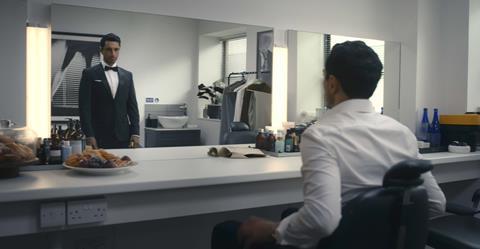
This idea was the conceptual hook for Ahmed’s latest project Bait. Developed at Jax Media with Ahmed’s Left Handed Films for Amazon MGM Studios, the six-episode miniseries is his most ambitious and personal work yet, with the actor starring and co-showrunning alongside Ben Karlin (The Daily Show). He plays Shah Latif, an actor who, like Ahmed, grew up in Wembley, London and whose life careens out of control when he auditions for the part of James Bond – a role to which the real-world rumour mill has, in the past, connected Ahmed.
“Yeah, that was a conversation in and around my life at one point, and it was one of the anecdotes I drew on,” he confirms. “But when we put that on the table, we realised it could be a vessel to contain the themes of the whole show, which is really about how we look for love in the wrong places, seeking the validation of others rather than finding self-love.”
To Ahmed, Bond was the ideal aspirational symbol for Shah: “A pinnacle of cinematic achievement, an archetype of alpha masculinity and a touchstone of British-establishment acceptance. Along all the different angles that Shah feels he’s not good enough, 007 is the thing he wishes he was.”
However, it was a risky vessel to commit to, given the protectiveness of Eon Productions’ Barbara Broccoli, who then had creative control over the spy franchise.
“We were quite far down the line, and everyone said, ‘She’s not going to let you use this. You have to pivot,’” recalls Ahmed. Even Amazon MGM Studios, which by that point owned the IP, could not help him.
“They said, ‘This is a Barbara conversation.’ But I thought, ‘If we’ve even got a 1% chance, we need to go all in, Casino Royale style.’ To her credit, Barbara is a class act, such a champion of new voices. And she got that the show is not about Bond. She really liked it and supported the vision. She said, ‘My only request is that you don’t depict me.’”
Interestingly, Ahmed reveals that the Bond idea came quite late in the writing process, which proved challenging given his intention to create a show that, while ostensibly a comedy, flips nimbly between genres with much tonal variation. “This character is having an identity crisis, so the show itself should be having an identity crisis, right? He’s shuffling, Rolodex-style, through these genres – a Linklater movie, a Bollywood soap opera, a sitcom like Ramy, a Paul Greengrass-type espionage thing… That was very deliberate, very considered and very difficult to do. It’s what we’re proudest of, because it makes the show distinctive.”
Anecdotal evidence
Bait is also inherently distinctive because it is so rooted in Ahmed’s life and experiences: its multi-lingual, enjoyably messy family scenes, its knowing film industry satire, and its exposure of his insecurities and internal dialogues – notably visualised with a severed pig’s head voiced by Patrick Stewart (“He was really game and humble”). It feels like the affirmation of a new phase in Ahmed’s career, characterised by the generation of his own material.
“I’ve definitely been on a bit of a journey,” he reflects on the years since he started keeping his diary of anecdotes. “What I’ve wanted to do in my career is to stretch culture in some way and make space for stories told in a way they haven’t been told before.” At first, he aimed to achieve this by “stepping into pre-existing archetypes and worlds like Star Wars or Marvel” (in 2018, he played the villain in Spider-Man spinoff Venom).
Now, he says, “the next stage is to try to create new archetypes. On a personal level, I used to feel like I was hitting a bit of a wall creatively, because acting involved putting on a mask and becoming someone else for someone else. Now I think it’s more for me. What’s exciting is the idea of acting as taking the mask off, being truly vulnerable, truly personal, truly sharing your privacy and your insanity in doing so. There’s something very liberating about that.”
Ahmed does not yet know whether there will be another season of Bait. “It works very well as a self-contained thing, but I love these characters. Maybe we’d want to revisit them, but I’ve not turned my mind to that yet.”
He will next be seen in another intriguing satire, appearing alongside Tom Cruise in Alejandro G Iñarritu’s Digger. Ahmed says it was “inspiring to be around such a bunch of obsessive perfectionists” while making it. “I don’t like being stuck in one kind of process, and there’s a unique way of working that Alejandro has, and Tom has, and which that project demanded. Everyone was joining hands and stepping out of their comfort zone.”
Given Digger, Bait and Ahmed’s recent stint hosting Saturday Night Live UK, he seems more drawn to comedy than anything else; after all, his big breakthrough back in 2010 was with Chris Morris’s Four Lions. He does not disagree. “With comedy you can be uglier, you can be more provocative, you can say more, and you can bypass people’s thinking and prejudices and biases,” he says. It is clear he takes comedy very seriously. “You can go straight to the gut. You make someone laugh. That’s connection, you know what I mean? I’m excited by how visceral it is, and how dangerous it can be.”






No comments yet