















Shoebox Films co-founder and former Film4 chief executive Paul Webster remembers his friend and collaborator Marjane Satrapi, who died last week aged 56.
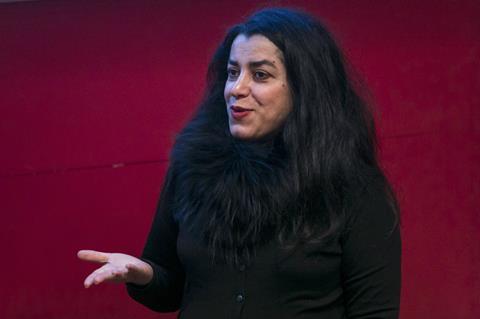
I met Marjane Satrapi in 2017 at Working Title’s offices in London to discuss her directing Radioactive, Jack Thorne’s screenplay adaptation of Lauren Redniss’s graphic novel about the lives of Marie Curie and Pierre Curie.
My fellow producer Tim Bevan and Studiocanal’s Ron Halpern were there too. I was the sceptic of the three of us, Tim and Ron were much more supportive. Marjane was there with her longtime collaborator Stéphane Roche and proceeded to wow us with a detailed and imaginative pitch replete with drawings and timelines presenting adventurous and well-thought-through proposals for the filming of the project.
I was very impressed. We all were. My scepticism evaporated. And so began a two-year odyssey into the world of Marjane that was unlike any I had experienced before. We were working with Marjane Satrapi, film director, sure. But she was so much more than that: a great animator, visual artist, painter, graphic designer, writer, activist, feminist, political agitator, disruptor, fierce debater, humanist, humourist, fashion maven, and all-round fabulous human being among many other things.
I can imagine her now, reading this tribute and the tongue-lashing I would doubtless receive for having the temerity to write it – “What are you doing this for? Forget about me, go live your life. I have lived my life and it’s been a good one, you just get on with yours.” That sounds like her: straight to the point, direct, but everything underpinned by compassion and modesty. Always challenging the norm, always the provocateur.
Marjane was a great artist. The extraordinary response to Persepolis, the graphic novel and her first film, made her famous around the world. She turned the harrowing journey away from home and family that she took as a very young person into art of the highest quality. She bore the scars of those experiences and used them to inform her vision of the world. Nonetheless, these were deep wounds and the pain of those experiences never left her.
She shone her light on so many. She was an inspiration to young people, to women of all ages, and used her presence and influence to help others less fortunate. She became a household name but never forgot her essential humanity.
Our experience working with Marjane on Radioactive was something none of us who collaborated with her will ever forget. No one is funnier than she was, no one as provocative. She was a close friend to profanity and scatology and indulged in them frequently to the outrage and amusement of all. She was a force of nature.
After the film was finished, I went on a road trip along the Côte d’Azur with Marjane, her beloved husband Mattias, and Stéphane, her best friend. It was a hilarious and inspirational trip in equal measure. One afternoon, we stopped in a pretty town for a break. In a small square stood an enormous old tree. Suddenly, there was Marjane, arms wrapped around the truck, whispering.
Intrigued, I asked her what she was doing. “I’m praying to the god of the tree,” she said, perfectly seriously. That was Marjane in a nutshell: the iconoclast and confirmed atheist praying to an arboreal deity. This is one of the many reasons that I loved her. She is irreplaceable and will be much missed.
She was a trailblazer for the recognition and promotion of women writers and directors but always insisted on being judged solely for the quality of her work, not wanting it to be considered differently from the work of men.
I’m sad that I lost contact with Marjane these past years, but I know I will never forget her. She was a gift to all who came across her and her name will live long in the hearts of those who did.
Rest in Peace, Marjane.
Paul Webster, June 2026.






No comments yet