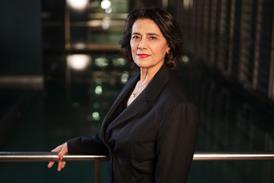
New BFI Filmmaking Fund director Isabel Davis said she was looking forward to “the chance to make work that is going to connect with audiences” at a pre-BFI London Film Festival event that heralded her arrival, toasted outgoing Fund head Mia Bays, and celebrated the BFI-backed films at the festival.
“It’s challenging times for film, isn’t it always? But how exciting to be in 2026 when people are going to the cinema, young people are going to the cinema,” said Davis. “The chance to make work that is going to connect with audiences is what is going to see us through, along with the commitment from our brilliant partners at the National Lottery.”
Davis, speaking at the end of her second day in the role, described the National Lottery as “the absolute backbone of British film funding, alongside BBC Film and Film4 – I can’t wait to work with you all.”
Bays addressed having “the honour, and the battle, of directing the BFI National Lottery Filmmaking Fund”, as her five-year tenure comes to an end later this month.
“It has been a milestone in my 35-year career,” Bays told the room, which included her Fund colleagues, senior production and development executives Ama Ampadu and Louise Ortega.
“There’ve been around 78 fiction features, which is an incredible number. I want to thank you, Ben [Roberts, BFI CEO] and Harriet [Finney, deputy CEO] for your trust in me, and in backing the reshaping of the fund, which has led to such an extraordinary range of projects and programmes.”
Features supported by the Fund during Bays’s tenure include Bafta winner Kneecap, Molly Manning Walker’s Cannes Un Certain Regard prizewinner How To Have Sex and Raine Allen-Miller’s Rye Lane. The organisation also launched the Creative Challenge Fund, which backs project development labs.
“The work demands stamina, conviction, and a willingness to fight for stories that deserve to exist,” said Bays. “It’s a privilege to do what we do, to stand behind filmmakers who refuse to look away, who insist on making work that means something and demands attention in a world determined to dilute it.”
Bays teased her next steps, which include running the UK chapter of the Dogma 25 filmmaking movement, “with a group of experienced filmmakers and producers. We believe in the Danes’ bold new manifesto, and we believe in each other, the chance to break ground and break bread.”
“We’re ready to make films that demand attention because they’ll be made with intention and with love.”
Supportive
BFI CEO Ben Roberts paid “special thanks [to] a very supportive UK government.”
“Don’t ever underestimate how lucky we are to have public funding,” said Roberts, who gave a full-throated endorsement of National Lottery support. “It’s amazing that we have this funding to help you make the stuff you’ve made, and to help us partner this festival.
“We need you to buy these tickets, and more importantly, as filmmakers, to talk about the National Lottery and its impact on your work,” added the chief executive, who referenced how athletes supported by the Lottery champion its backing in interviews. “They’re brilliant at it, and we ought to find a way to build that into our narrative.
“And not just ‘the lottery’, we’re not talking about the postcode lottery,” he continued. “We’re talking about the National Lottery. You have to say the whole thing. If your friends say, ‘I can’t wait to play Omaze and win that house’ – maybe think about playing the National Lottery, because Omaze doesn’t make films. These things matter.”
Roberts, who was Bays’ predecessor in the Filmmaking Fund director role, thanked the departing executive for her efforts in “a really hard job”.

“It’s a job that Mia has had to do at a difficult time,” said Roberts, who reminded the room Bays was recruited during lockdown.
“Making films has got harder, and the pressure on Mia and the Filmmaking Fund team has got tougher, because more people need the money.
“It’s not an easy thing to do, but Mia has made it completely her own. She’s had a fantastic tenure, and she’s leaving it with grace. We all owe a debt to Mia, and all of you in this room with films in the festival owe Mia and the team a debt.”
Roberts also championed Davis, who previously worked at the BFI from 2011 to 2018 as a senior executive, then head of international.
“Isabel left to build her stamina in Scotland, and has run Screen Scotland for eight years, so she’s got public service running deeply through her veins,” said Roberts. “We’re in good shape, passing from Mia to Isabel.”
Transaction
Roberts also introduced actress Joanna Scanlan, who took on the role of BFI ambassador last month, with the goal of raising awareness of National Lottery Good Cause funding for film.
“This all starts with the purchase of a lottery ticket,” said Scanlan. “For most people that’s just a flutter, or a desperate measure – maybe I’m going to win the lottery. But it’s never a lost cause, because that tiny transaction unpacks a staggering, beautiful chain reaction across our whole society. It’s the lifeblood of British film, and its impact is revolutionary. It unblocks and unfolds independence.”
“The lottery ticket builds a bridge to the future,” continued Scanlan. “It brings film to the classroom. It provides young people from every background with mentorship, resources to follow their dreams, creating pathways into every corner of our industry. It provides a screen culture that belongs to everyone.”
Filmmakers in attendance included Ben Sharrock, who is prepping his next feature Alone Together; Tristan Goligher, who produced Andrew Haigh’s LFF selection A Long Winter; and 2026 Screen Star of Tomorrow Fateme Ahmadi, in post on debut feature Daughter Of Eden.


No comments yet