











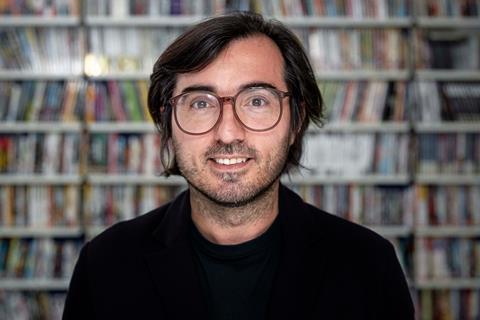
Mubi founder and CEO Efe Cakarel says the company is “going to stay as far away from AI as possible when it comes to films”.
Cakarel was giving a keynote speech at the Zurich Summit at the Zurich Film Festival on September 26, when he detailed his company’s strategy regarding artificial intelligence technologies.
“At Mubi, we’re going to use AI, and we are using AI in engineering, finance, operations, forecasting, customer service,” said Cakarel. “But there is one place where our AI strategy is extremely sophisticated: the films. We’re going to stay as far away from AI as possible when it comes to films.
Cakarel qualified this strategy in a speech that was well-received in the room in Zurich. “Not because I believe AI cannot make something good. That argument is complacent and probably wrong. It is precisely because AI-generated content is about to become so good that human creation becomes more valuable. When a machine can make a perfectly competent thriller in 30 seconds, competence becomes worthless.
In the future, the value will be in “intention”, said the CEO. “Someone has something to say. Someone spent five years making it. Someone risked humiliation. Someone persuaded an actor to do something that neither of them knew would work. Someone failed, and imperfection becomes a luxury good. In a world of infinite synthetic entertainment, provenance becomes part of the product.
“Nobody drinks a Grand Cru burgundy because fermented grape juice is technologically difficult to manufacture,” said Cakarel. “They care where it came from, who made it, what year, soil, terroir, what happened. And cinema is going to become more like that.
“The media industry spent 20 years saying content is king,” continued Cakarel. “I think content is about to become so abundant that that phrase becomes meaningless.”
Trust
Instead, value will be in “taste, attention, cultural legitimacy, community, provenance, and above all, trust,” said Cakarel. “We are not trying to own every minute of your leisure at Mubi, and frankly, that sounds exhausting for both of us. But we want you to trust us with two hours of it.
“That is why Mubi has to exist beyond streaming - the global home for cinema, being there when a film is financed, when it opens in a cinema, when people argue about it, when it enters a library, and when somebody discovers it 20 years later.”
Earlier, Cakarel reiterated Mubi’s commitment to building theatrical venues, saying “very soon we’ll be having actual physical cinemas” when detailing the company’s operations across finance, acquisitions, distribution, exhibition, publishing and festivals.
“A global home for cinema means to me not another app, but an institution capable of taking an idea, a film, all the way to an audience and staying with it for decades,” said Cakarel, who went on to address how he feels AI will affect commissioning and production at major companies.
“Imagine I run one of the world’s largest entertainment platforms, and my data tells me there are 14.7m people who disproportionately enjoy Russian dramas with sexual jealousy and murder. Today I can greenlight a production or acquisition against that insight. Soon, I can generate [a film] against it.
“There are hundreds of millions of households with billions of individual entertainment preferences,” said Cakarel. “Historically, serving every tiny cohort was economically impossible because filmmaking was so expensive. That’s why Netflix is spending about $20bn a year on content, and I cannot find a single thing I want to watch.
“AI changes the economics of that niche very quickly. It can cause the inventory to be created, and the temptation will be enormous. And I don’t think Netflix will be alone. Disney will do it. Amazon will do it. Independent studios will do it. Even companies we currently think of as guardians of filmmaking-driven cinema will eventually be tempted.”
Culture
This may lead to different versions of the same film being made for different viewers, posited Cakarel. “Today’s algorithm says ‘people like you enjoy this’. Tomorrow it can say ‘I made this because people like you enjoy this’, and eventually, ‘I made this for you’. At that point, a 22-year-old in Zurich and a retired teacher in Bogota may not merely be recommended different films; they may receive different versions of what is nominally the same entertainment.
“That is extraordinarily efficient, right? But I’m not sure it is culture. Culture requires shared objects. Hyper-personalised entertainment gives you satisfaction, but cinema gives you something to talk about. That distinction is going to matter enormously in coming years.”
“AI is about to do to creation what the internet did to distribution,” said the executive in closing his speech. “We will go from abundance to something approaching infinity, and I don’t think the winners will necessarily be the companies capable of making the most out of AI. They may be companies capable of saying ‘this filmmaker, this film, deserve to be seen’.
“So yes, we want machines doing a great deal of work in our lives; we just don’t want them making the movies. Because if I’m right about where entertainment is going, 20 years from now, the most radical thing a film company may be able to say is ‘This was made by people’.”
Cakarel’s speech was part of the eight-hour Summit day, which also included speeches from Academy CEO Bill Kramer, YouTube Germany managing director Andreas Briese, and The Creatives CEO Romain Bessi.
Zurich Film Festival continues until Sunday, October 4.






No comments yet