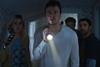











Austin Abrams impresses in Sony’s darkly funny horror actioner which rolls out globally from September 16

Dir: Zach Cregger. US. 2026. 90mins
Thirty years after the release of the first video game, Resident Evil has become one of entertainment’s most successful IPs. With nine instalments of the game (the most recent, Resident Evil: Requiem, arriving earlier this year this year), six films released between 2002 and 2017, 2021 reboot Welcome To Racoon City and a (short-lived) 2022 Netflix show, you might think this series had reached saturation point. Filmmaker Zach Cregger would beg to differ; his bombastic, bloody, back-to-basics Resident Evil cuts through the sprawling mythology of the previous films and successfully resets the franchise for a new era.
The game’s visual elements are a jumping off point for some impactful, inventive effects
Rolling out globally from September 16, Resident Evil is tracking to achieve the biggest box office opening to date for the Sony franchise, which has already grossed more than $1.2bn – unsurprising, given both its enduring popularity and its director’s substantial genre pedigree. Cregger’s 2022 feature debut Barbarian became a sleeper hit, grossing $46m worldwide against a budget of around $4m; 2025 follow-up Weapons took $270m and won star Amy Madigan an Oscar for best supporting actress. While this latest feature is not as inventive or cerebral a prospect, it’s a hugely entertaining genre actioner that should appeal to both newcomers and existing fans.
Crucially, Cregger and co-writer Shay Hatten (John Wick: Chapter 3 and Chapter 4) are not trying to reinvent the wheel here, instead leaning gleefully into the story’s video game origins. The filmmaker forgoes the non-linear narratives of his previous films to tell the relatively simple A-to-B survival tale of courier Bryan (Austin Abrams), who must deliver an urgent parcel from one hospital in the Colorado flatlands to another in Racoon City, high in the mountains. Initially encountering a bizarrely-behaved pedestrian on the dark, icy road, Bryan soon finds himself thrust into a hellish scenario in which an escaped virus from the shady Umbrella Corporation is turning the local population into mutated killing machines. Unlucklily for him, his package contains the last hope for an antidote.
Euphoria star Abrams previously impressed in a scene-stealing role in Weapons and as the hapless straightman in Wolfs (2024), and his pitch-perfect performance is key here. Affable, likeable but far from dynamic, Bryan is, in essence, an avatar for any first-time Resident Evil player, who finds themselves thrown into a world of carnage without any preparation or a coherent plan of action. Abrams is, however, careful to flesh out his character, bringing a dark humour to this unravelling nightmare through his deadpan Gen Z tone – “Interesting” he observes as tentacles emerge from a headless body – and bumbling attempts to do the right thing. Bryan’s dissociative demeanour is a believable defence mechanism, which anchors the narrative and lays the groundwork for some effective jump scares.
As Byan moves briskly through increasingly treacherous environments – a car, a farmhouse, a city sewer, a multi-storey hospital (the film shot in the Czech Republic, with Prague doubling for Racoon City) – there is the sense that he is levelling up in terms of his bravery and tenacity. A wry throughline highlights Bryan’s lack of skill with a gun, and his game-appropriate progression from pistol to shotgun to MP5. (Examples of the several exact replicas from the game which, along with well-placed easter eggs, should please eagle-eyed fans).
Cregger and his team also use the game’s visual elements as a jumping off point to create some impactful, inventive effects. While the human (and canine) hosts of the virus retain those familiar tentacles, the film pushes the idea of mutation to its limit. The infected have a disturbing way of merging together to create huge, fleshy, grotesque abominations that cartwheel on multiple hands and feet. (Similar to effects seen earlier this year in Yeon Sang-ho’s Colony and, of course, in Peter Jackson’s 1992 genre classic Braindead).
Throughout, intense, kinetic camerawork from Dariuz Wolski takes its cue from the game’s first-person POV; peering over Bryan’s shoulder, swinging left and right to keep up with his eyeline or staring directly down the barrel of his gun. Handheld cameras and the use of gimbals get us into dark corners and tight spaces – including, in one memorable sequence, the tiny bathroom of an abandoned RV.
With the film taking place entirely over the course of one night, the mood is shadowy and atmospheric, the artificial light from cell phone torches and car headlights casting a sickly glow. Snappy, nervy editing from Joe Murphy (returning from Barbarian and Weapons) and a pulsing score from Ryan and Hays Holladay (also from Weapons) keep things moving at an appropriately breakneck pace – as anyone familiar with the game will know, if you stop, you die.
Production companies: Constantin Film, Davis Film, Subconscious, Vertigo Entertainment, PlayStation
Worldwide distribution: Sony Pictures
Producers: Robert Kulzer, Zach Cregger, Roy Lee, Miri Yoon, Victor Hadida, Asad Qizilbash, Carter Swann
Screenplay: Zach Cregger, Shay Hatten
Cinematography: Dariusz Wolski
Production design: Tom Hammock
Editing: Joe Murphy
Music: Ryan Holladay, Hays Holladay
Main cast: Austin Abrams, Paul Walter Hauser, Zach Cherry, Kali Reis, Will Merrick