










Wang Jiangyong’s feature premiered in Tokyo competition, where Hun won the best actress award
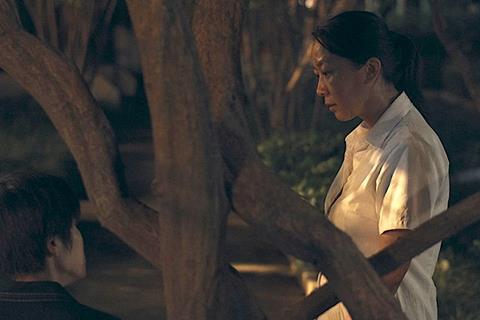
Dir: Wang Jiangyong. Hong Kong/France. 2026. 96mins
A grieving middle-aged dormitory manager and a disaffected student play surrogate for the missing parts of each other’s lives in multi-hyphenate Wang Jiangyong’s The Night That Binds Us. Wang’s debut feature is a deliberately-paced, borderline-inert internalised drama, in which the story’s protagonists walk a fine line between being complex and recognisable, and reprehensible navel-gazers. Understated to a fault and hinging on a questionable physical moment, the film garnishes its themes of alienation, collapsing families and life as a social discard with opaque, flat visuals, but is buoyed by compelling starring performance by Hu Ling, best known for her 2007 break-out in Lou Ye’s Summer Palace.
Much of what works about The Night That Binds Us can be laid directly at the feet of Hu
A one-time assistant director to Zhang Ming (on The Pluto Moment), who executive produces here, The Night gives off strong Bi Gan (Resurrection) or the late Hu Bo (An Elephant Sitting Still) vibes, just without taking quite as big a narrative or thematic swing as either of those directors. Nonetheless, festivals, arthouse distributors and niche streamers could show an interest in an independent perspective from China – and despite the film’s production credits it’s very much a Chinese film. Hu’s best actress win at Tokyo, where the film premiered, may also boost interest.
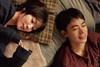
The Night begins with Chengdu-born Shanghai university student Sun Guofeng (newcomer Tan Zuhong) hanging out in a nightclub, drinking too much and not eating enough. His body language says he’s indifferent to whether he lives or dies. He stumbles home to his dorm, where the night manager An (Hu), won’t let him back in unless he signs in; he opts to crash on a bench and she eventually relents. This repeats for several nights until on one occasion, after An gives him a much-needed meal, they kick off an ambiguously consensual sexual relationship – one that continues when everyone in the dorm except Guofeng goes home for a holiday.
Both hailing from Sichuan province, An and Guofeng also find a point of connection in similar personal losses: his parents have been arrested on suspicion of fraud, her only daughter was killed after moving to the city. Their relationship sputters when everyone comes back from holiday and Guofeng doesn’t want anyone finding out about their tryst.
Wang’s adaptation of Zhang Chu’s short story is ultimately an old-fashioned, slow burning examination of two marginalised people making a fragile connection that neither can quite explain. Both have gutted families – she’s lost a child and he’s lost a mother (a vaguely unsettling dynamic) – and both are living in the shadow of a dark cloud of shame according to Chinese social norms. Despite that,both are trying their level best to work within the system that’s shunned them, or is about to. Ironically, Guofeng is studying for a civil service exam that would likely be meaningless even if he passed thanks to the accusations against his parents.
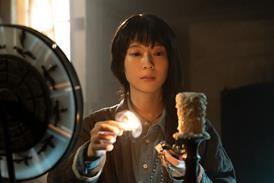
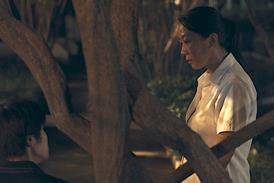
The film makes some obvious choices to telegraph all this angst: cramped dormitories, a barren campus, grim working class flats, the requisite grey filter of oppression or alienation, hazy images that mask simmering pain. Cinematographer Piao Xinghai (a camera operator on Lou Ye’s Saturday Fiction) keeps the camera steady, uncluttered and stage-like, with the exception of closing moments that switch to almost frantic hand-held work, as An literally slips away from Guofeng for good. Then The Night simply stops rather than ends. It’s less artistic and cryptic than mannered and frustrating.
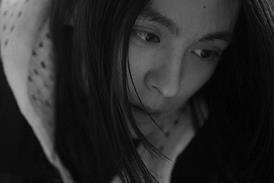
Much of what works about The Night That Binds Us can be laid directly at the feet of Hu, whose career has straddled two decades but only a handful of screen appearances. Her nuanced turn here gives the story what depth it has; she’s heartbreaking and empathetic, economical in her gestures and expressions, making An’s sorrow feel real and lived in, like a weight she’s been hauling around for years. Unfortunately, Wang’s writing almost turns her into a garden variety stalker in act three (this after flirting with assault victim early on) and muddies the waters surrounding An’s past and her present. Still, Hu is so luminously engaging, brave and grounded it’s easy to overlook those flaws, which would be more damaging without her wounded warmth.
Production companies: Forever Young Pictures
International sales: Forever Young Pictures, wangjiangyong121@163.com
Producer: Wang Jiangyong
Screenwriter: Wang Jiangyong, based on the short story by Zhang Chu
Cinematography: Piao Xinghai
Production design: Wang Zhijian
Editing: Wang Jiangyong
Music: Wen Zi
Main cast: Hu Ling, Tan Zuhong, Chen Naihan, Li Hongyu