









Penelope Cruz contributes a couple of firecracker sequences to La Bola Negra, as a cabaret performer entertaining the Nationalist troops. Screen talks to the department heads who collaborated to create the look.
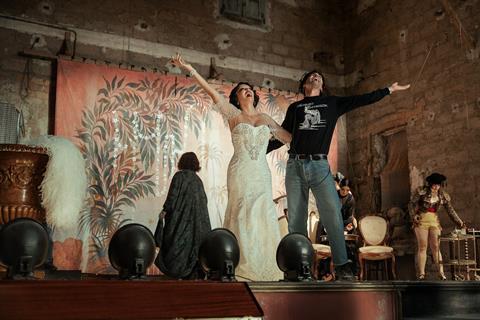
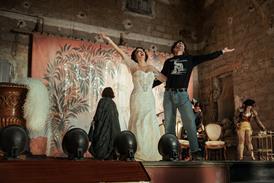
Penelope Cruz steps onto the stage of a theatre in ruins in La Bola Negra, dressed all in white and ready to steal the show. She plays Nené Romero, a singer performing for the right-wing Nationalist army in 1937 on the frontline of the Spanish Civil War. Unfazed by the howls of the young men watching her, she sings, teases and gives them a breather from the bloody conflict.
The key heads of department are all frequent collaborators of the director pair Javier Calvo and Javier Ambrossi (aka Los Javis): production designer Roger Bellés, costume designer Ana Lopez Cobos and make-up designer Marilo Osuna, with credits including TV series Veneno and La Mesías.
The sequence falls in the middle time period of an ambitious film that flips between 1932, 1937 and 2017, inspired by the life and work of queer poet and playwright Federico Garcia Lorca, and his unfinished play that gives the film its title. La Bola Negra was picked up by Netflix for the US after its Cannes Competition premiere, and by Altitude for the UK.
“I met Los Javis when they were preparing their first film Holy Camp! [in 2017],” explains Bellés. “I was drawn by their creativity and their boundless energy. I felt like a kid running away with a travelling circus company.”
Costume designer Lopez Cobos entered Los Javis’s orbit even earlier, when they were “performing in the hall of the Lara theatre in Madrid, and Ambrossi was doing shifts as a waiter”, she says.
“I have worked with them ever since, but every project is different. They’re always exploring the new so you’re never in the comfort zone, in the best possible sense.”
The setting for Cruz’s performance for the soldiers was described as “a theatre in ruins, with the idea her character brings light and beauty in the context of war”, says Bellés. “Choosing the right setting was key, but we were also aware Penelope has worked in individual sets that cost what our entire film cost. We knew we couldn’t give her a Pirates Of The Caribbean soundstage, but we could offer something special.”
Bellés checked around 40 options for the location, eventually selecting an old cinema in Sigüenza, a town 130 kilometres northeast of Madrid, that had closed in the 1950s. “It was in a derelict state, perfect for the ‘ruins’ part of the brief, but we also had to make sure it would be safe to work in”. The painted backdrop was replicated from a real 1940s theatre.
The venue was ready for action after an industrial clean-up operation and structural reinforcement. “We restored it to adapt it to our needs,” explains Bellés. “And Penelope was totally game, she loved the atmosphere and the details. I was worried we would have missed a pigeon dropping here or there, but she never complained,” he adds with a laugh.
Echoes through time
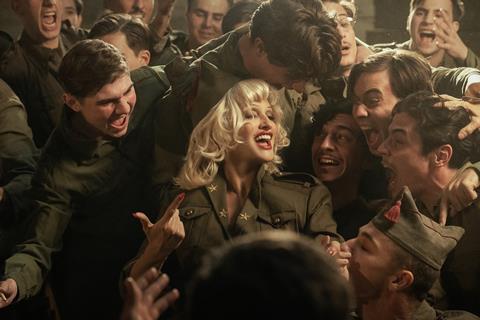
Bellés dug far and wide for design inspiration. “In the three timelines that intertwine in the film, the mood and the filmmaking style change, so the references we used were different too,” he explains. “In the strand set during the war, most of our sources were archive photos, but for this scene, even though it’s set in 1937, everything that surrounds Penelope’s performance was more about creating a chance to escape reality.
“So here, people will see echoes of paintings by Egon Schiele, Toulouse-Lautrec, Bob Fosse’s Cabaret, Fassbinder,” continues Bellés. “We combined it all with thorough research to find out what the performances for the Nationalist army were like during the war.” But Los Javis “don’t give references for you to replicate anything. It’s just to convey the mood they’re looking for. They are very precise but they don’t micromanage.”
Later, when Cruz makes an entrance singing on top of a tank for a second performance, she did so “on a real Panzer 1 we got from a Spanish collector”, says Bellés. “This was part of the shipment Hitler’s Germany sent to the right-wing army during the Spanish Civil War. The collector drove it himself. We tried to get a sense of the real throughout the film, and this is a real tank, a real theatre but a magical moment too, truth amid the great lie that is cinema.”
Material gain
For Cruz’s outfit, costume designer Lopez Cobos did her share of historical research into the women cuplé performers Los Javis wanted to pay homage to — a cabaret-style musical performance that was popular in Spain in the late 19th and 20th centuries, mixing songs, humour and risqué sensuality.
The filmmakers studied a book about cuplé by Gloria G Duran. “[They were] women who were courageous, provocative and strong, who advocated for women’s rights and took to the stage at a moment where everything was controlled by men,” explains make-up designer Osuna.
“The costumes worn by these singers were often inspired by 19th-century French fashion — more structured looks,” explains Lopez Cobos. “And Penelope was keen to use a corset so we went for a French-style outline. The initial inspiration was a photo of a Folies Bergère artist, but we added the heart-shape décolleté, the siren [fish] tail, and a pearly bolero jacket in a Goya-esque touch.”
Other options on the table included a black gauzy dress inspired by 1920s Hollywood. But the Spanish star was immediately drawn to the white dress, something cinematographer Gris Jordana appreciated in the darkness of the location.
“It made sense with the symbolic value of the scene, too,” explains Lopez Cobos, “a fantasy glimpse in the context of the horrors of war.”
Completing the look is a white feather boa. “It was a last-minute addition, but it looked so great that we went for it,” reveals the costume designer. The dancers surrounding the glamorous actress singing ‘Las Tardes Del Ritz’ (‘Afternoons At The Ritz’) wear bullfighters’ jackets. “They are historical too, from a later era, and we liked the lived-in look.”
For make-up, Osuna worked closely with Cruz’s personal make-up artist Pablo Iglesias. Bette Davis, Jean Harlow and Greta Garbo were among their references, and smoky colours dominated the palette: dark browns, purple, burgundy. “Back in the ’20s and ’30s, there was a tendency in make-up that was the opposite of uplifting. The eyes had a languid, melancholic turn because the lines went down,” says Osuna. “A style designed by men to make women look sad, with a small mouth that ideally they wanted shut.”
Cruz’s Nené proves these men wrong, doing anything but staying silent. All before the army she entertains and the dictatorship they brought to power would clamp down on women’s rights for decades to come in Spain. This too colours La Bola Negra.






No comments yet