












Palestinian actress Leem Lubany gives an impressive performance in Stelana Kliris’s third feature, which plays both Tallinn and Thessaloniki

Dir/scr: Stelana Kliris. Cyprus/Greece/UK. 2026. 104mins
A woman from Cyprus moves to South Africa for her arranged marriage in the 1970s-set Apart, from South African-Cypriot filmmaker Stelana Kliris. This melodrama feels a little airless and too narrowly focused on a small cast of characters to give a true sense of the complexity of the socio-political history of nations that are not just geographically very far apart, though its central performance, by Israeli-Arab actress Leem Lubany, is certainly incisive.
Lubany’s performance will make audiences want to stick with the story to the end
This third feature from Kliris following 2024 Netflix romance Find Me Falling and 2014 comedy Committed plays Thessaloniki immediately after premiering in Tallinn’s Critics Picks Competition, and should travel to further festivals. Travel beyond the circuit may prove more of a challenge, but Lubany’s excellent performance is a strong selling point.
Because it is at least partly inspired by the story of the directors’ parents, the film’s focus on personal emotions is certainly understandable. Yet it’s a shame that its restricted scope means it does not allow for much more than a basic suggestion of the historical and socio-political intricacies of the countries in which it is set.
The 1974 Turkish invasion of Cyprus resulted in the island’s division into Greek- and Turkish-speaking parts; a separation that persists to this day. Meanwhile, the 1976 Soweto Uprising marked the beginning of the unravelling of the notion that South Africa’s white minority could maintain control over the entire country. These two major events in nations over 4000 miles apart could each have inspired a mini series by themselves, so shoehorning both of them into a single feature was always going to be a challenge.
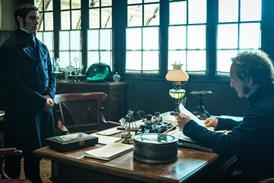
The film’s emotional core belongs to Eleni (Lubany, seein in Hany Abu-Assad’s 2014 Oscar-nominated Palestinian film Omar), whose arranged marriage to Nico (British actor Luca Pasqualino) has taken her to South Africa shortly after the invasion of Cyprus by the Turks. It is stressed several times that Nico doesn’t speak much Greek because he left when he was only a child, so the two mainly converse in English. They are, however, two quite different personalities and one of the main things they cannot agree on is that, according to Eleni, there were bad and good people on both sides of the conflict back home. Nico – who has only heard about the conflict but never actually experienced any of it – refuses to accept her position.
Nico runs a small grocery shop in a South African town (actually filmed in Cyprus on a single street that doesn’t seem to extend beyond the corner) that’s owned by a local Afrikaner, Mr Van Zyl (Robert Hobbs, District 9) and his wife, Suzette (Zimbabwean-South African actress Mary Anne Barlow). Eleni helps out in the shop and, initially, the newlyweds even sleep in an area out the back. Things become more complicated when Eleni turns out to be too independent-thinking for the country she’s in, making several faux pas when trying to help the shop’s Black employee Johanna (Namibian actress Girley Jazama, doing miracles in an underwritten part).
It is clear that Eleni does not understand the reality of Johanna’s life at all, though, oddly, Kliris, who also wrote the screenplay, doesn’t draw many direct parallels between the lives of the two women, both seen as non-entities (or worse) in the country in which they live. Instead, part of the screentime is devoted to the slow revelation of a secret from back home in Europe — revealed through intermittent flashbacks — that risks capsizing the narrative. It brings up questions of identity, solidarity and living in harmony that, in the film’s second half, take up so much room that the South African situation is only barely sketched out.
Since the point-of-view stays close to Eleni, a foreigner with little understanding of local politics, and Johanna’s character isn’t much of talker on top of not being fully developed, the South African story gets short shrift. Instead, Kliris focuses on the human emotions that history’s great changes cause in the individual, which are certainly relatable. The film hinges on Lubany’s performance, which reveals more about her character as new revelations emerge. It’s Eleni’s core of human decency, as well as her unwavering tenacity, that will make audiences want to stick with the story to the end.
Production companies: Meraki Films, Over The Fence Films, Atalante Productions
International sales: Reinvent Yellow Sales (helene.auro@reinvent.dk)
Producers: Stelana Kliris, Susan Simnett, Jamie Harvey, Ioanna Bolomyti
Cinematography: Simon Sarketzis
Production design: Lydia Mandridou
Editing: Emilios Avraam
Music: Kostas Christides
Main cast: Leem Lubany, Luca Pasqualino, Girley Jazama, Robert Hobbs, Mary Anne Barlow