







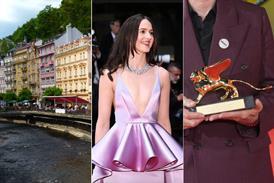






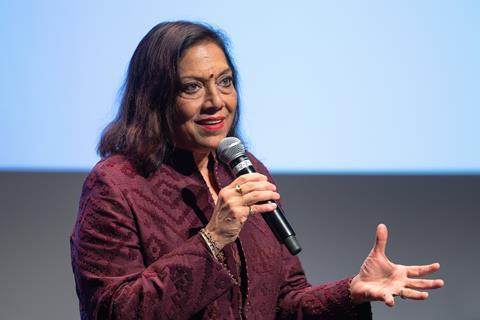
Self-described “Indian filmmaker at home in the world” Mira Nair had barely wrapped work on her latest feature, Amri, before travelling to Switzerland to receive the Film & Beyond Award at the 32nd Geneva International Film Festival (GIFF) on Sunday (November 1).
“I literally finished my new film 10 hours ago, at 11 pm in New York City, and jumped on the plane,” says Nair. “I’m still deeply immersed in the beauty and struggle of independent cinema. This award is heartening — a reminder that my work still resonates, that it has an audience and that I’m not alone.”
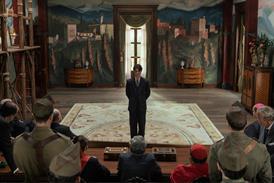
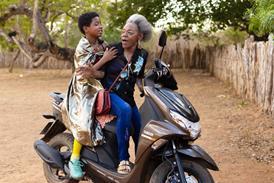
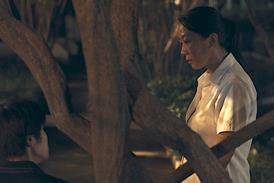
The director of films including Salaam Bombay!, Mississippi Masala, Monsoon Wedding and The Namesake returns to feature filmmaking after a decade with Amri, a biopic of Hungarian-Indian painter Amrita Sher-Gil, played by Anjali Sivaraman. The international cast also includes Emily Watson, Priyanka Chopra Jonas and Jaideep Ahlawat.
Spanning 1915 to 1941, the film follows Sher-Gil, daughter of a Hungarian-Jewish opera singer and a Punjabi Sikh aristocrat, from her childhood across Hungary and India to her training at Paris’s École des Beaux-Arts and emergence as a pioneer of Indian modernism.
Filming took place in India and Hungary.
Nair revealed plans to submit the film to Cannes, with a theatrical release targeted for later in 2027.
Creative control
Sher-Gil’s influence on Nair’s filmmaking stretches back decades. “I firmly and deeply believe that Amrita Sher-Gil taught me how to see. Period,” Nair says. “In every film of mine, I make a manifesto of what it will look like, and in every one of those manifestos are Amrita Sher-Gil’s paintings, her palette, her colour, her sense of bravery, her sense of framing.”
Nair explains she still has to fight for creative control when securing backing for her films.
“Financing always comes with conditions,” she says “I don’t have trouble, in some ways, raising money, but it’s the conditions that can be attractive or not.”
Amri, however, drew support largely from the art world.
“The financing came from those who would have made Amri, the artist, happy,” she says. “It came with no strings. It came with a belief that the film I would make would be art itself. The key thing for me is freedom.” The result, she says, is a film that reflects her vision. “It’s exactly the film I wanted to make.”
For Amri, Nair reunited with longtime collaborators, including producer Michael Nozik and The Namesake cinematographer Frederick Elmes. Nair co-wrote the screenplay with Clara Royer and produces alongside Nozik and Samudrika Arora through Mirabai, Samscape and Papertown Production, in association with Delhi’s Kiran Nadar Museum of Art and Miramax.
“Many of the key players on the film are people I’ve worked with for 30 to 40 years,” she says “It’s a beautiful feeling.”
She adds with a laugh: “I’m very collaborative, so long as I have the last word.”
Although Amri marks her first feature since Queen Of Katwe in 2016, Nair has remained busy, notably directing the 2020 BBC and Netflix adaptation of A Suitable Boy and developing a stage musical of Monsoon Wedding. Following a sold-out Brooklyn run in 2023, she plans to bring the musical to London’s West End by the end of 2027, followed by India and a return to New York.
“The film became an anthem”
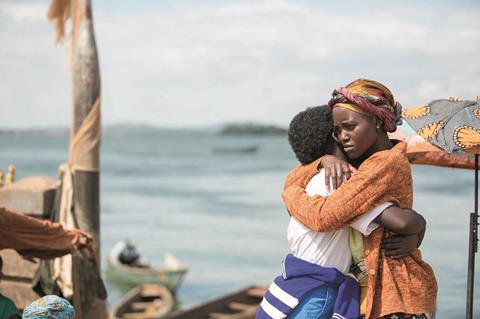
Beyond her own filmmaking, Nair has devoted considerable energy to nurturing emerging talent through Maisha Film Lab, which she founded in Uganda in 2004 to address the lack of filmmaking opportunities in a region rich in storytelling and oral traditions.
Alumni include the Ugandan filmmaker Moses Bwayo, whose documentary Bobi Wine: The People’s President earned an Oscar nomination, and Kenyan documentary filmmaker Zippy Kimundu, as well as Queen Of Katwe star Lupita Nyong’o.
Nair takes particular pride in seeing former students establish their own filmmaking initiatives, creating what she described as a “ripple effect” of mentorship.
“My big mantra is: if we don’t tell our own stories, no one will tell them,” she said. “And if they tell them for us, as they have done through decades of colonialism, then they tell them terribly.”
It is a conviction rooted in her own experience. Nair recalled questioning whether there was an audience for her stories of cultural hybridity when she made her second feature, Mississippi Masala, a romance between an African-American man and an Indian-American woman in the American South.
“I remember seeing lines around the block at the Curzon Cinema in London, full of interracial couples,” she said of the film’s 1992 release. “I thought, ‘my God, I think I may have an audience. People are listening’. The film became like an anthem because it had never been made.”
Today, she is encouraged by a new generation of filmmakers and the growing network of festivals, workshops and mentorship programmes supporting them.
“It’s now a much more hospitable time to be brown or black and to find a community for yourself,” she said. “I don’t think the process is going to be easier or simpler, but at least it’s possible.”
For Nair, storytelling and political engagement are closely intertwined, a connection she also sees in her son, New York mayor Zohran Mamdani, whose grassroots campaign she supported through months of canvassing.
“He grew up in a home full of political ideas and visual ways of opening up the box and saying, come on into this world you would otherwise not see,” she said. “For me, engagement is home.”
Nair received her GIFF award ahead of the GIFF screening of the six-part A Suitable Boy. “I used to fool myself that television is like cinema, but actually it isn’t,” she says. “It’s born out of the artificial creation of the cliffhanger. It’s a rhythm you have to embrace fully, which is quite different from making films. I’m much more a cinema filmmaker.”
She is equally wary of AI’s implications for creativity. “I’m slow to embrace it. I don’t know enough about it yet, and I don’t fully trust it,” she said. “Nothing can duplicate human imagination, and if anything chips away at it, that is terrifying to me.”
While acknowledging AI’s ability to create “the semblance of something creative”, she described its imitation of music as “so corruptive and so deeply unmusical”. “I dread to think of a community of people who will only know that,” she adds.
As GIFF revisits her career with 35mm screenings of Mississippi Masala, Monsoon Wedding and The Namesake, Nair continues to find purpose in cinema’s capacity to challenge perceptions and connect people across cultures.
“Cinema is my vocabulary,” she said. “Cinema can open one’s eyes in a way that is so powerful and so lasting.”
And despite the career honour, she has little interest in slowing down.
“I’m sleeves rolled up, always trying to make poetry and sense of the world,” she said. “I’m a lifeist. I believe very majorly in life.”






No comments yet