

















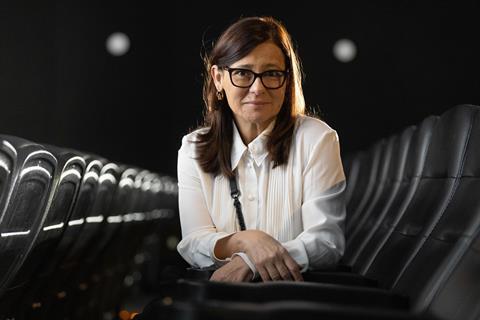
As São Paulo Intl Film Festival, known as Mostra de São Paulo, celebrates its 50th edition, its director Renata de Almeida reaffirms the convictions of an event born under Brazil’s dictatorship. “It was the only place in Brazil where one could vote. That explains why we have kept the audience vote to this day,” says de Almeida.
Since it was founded in 1977, Mostra de São Paulo (October 15-29) has screened 11,692 films by 8,474 filmmakers, establishing itself as Brazil’s premier showcase for auteur cinema. Furthermore, the event has always been known as a champion of emerging talent and that commitment to new and unknown storytellers is as strong as ever.
“Packing a movie theatre with a film by a director who has already won awards at major festivals would be very easy,’’ says director Renata de Almeida. “We do bring in the year’s biggest award-winners but our very reason for existing is to draw attention to lesser-known films.”
As an example of this overarching mission, de Almeida cites Danish-Egyptian May el-Toukhy. “When we recently contacted her about bringing Venice Golden Lion winner Woman Unknown to São Paulo, she recalled coming here to show her first film,” she says. The festival presented el-Toukhy’s debut film, Long Story Short, in 2016, as well as her follow-up, Queen Of Hearts, two years later.
This year’s line-up boasts four major Cannes winners and cinephiles in São Paulo – Latin America’s largest city, with a population of more than 23 million – have grown accustomed to seeing the year’s most anticipated films at the event. Sell-outs are expected for Cristian Mungiu’s Palme d’Or winner Fjord, Andrey Zvyagintsev’s Minotaur which won the Grand Prix, Fatherland for which Pawel Pawlikowski won best director ex aequo, and Ryusuke Hamaguchi’s All Of A Sudden whose stars Virginie Efira and Tao Okamoto were named best actress.
A festival of emerging talent
It’s by investing in discoveries that Mostra de São Paulo has become one of Latin America’s most prestigious film festivals, screening the highest number of films this year in Brazil (392 titles from 93 countries across 57 venues). The event, which drew 169,000 attendees last year, is regarded by critics, professionals and cinephiles as having the country’s most rigorous and uncompromising curatorial vision. This explains why Walter Salles chose São Paulo for the Brazilian premiere of I’m Still Here at the 48th edition, attributing his decision to his “filmic and emotional connection” to the event.
“Jafar Panahi, who returned to Mostra last year after winning the Palme d’Or with It Was Just An Accident, was awarded here with The White Balloon in 1995, when Walter Salles was on the jury,” recalls de Almeida, who has been working at Mostra de São Paulo since 1989 and has helmed the event solo since 2011 following the death of founder Leon Cakoff.
“Today, many festivals award debut films but we have highlighted early-career works since the festival’s inception,” says de Almeida, adding that 115 films were selected for the New Directors Competition this year. Only films by emerging filmmakers – with no more than two feature films to their credit – are eligible for the Bandeira Paulista trophy, which is created by the late Japanese-Brazilian visual artist Tomie Ohtake. The films first undergo a public vote which determines the finalists to be screened before an international jury.
Several other emerging talents have passed through São Paulo before achieving global acclaim. Examples include Iranian director Abbas Kiarostami who screened Close-Up in 1990 at the festival and went on to win the Palme d’Or at Cannes with Taste Of Cherry in 1997, and Hector Babenco, whose Lúcio Flávio won the audience award at the inaugural Mostra in 1977 and whose 1985 drama Kiss Of The Spider Woman received four Oscar nominations with William Hurt winning best actor.
“Quentin Tarantino also came to our festival [in 1992 with Reservoir Dogs] when he was still unknown,” says the festival director. “Alongside Maria Medeiros, who was in São Paulo with her film The Prince’s Death, Tarantino would rush from one screening room to another to catch as many films as possible. Two years later, the pair would make Pulp Fiction together, and we would dine with them at the Palme d’Or table in Cannes.”
Stories from the front line
These and other stories are revisited in her memoir “Antes Que Eu Me Esqueça” (“Before I Forget”), published to mark the festival’s 50th anniversary. “I wrote only about what I experienced. It is an account of the encounters, the people, the accidents, what went right, what went wrong, and the funny and sad moments,’’ she says.
The book is organised by festival editions, starting with her first, the 13th. In addition to offering a perspective on the role of cinema in Brazilian culture, she recounts the challenges of keeping the event running and shares her experiences of major figures in cinema — including Wim Wenders, Francis Ford Coppola, Geraldine Chaplin, Manoel de Oliveira, Abbas Kiarostami, Pedro Almodóvar and Theo Angelopoulos.
Everything in the book is revisited with de Almeida’s most distinctive trait: discretion. Her personality aligns perfectly with the ethos of Mostra de São Paulo which has never invested in the red carpet culture to chase media frenzies. “The only year we had a red carpet, at the request of [São Paulo’s public cinema and audiovisual agency] Spcine, I wanted to invite São Paulo graffiti artists to subvert it. But I couldn’t pull it off,” she laughs.
“I find it awful when the red carpet becomes more important than the cinema itself,” says the festival director, who is used to clashing with producers wanting to fill the theatre with VIP guests. “Not here. At Mostra de São Paulo, the star is always the film and the only thing that raises the temperature is the heat coming from the audience.”





No comments yet