











The Pitt doesn’t pull any punches in its politics or depiction of medical procedures. “Some of it is quite gnarly,” showrunner and creator R Scott Gemmill tells Mark Salisbury. “That was our goal”
After nine years on NBC’s hospital hit ER, Canada-born writer and producer R Scott Gemmill thought he’d had his fill of medical dramas. “We had done it well with ER and I didn’t feel I had any other [medical] stories to tell,” says Gemmill, who went on to work on ABC’s police procedural/legal drama Women’s Murder Club and CBS’s military procedural NCIS: Los Angeles. “I couldn’t imagine going back. And anything we did would seem to be derivative.”
And yet, never say never, as he “came up with a thought that would make it unique for myself, so I would consider doing it”. The idea was to reboot ER — which had been created by Jurassic Park novelist and former MD Michael Crichton and ran from 1994-2009 — but have it centre on one of the original characters, John Carter, played by Noah Wyle.
“I wanted to call it Carter,” says Gemmill, who was working with ER executive producer John Wells and Wyle on the reboot. “The whole plan was to use original footage [from ER] as flashbacks. Footage of Noah in his 20s playing the same character at 50.” Alas, the reboot “fell apart” when Warner Bros Television could not, reportedly, come to an agreement with the Crichton estate, overseen by his widow Sherri. Gemmill, Wells and Wyle moved on.
But Max [soon to be HBO Max], the streamer behind the reboot, was still keen to do a medical drama and asked the trio for any ideas. “At that point we had a blank slate to create whatever we wanted,” says Gemmill. “We started from scratch, trying to think what a new medical show would look like. We went back to the ER, hung out with emergency physicians and nurses, saw how things had changed. The Pitt is what we came up with.”
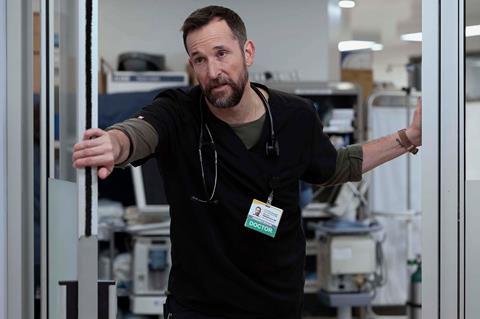
Set in the emergency department of the fictional Pittsburgh Trauma Medical Center, The Pitt stars Wyle as attending physician Dr Michael ‘Robby’ Robinavitch, struggling with a healthcare system on its knees and PTSD caused by Covid. “I started with the character,” says Gemmill. “Things had changed since [ER]. One of the big ones was Covid. It had a huge impact, not only on the world, but on healthcare workers. We didn’t know where we wanted to set it, but we didn’t want to do Los Angeles, New York, Miami or Chicago. We wanted someplace that was very middle America, a blue-collar city, and Pittsburgh fit that to a T.”
In August 2024, Crichton’s estate sued Warner Bros Television, Gemmill, Wells and Wyle, claiming The Pitt was a reworking of an ER reboot the estate had not approved. In November 2024, the defendants filed to dismiss. At time of writing, the lawsuit is still ongoing.
Gemmill was keen to make The Pitt an immersive experience. “We decided never to go home with our doctors, not to have any music — trying to make you feel like you’re in the emergency department. The way to do that was once people get there, don’t let them leave. And the way to do it was to keep it in real time.”
Each season of The Pitt takes place over one day, with every episode accounting for an hour in the emergency department. “I don’t think I would have come up with [that] if we were a network show, doing 22 or 24 episodes,” admits Gemmill. But since The Pitt was for streaming, that meant fewer episodes per season. “I imagined the first order was going to be 12. It seemed an easy fit — 12 hours for a shift, 12 episodes. Ultimately, they wanted to do 15, so we added three hours. Then it was about creating characters to surround Robby that represented every little facet of healthcare work going on these days.”
Medical expertise
The Pitt’s writing staff includes several former medical professionals. “I have three doctors in the room,” says Gemmill, who is deep into the writing for season three, which starts filming in July. “Two are writers and physicians. All three are emergency room physicians. Obviously, I couldn’t do the show without them because they provide all the medical expertise.”
In addition to playing Robby, Wyle is an executive producer, wrote two episodes in season one, two in season two, and directed an episode in season two. “Noah is in the writers’ room until pretty much production,” says Gemmill. “Noah is the heart and soul of the show. He sets the tone on the set. He raises the bar for everyone, not just the actors.”
Each episode takes nine days to film, shooting in chronological order, in an emergency room set designed by Nina Ruscio on the Warner Bros lot in Burbank, with real nurses backing up the actors during on-screen procedures and an ER doctor always present.
“It’s a lot of planning,” says Gemmill. “It starts with the script. All the writers have maps of the set at home, and we use them in the writers’ room. We also have a model. We write to the set. Then, during prep, the director will do stage walks with the writer. All the background actors, all the other patients who aren’t featured [in the main storyline], they’re all plotted out. They all have conditions. That’s all tracked by the ADs [assistant directors] and the writers.”
Given its home on a streamer rather than a network, The Pitt is much more graphic than, say, ER ever was. “Some of it is quite gnarly. That was our goal, to show what these men and women deal with on a regular basis. To shy away from it would be to shortchange the heroism of these individuals,” says Gemmill. It is also a political show, covering issues including the failings of the US Medicare system, domestic abuse, gun violence, mental health, abortion and Immigration & Customs Enforcement (ICE).
“Some are things of concern to us [writers]. Some are practical challenges faced by emergency departments. When we meet doctors and nurses, we ask, ‘What keeps you up at night? What do you worry about?’ A lot comes from there.”
The Pitt’s first season won five Primetime Emmys — including outstanding drama series and best actor for Wyle — along with the respect of the medical profession. “When we did the first season, we didn’t have an air date, so we wrote and produced it in a vacuum,” reveals Gemmill. “The first people to embrace the show were medical professionals, and that was very fulfilling because their vote of approval was our goal. One of the reasons we strive for authenticity is so it’s an honest and accurate portrayal of healthcare workers. I think they appreciated it. They felt seen for the first time, and were able to show their loved ones what they do every day.”




No comments yet