






Joseph Archer’s feature debut premieres in Edinburgh before heading to FrightFest
Dir: Joseph Archer. UK. 2026. 85mins
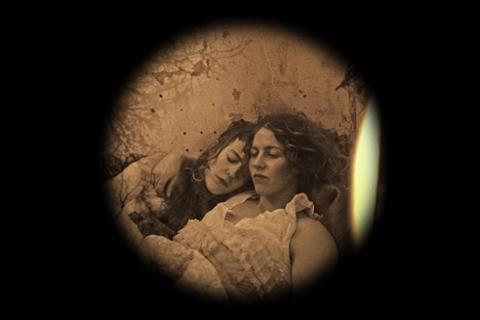
London, 1888. As Jack The Ripper terrorises the East End, an all-female ghosthunting group attempt to prove the murders are, in fact, being committed by a supernatural entity. That’s an intriguing premise, and UK debut feature director Joseph Archer (who also acts as cinematographer and editor) has decided to crank it up a notch by telling this story entirely in a 1:1 circle aspect ratio, to mimic the pinhole lens of a newfangled moving picture camera. It’s certainly inventive but, while everyone involved is committed to the endeavour, this narrow field of vision – plus the dramatic and narrative license needed to sustain it – doesn’t give Snapshot enough room to ever truly breathe.
Relies heavily on the novelty of its visuals
Premiering in Edinburgh competition, Snapshot (which shares its name with a 1979 Australian horror feature with which it shares themes of voyeurism and exploitation) is an ambitious step-up to features by Archer, whose horror-tinged shorts include The Cornucopia Club (2024) and Mean Spirited (2021). Its period found footage hook will likely win some more festival attention particularly from genre events and strands – it will next travel to the UK’s Frightfest. But it may well prove too niche to make much of an impact beyond.
Opening on-screen text informs us that, in April 2026, a box donated to the ‘British Film Archive’ was found to contain several reels of footage dating from 1888 which have been ‘cut, reordered and manipulated’. Luckily, several wax sound cylinders were also included, so the result is a coherent feature-length film with sound. That’s pretty impressive, given that it was shot in the same year that the earliest known motion-picture sequence – the jerky 2.11 second long ‘Roundhay Garden Scene’ – was created by Louis LePrince on his single lens camera.
In the world of the film, however, the conceit is that an unseen filmmaker named Tamworth (voiced by Tom Stourton) has got his hands on a motion picture machine, and is documenting the lives of several women. There’s Minnie (screenwriter Cathy Wippell), who is from a well-to-do family but prefers sneaking out to Whitechapel to spend time with best friend Fanny (Hazel Rogers). Fanny is a prostitute under the care of the kindly, no-nonsense Madam Evelyn (Nadia Laman); the girls are obviously terrified of the Ripper, but don’t have the option to stop work.
Together with Irish immigrant Molly (Lydia Brian) and wealthy spiritualist Constance (Rosie Johnson), they have become convinced that the killing spree is, in fact, the work of a malevolent spirit. Tamworth and his camera follows their investigations – séances in which they contact the murdered women, outings to creaking warehouses in search of evidence.
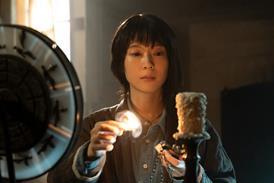
The resulting film is undeniably eerie, with the sepia texture and well-timed jump cuts giving the whole thing an unsettling air. Yet the fact that Tamworth can manoeuvre this cumbersome piece of kit with the ease of a digital camera is just one of the many hurdles Archer asks his audience to overcome, along with plenty of expositionary dialogue that’s needed to explain what’s going on beyond the camera’s reach. The film relies heavily on the novelty of its visuals; characters are thinly drawn and performances are stilted, likely because of the physical constraints of the claustrophobic aspect ratio.
Still, there’s some good stuff to be found here, not least a poignant commentary on the institutional misogyny and working-class poverty that puts these women at increasing risk from The Ripper and other malevolent entities, whether supernatural or earthbound.
Production company: Silicon Gothic
International sales: Alief, info@alief.co.uk
Producers: Joseph Archer, Chippy Babu, Suresh Cedrick Pereira, Mario Stefan
Screenplay: Cathy Wippell
Cinematography: Joseph Archer
Editing: Joseph Archer
Main cast: Tom Stourton, Cathy Wippell, Hazel Rogers, Lydia Helen, Nadia Lamin, Rosie Johnson