












Legendary producer Sigurjón ’Joni’ Sighvatsson reflected on working with filmmakers such as David Lynch and David Fincher during an in-conversation event at the Locarno Film Festival today (August 7).
Sighvatsson, who is in town to receive Locarno’s Raimondo Rezzonico Award, produced David Lynch’s 1990 Palme d’Or winner Wild At Heart, which screened last night in the Piazza Grande.
In 1986, Sighvatsson co-founded LA-based Propaganda Films with the late Steve Golin. It quickly became a production powerhouse that once produced a third of all music videos in the United States, including early works by Zack Snyder, Spike Jonze, Antoine Fuqua, Gore Verbinski and Michael Bay.
Sighvatsson went on to produce more than 60 feature films and TV series, fromTwin Peaks, Beverly Hills 90210 and Armistead Maupin’s Tales of the City through to Nicolas Winding Refn’s Valhalla Rising and Julian Schnabel’s Basquiat.
Born and raised in a fishing village in Iceland, Sighvatsson won a scholarship to study film at USC in Los Angeles, where he also attended the American Film Institute.
After leaving Propaganda in 1994, Sighvatsson was the first president of Lakeshore Entertainment. He later acquired Nordic distributor Scanbox, which is now run by his son Thor.
Music video pioneers
Sighvatsson studied literature at university, but said he turned to film because he couldn’t sit down and focus on writing books. “Everybody who’s in film, we have OCD and ADHD. If you look at a filmmaker, you know they have one of these traits, and I had both.”
After studying, Sighvatsson set up Propaganda. Finding it difficult to break into the closed studio film system that dominated the film industry at the time, he, and fellow film school graduates, started to make music videos for the then fledgling MTV. Very quickly, Propaganda became hugely in demand, with many young filmmakers cutting their teeth on music videos and commercials at the company.
“Propaganda was not really money-driven,” he said. ”What united us, and what later became the thing that unravelled Propaganda, was that everybody [wanted to] go on to make feature films. Everything we were doing… was all a quest to get to do feature films, particularly for David Fincher. Every video he did was a part of something he wanted to later incorporate into a film. He had this whole list - [he’d say] ‘I’m doing this scene because one day I want to shoot somebody on a plane…and they somehow inserted that into the video.’”
Recalling working with David Lynch, Sighvatsson said: “The thing that’s surprising about David Lynch is that he was very single-minded. If I’d say anything about David, I would say he was on a spectrum because he was so single-minded.”
He recalled Lynch funding his 1977 classic Eraserhead while a student at the AFI by using the school’s equipment and earning money by delivering The Wall Street Journal newspaper by bike.
Sighvatsson first worked with Lynch on a perfume commercial for Armani, which was meant to run for 30 seconds but was delivered at three minutes long. “Armani called to complain, and David said, ’Mr. Armani, I’m giving you something very special. You paid for 30 seconds. I gave you three minutes.’ Armani was a great man, very smart. He said, ‘I realise that it’s fantastic, and I’m gonna show it exactly the way you delivered it to me.’”
Wild At Heart
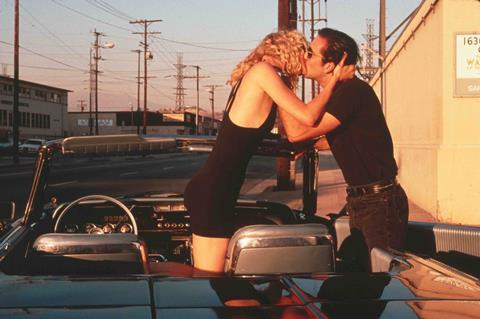
The first film that Sighvatsson and Lynch worked on together was Wild At Heart. The director had found working for producer Dino De Laurentiis on 1984 studio film Dune a ‘traumatic’ experience, vowing never to work for a studio again and to keep creative control at all times.
Sighvatsson optioned the rights to Barry Gifford’s book Wild at Heart and sent it to Lynch on a Friday. The following Monday, Lynch called back to say he loved the book and had started writing the script. “I said, ’David, we have to make a deal.’ And he said, ‘There’s no deal. I’ll just write it and then we make it.’”
Sighvatsson went on to pioneer international co-productions and VHS distribution to finance projects such as Lynch and Mark Frost’s ABC series Twin Peaks and Channel 4’s Armistead Maupin’s Tales of the City, becoming a high-end TV trailblazer at a time when many filmmakers turned up their noses at television production.
Giving his advice to young filmmakers looking to break into the industry today, Sighvatsson said there were similarities to when he started out.
“The film business was a closed case then, so we went in through the back door, through music videos, commercials, and all these weird television series and weird films. We didn’t break the system, but we managed to open the system.
“One thing that has always worked is, just go and make your own thing. Now you can do it on your phone. If you make something good - and now you can do it cheaply and [make it] personal – it will get heard. You will get there. Now you don’t need this big system around you to get people to see visually what you do.”
Sighvatsson, who now lives between Iceland and Portugal, continues to produce and has three films in the works, including two in post-production.




No comments yet