







Gabriel Tejedor’s expertly-crafted feature premieres in IDFA
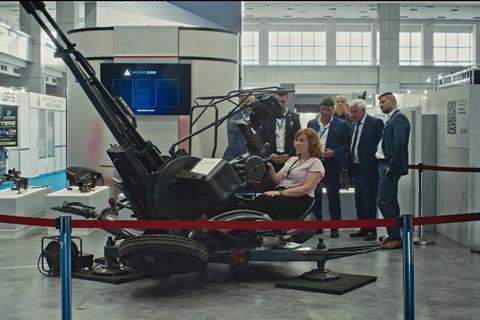
Dir: Gabriel Tejedor. Switzerland. 2026. 79mins
“Sometimes I wish we were making fridges, or bicycles”, says a factory worker while relaxing with friends on her day off. Instead, she and around 10,000 other inhabitants of the Bulgarian town of Kazanlak spend their working days making bombs, rocket launchers, assault rifles, ammunition and other accessories of war for Arsenal, the largest manufacturer of firearms and ordnance in the European Union. Many are destined for the Ukrainian army, fighting a war on a frontline quite close to home.
Approaches a hot topic with fresh eyes
Swiss director Tejedor’s fifth documentary feature approaches a hot topic with fresh eyes. Unable to gain access to the factory, he embeds himself in the community that supplies its workforce; a rural town that, ironically, is also famous for its damask rose production and summer Rose Festival – an event sponsored, naturally, by Arsenal. What emerges is a portrait of a place whose everyday conflicts and tensions are thrown into relief by the military-industrial complex at its centre, and kept front and centre by the regular explosions emanating from the vast weapons testing site that the factory backs onto.
Despite the secrecy surrounding the factory and its poor worker safety record – a subject that is only briefly touched on in the film – Tejedor takes a cumulative route, layering his purely observational footage in ways that forces the audience to do some rewarding work. It’s this intriguing journey, coupled with some high-quality production values – notably the warm lenswork of DoP Thomas Szczepanski and the austere, folksy choral soundtrack by Petar Dundakov – that will engage audiences with an appetite for good-looking, thought-provoking documentaries after the film’s premiere in IDFA’s Lightbox.
In a virtuoso opening shot, a forest canopy, viewed from above, is suddenly sliced across diagonally by four missiles. We cut to the Rose Festival, where an Arsenal spokesman talks up the company’s role in assuring the town’s future, boasting of exports to more than 120 countries. We cut again to shops and stalls selling – literally – guns and roses, to a juvenile dance troupe, to a graveyard, to the factory gates.
This pre-credit sequence, scored by a cheerful brass band march, is a taster of what’s to come: a work outstandingly edited by Christine Hoffet, using overlays not only of music but also scraps of recorded dialogue. At times these float so free of their speakers that we wonder who they should be attributed to. The effect, enhanced by Dundakov’s bracing choral soundtrack, is to create a kind of ’Our Town’ fresco from the disparate characters we meet and the urban landscapes we visit.
It’s a fresco that has its moments of droll, deadpan humour. When we first meet Pavlina, one of four or five characters the documentary homes in on, she seems to channel that very spirit, with her cheeky smile and jokey comments about what she’d do to her husband if she ever found him cheating. But her work in the factory and the fact that she spends part of her leisure time doing target practice at a shooting range, lends an edge, one that is honed as we learn more about her.
Two men who define themselves as pacifists – a local writer and Ukrainian car mechanic Viktor, who moved here with his teenage daughter to get away from the war – also take on complexity as our knowledge of them, and the town, piles up. Pacifism, these days, can be a codeword for support for Russia; shown to be rife in this Eurosceptic community. Viktor is seen relaxing by playing a shoot-em-up video game; at the same time, he probes his daughter about whether she’s the victim of bullying from pro-Russian schoomates. Meanwhile, we realise that in the Valley of the Roses, even an anti-Fascist intellectual can be casually racist – because if there’s one thing that appears to unite all the non-Roma townspeople of Kazanlak, it’s that “gypsies”are different.
The camera also follows a Roma woman, the widow of a factory worker who died of a work-related illness. Her dignity is touching. When a boss informs her – remarkably affably – what is wrong with her people, she simply smiles and endures. It’s this continual cross-stitching, this superimposition of guns and roses, tolerance and intolerance, conflicting systems of belief, industrial dehumansation and emotional intelligence, that makes The Big Boom! such an absorbing portrait of our confused times.
Production company: Mira Film
International sales: Lightdox hello@lightdox.com
Producer: Susanna Guggenberger
Cinematography: Thomas Szczepanski
Editing: Christine Hoffet
Music: Petar Dundakov