






UK-born Moritz de Hadeln, director of the Berlin International Film Festival from 1980 to 2001, has died at the age of 85 in Nyon, Switzerland.
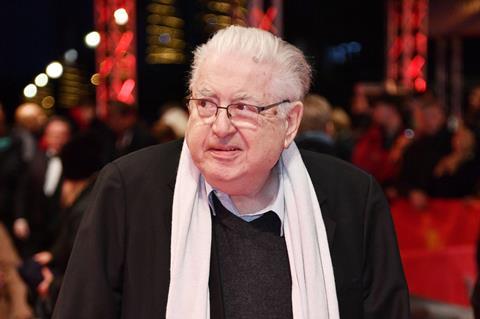
De Hadeln was the third festival director of the Berlin International Film Festival, otherwise known as the Berlinale. He succeeded the film critic Wolf Donner in 1979, taking over the reins of a festival that Donner had just moved from June to February.
During his more than 20 years overseeing the Berlinale, de Hadeln’s many achievements included relaunching the industry-focused Filmmesse as the European Film Market in 1988, to be run by Swiss exhibitor Beki Probst. He was also an enthusiastic supporter of the Teddy Award, which was first presented in 1987.
Based in West Berlin at the Zoo Palast, de Hadeln was able to programme films in East Berlin from the1990 edition following the fall of the Berlin Wall in November 1989.
De Hadeln was an early champion of the then-newly emerging Chinese cinema and invited films such as Xu Lei’s Strange Friends and Zhang Yimou’s Red Sorghum to Berlin. The latter became the first Chinese film to win the Golden Bear in 1998. In 1993, the Berlinale became a platform for a cultural rapprochement between China and Taiwan when de Hadeln welcomed Xie Fei, the Chinese director of Woman Sesame Oil Maker, and Ang Lee, the Taiwanese director of The Wedding Banquet on stage at the Zoo Palast as the joint winners of the Golden Bear.
One of the major logistical challenges facing de Hadeln and his team in later years was the preparation for the festival’s relocation from West Berlin to Potsdamer Platz in Mitte in East Berlin in time for the 2000 edition, which opened with Wim Wenders’ The Million Dollar Hotel.
However, the same year, Michael Naumann, the newly-reunified Germany’s first state minister for culture and media, suddenly announced de Hadeln’s contract would be terminated in April 2001, triggering widespread outrage within the film industry.
Former film fund executive Dieter Kosslick took over from de Hadeln, holding the post until 2019 when he handed over to the management duo of Carlo Chatrian and Mariette Rissenbeek.
De Hadeln became director of the Venice International Film Festival for the 2002 and 2003 editions and was finally the programme director of the only edition of the newly created Festival International de film de Montréal in 2005.
Early career
De Hadeln had begun his career as a freelance photographer for some years, and directed his first documentary Le Pèlé in 1963 before going on to work in various roles in the film industry in Switzerland and Germany.
In 1969, his career in the festival world began when he and wife Erika founded the Nyon International Documentary Film Festival, now known as Visions du Réel, for which he served as director until 1979. He also assisted his wife when she was head of this festival from 1981 to 1993.
De Hadeln also served from 1972 to 1977 as head of the Locarno International Film Festival Parallel, where he first met Probst, who organised Locarno’s trade show. He was instrumental in introducing the evening open-air screenings on the town’s Piazza Grande to the programme as well as several sidebar events such as the Fipresci week and INformation Suisse.
Looking back on his time heading up the Berlinale, de Hadeln said there were three films he had regretted not programming: Héctor Babenco’s Pixote, Giuseppe Tornatore’s Cinema Paradiso and Roberto Benigni’s Life Is Beautiful.
“The difficulty of being a festival director is that, on the one hand, you need a thick skin to withstand the constant attacks from critics, but on the other hand, you need to have the sensitivity of a child when watching films in order to choose the right ones,” he said in an interview with Christian Jungen, who wrote a biography of de Hadeln called Mister Filmfestivall.
“Sometimes these requirements come into conflict and you end up making the wrong decision.”
In his own publication Closing The Book which appeared for his final edition as the Berlinale head in 2001, de Hadeln was confident he had made his mark. “The festival’s film selection has, over the years, had a formative influence on the cinematic tastes of generations of festival-goers, not to mention the many talented individuals we discovered who are now pursuing careers,” he wrote
Indeed, filmmakers such as Stanley Kwan, Ang Lee and Andrei Zvyagintsev told Jungen they owed their international careers to de Hadeln.
“What a strange job it is to be a festival director,” wrote de Hadeln. “You work all year round for a few days of fleeting excitement, and if, unfortunately, it goes wrong, a whole year and your reputation are lost.”



No comments yet