











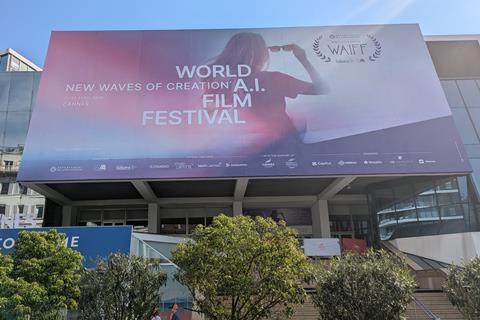
The second World AI Film Festival (WAIFF) showcased films, shorts, advertising and micro-series created using at least three generative AI tools, including one for image creation.
It took place from April 21-22 in Cannes.
A jury led by French filmmaker Agnès Jaoui and festival president Gong Li handed the best film prize to 12-minute short Costa Verde, a personal story about childhood from French writer-director Léo Cannone, produced by the UK’s New Forest Films.
Screen rounds up seven key talking points from the festival.
AI tools are evolving fast
“Last year’s best films wouldn’t make the official selection of 54 films this year,” said WAIFF artistic director Julien Raout of the quality of this year’s titles. “The tools have evolved faster than any technology we’ve ever seen in video creation.”
Last year’s inaugural edition attracted 1,500 submissions from 80 countries. This year, the numbers exploded to over 7,000 submissions, of which 1,300 were from South Korea.
However, films from US creators were thin on the ground. “Hollywood studios are scared,” suggested WAIFF founder Marco Fandi. “They should embrace AI and help the evolution.”
An edition of WAIFF is launching in Los Angeles in October.
Established filmmakers are turning to AI
Veteran French filmmaker Claude Lelouch talked about embarking on his 52nd feature using AI. “My last films didn’t do very well. Since I’m struggling to find money, I’m turning to AI,” he admitted. “AI is a camera that gives you images even before you’ve filmed anything. It will change cinema.”
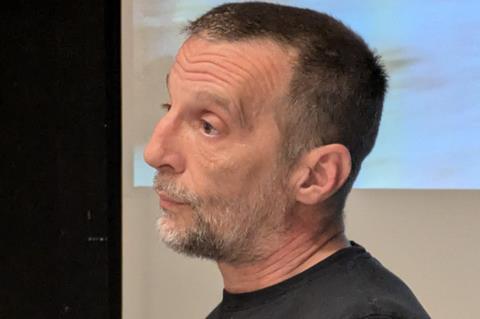
Actor-director Mathieu Kassovitz explained he had paused pre-production on his animated feature God Of War to build AI tools superior, in his view, to CGI.
“A project that might have cost $50-60m is now closer to $25m using AI,” he said. “But it is not just about cost. AI is also generating ideas. It becomes part of the creative dialogue.”
The key challenge was not image generation, he said, but control. “If I ask a character to move left, will it move left consistently? Can I actually make a full film this way? To do that, we need to build tools on top of existing models – layers, APIs, systems that allow us to control outputs precisely for filmmaking purposes.”
AI fears need to be faced
French filmmaker Jaoui said she felt “terrorised by AI and all the fantasies it represents,” which is partly why she accepted the invitation to sit on this year’s WAIFF jury.
“Whether we like it or not, AI exists and we might as well go and see what it is exactly, rather than being overwhelmed by our fears and rumours,” Jaoui said.
“To be an actor is unique in the way we are exposing our soul, and from what I have seen so far, there is no emotion in AI,” said actor and festival juror Elsa Zylberstein. “AI might work for action, VFX and period films, but not the human dramas that I care most about.”
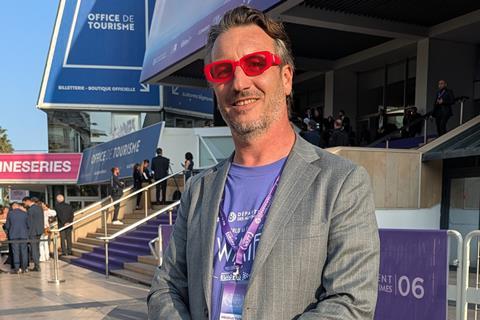
Yet Generative AI is advancing at pace. The AI‑generated characters in last year’s entries “looked wooden,” according to Raout. “Now you can feel emotion with micro‑expressions, proper lip‑sync and believable faces.”
Actors and craftspeople working in production design and cinematography will have to adapt, insisted Kassovitz.
“That’s how it’s always worked. When bluescreen came in, it changed sets. When digital cameras replaced film, it changed workflows. Every technological shift forces parts of the industry to evolve.
“Younger generations won’t necessarily care whether something is AI-generated or not,” he claimed. “Unless it’s explicitly labelled, they may not even be able to tell the difference.”
New copyright model is needed
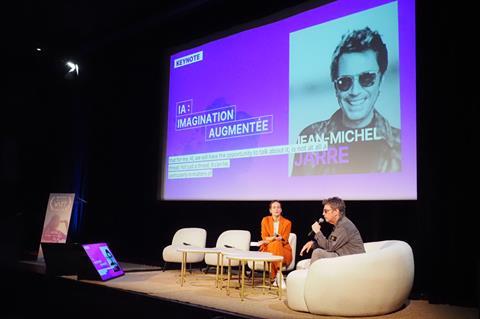
While evangelising the use of AI as “augmented imagination”, musician Jean-Michel Jarre, the festival’s ambassador, called for copyright regulation and artist remuneration.
“Human creation is the foundation of generative AI. At some point, we must stop being treated merely as data suppliers and instead be treated as business partners,” he said.
The need to establish rules for AI is urgent, he added. “We need to bring together cinema, music, books, video games, literature, journalism and reach global agreements. I don’t believe we can apply traditional copyright philosophy anymore, simply because most algorithms can no longer identify the exact origin of their sources. It will be difficult to demand traditional copyright remuneration. We need a new model.”
Launching a ‘Netflix of AI’
WAIFF insists its primary purpose is to surface new creators. Landi cited this year’s standout film Beginning, winner of the Emotion award, by Jordanian filmmaker Ibraheem Diab as an example of the unexpected voices emerging through AI‑enabled production.
“We received 86 films from Iran,” he added. “We want to provide a window for these new talents to show their creativity.”
WAIFF is developing its own online distribution platform which could launch in the next few months. “We want to launch a ‘Netflix for AI films’,” Raout revealed. “We already have at least 500 very strong films, far beyond the official selection, and we want to showcase them to audiences and be a place where creators can monetise their work and maintain control of their IP.”
As to whether audiences want AI content, Raout was in no doubt. “Young people are bored with low‑effort AI fakes. They want real creators using AI as a tool to tell meaningful stories. They want new voices with new ideas, not the same stories recycled by big production companies.”
Feature-length fiction AI films are coming soon
In 2025, WAIFF allowed submissions for films to be as short as one minute. This year, it raised the bar to 10 minutes for shorts while entries into the long-form category had to be at least 25 minutes long.
The winner of the long-form category was Napoléon III, Le Prix De L’Audace, a docu-series produced by Federation Studios, directed by Edouard Jacques, already broadcast on Canal+ and TV5 Quebec.
“We received some feature‑length submissions, but not many,” said Raout. “Next year, we’ll have full AI fiction features over an hour long.”
A technological tipping point may already have been breached. “For the first time, I cannot tell whether a shot was filmed or generated,” said Gilles Guerraz, CEO at AI training agency Nextrend. “The technology is here. But without artistic intention, AI alone won’t create meaningful work.”
Cannes provocation or cooperation?
The festival shifted location from Nice to Cannes just a few weeks ahead of the 79th Cannes Film Festival.
While WAIFF entries must include use of Generative AI, the Cannes Film Festival has outlawed the technology as a principal authoring tool. Nonetheless, AI is permitted for technical processes such as sound restoration, provided its use is acknowledged. Meanwhile, the Marché du Film’s Cannes Next program includes an ‘AI for Talent’ summit.
The lines are blurring. “One day, there will no need for a separate AI film festival,” said WAIFF’s Landi. “One day it will all just be film.”





No comments yet