












The growing number of social media creators moving into filmmaking is opening a new conversation about audience-building and how filmmakers connect with viewers.
While Hollywood has increasingly embraced creator-filmmakers through projects such as Curry Barker’s Obsession and Kane Parsons’ Backrooms with A24, the Arab film industry is only beginning to explore what that transition could look like.
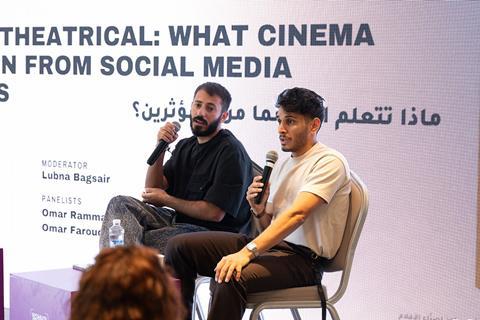
At the Amman International Film Festival - Awal Film, Bahraini creator-turned-filmmaker Omar Farooq and Palestinian filmmaker Omar Rammal offered two different perspectives on that shift, discussing how online audiences can become the foundation for independent filmmaking, while warning that success on social media does not automatically translate into sustainable film careers.
Farooq, whose 2025 feature Salem Not Salem was selected for Amman’s short competition, built one of the Arab world’s largest online audiences through his Omar Tries series, which has amassed more than two billion views and over 18 million followers across platforms.
Rammal, meanwhile, has leveraged his growing online following into an independent filmmaking career. His shorts, including Fatimah, Hajez, The Place and Home Sweet Home, have played at international festivals. His latest work, Kentucky Gaza, arrives at Amman after premiering at Clermont-Ferrand and screening at festivals including Brussels Short Film Festival and Short Shorts Film Festival & Asia. He is currently developing his debut feature.
In a panel titled From Viral to Theatrical: What Cinema Can Learn from Social Media Creators, Farooq and Rammal argued that, despite their different formats, cinema and social media share the same foundation: storytelling.
“Storytelling is the language of humans,” Farooq said, tracing the practice from early cave drawings to today’s digital platforms. The difference, he suggested, lies not in storytelling itself, but in how those stories are shaped and delivered to audiences.
Having moved from digital content into filmmaking, Farooq said the transition exposed him to the different demands of each medium, from storytelling approaches to production tools and standards of quality.
On the other hand, Rammal highlighted audience access as one of the biggest advantages social media offers filmmakers. The platforms, he said, can help artists build recognition before entering the traditional industry system, turning their online presence into a form of portfolio and built-in audience.
“Social media has become sometimes more important than a CV or portfolio,” he said, explaining that sharing his work online helped collaborators discover his skills and eventually led to professional opportunities.
But the discussion was not about replacing cinema with social media. Instead, speakers pointed to the need for filmmakers to better understand audience behaviour.
Jordanian Canadian producer Rula Nasser, founder of Amman-based production company The Imaginarium Films, said the key lesson filmmakers could take from creators is their ability to identify and understand their audiences. While cinema often starts by defining a target demographic, she argued that digital creators have developed a more direct relationship with viewers and a clearer sense of who they are speaking to.
Nasser, whose credits include Sara Ishaq’s Cannes 2026 Critics’ Week selection The Station, Holy Spider, Inshallah A Boy and Hajjan, is currently collaborating with Rammal on the development of his feature debut, inspired by his own family story.






No comments yet