

















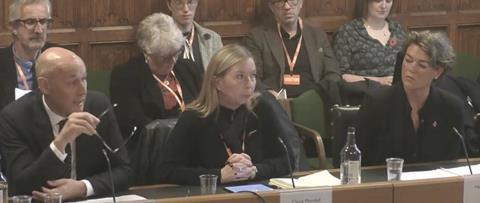
The UK production community is “very concerned” about what impact the proposed US federal tax incentive will mean for the UK industry, as stressed during a Culture, Media and Sport (CMS) Committee hearing in UK parliament yesterday (November 11).
Glasgow-based Claire Mundell, managing director of Synchronicity Films, was speaking in front of the cross-party committee alongside BFI deputy CEO Harriet Finney and British Screen Forum chief executive Pete Johnson, as a follow-up to the committee’s inquiry into British film and high-end TV, which ran from 2023-25.
“In the production community we are very concerned about the proposed US incentives that are on the horizon and what they will do to inward investment in the UK,” said Mundell, stressing the income producers receive from working on a service basis for these projects to help fund their own companies, as well as the skills and training opportunities they provide. Synchronicity’s credits include Sky series The Tattooist Of Auschwitz.
These concerns have been intensified by a slowdown in inward investment in the UK, as revealed in stats published on November 10 by the BFI highlighting inward investment spend on film in the UK was down 40% in the first nine months of 2026, compared to 2025.
“We are seeing a global reduction in commissioning. Hollywood is commissioning less around film and HETV,” said Finney. “The key thing is the UK’s market share remains robust and high, but we do need to think about the competitive environment that is around us.
“We are definitely seeing other territories who look to the UK as an absolute model of how the production landscape can be shaped around skills, around workforce, around talent, and importantly around the tax incentives as well. Ireland, our neighbouring territories in Europe, Australia, definitively are much more competitive environments, as we look ahead also to the US federal tax incentive.”
“The trick we need to pull off is to retain and build that inward investment – we don’t want to lose any of that,” said Johnson. “But also, to recognise we need a stronger domestic economy.”
Across the whole of 2025, 91% production in UK inward investment and only 7% was UK production. In the first nine months of 2026, the BFI’s stats also showed that spend on local UK features in Q1-3 2026 was down by 17%.
To help bolster local UK production, Johnson advocated for an extension of the research and development (R&D) tax relief to film. It is currently limited to companies investing in scientific or technological innovation. He believes it would have “a significant impact” and noted other countries already allow their creative companies to claim R&D relief.
Finney said a report on what the impact of the introduction of the Independent Film Tax Credit (IFTC) in 2024 will be published next year.
Mundell added, “Very specific British cultural stories are the hardest to fund at the moment” via the market, and in particular, “anything with a regional accent become very dependent on low budgets”.
Problems around support for the distribution of UK film was also acknowledged. A BFI box office report published on November 10 revealed that from January to September of this year, the market share of UK qualifying independent films at the box office was 6.8%, compared with 7.5% for the same period last year
“UK films are not cutting through at box office,” said Finney, with chair of the committee, Conservative MP Caroline Dinenage, noting recent disappointment in the industry that a prints and advertising tax relief to help with distribution costs for independent film was not introduced in the autumn budget, as had been expected.
UK government “open-minded” about AgoraEU
In the second part of the committee session, creative industries minister Ian Murray was asked about whether the UK would consider joining the media strand of AgoraEU. The CMS committee’s inquiry into British and high-end TV film published a list of recommendations to the government for the sector in 2025, of which rejoining AgoraEU predecessor Creative Europe post-Brexit was one.
“They don’t know what the final structure of that will look like, or what the cost will be,” said Murray of the new-look AgoraEU.
Pushed by Dinenage on whether the UK has completely ruled out joining, Murray said, “We have at this stage – but we are open minded to see what it looks like.”
He also left the door slightly ajar to a UK streamer levy, something both the last Conservative government, and the current Labour government, have repeatedly shied away from.
“We did rule out a streamer levy… we don’t believe at this stage that mechanism is needed, because you can see significant investment coming into the country with all of that matrix of funding,” said Murray. “It’s been ruled out at this stage – but given the way in which the market is going, given that fragility, we’re always looking at whether or not the tax relief system and the environment is conducive, and we will continue to do so.”
Dinenage also pressed Murray on how front-footed he has been in advocating for the sector with Treasury, on issues such as tax incentives. When asked how many times he has met with his equivalent minister in the Treasury department – having taken on this role in September 2025 – Murray said he had done so just once, before the summer.
“Not good enough,” responded Dinenage.
National Lottery assurances
Murray did give some positive assurances about National Lottery funding. A review into how the National Lottery allocates its funding is currently underway. National Lottery ‘good cause’ funding makes up around a third of the BFI’s budget.
“The National Lottery review will not affect people’s funding as it sits at the moment,” said Murray. “This is a review of what will happen with additional future funding. The core money that goes to the BFI will not fall as a result of the work we are doing with the National Lottery review.”
“Us working better with other lottery distributors is really a key as part of that,” said Finney, of how the BFI can make the lottery money work harder. “Us working better in local communities, with local decision makers, is really important.
“The one thing I would say, in terms of the share – we have 2.7% of the share, that’s £50m. Only 10% of the applications we receive can we meet. In some of the programmes, it’s only 3%.”





No comments yet