






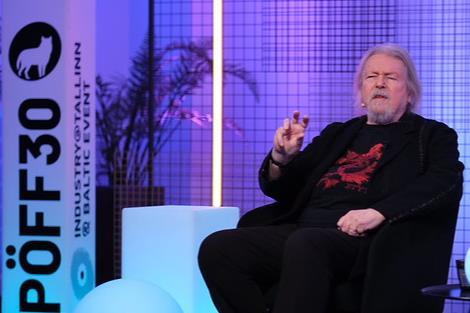
Generative AI may be unsettling Hollywood screenwriters and provoking anguished debate about ethics and originality, but Christopher Hampton, the Oscar-winning UK screenwriter of films including Dangerous Liaisons, Atonement and The Father, gave it very short shrift in a talk called From Stage To Screen: The Art of Adaptation at the opening of Tallinn’s Discovery Campus 2026.
Hampton refused point blank to engage with the AI debate.
“Artificial intelligence is not a subject that has troubled me very much. I am more interested in real intelligence,” he told an audience including many young Discovery Campus participants. “The flaw in artificial intelligence is in the name, because it is artificial. I don’t think there is any replacement for original creativity. For me, it is nothing other than a Super Google.
“Our work is more interesting than its work,” he insisted.
AI, though, would not go away. During the 90-minute session, he faced further questions on the subject and again parried them.
“Never forget that anything worthwhile is extremely difficult,” he underlined. “There is no such thing as an easy script to write. The more difficult the challenges you set yourself, the better the result will be. You have to choose what is difficult. Of course, if you write a script with AI, you are choosing something easy, you’re being lazy. You’re allowing some other external force to take over. You might as well choose a different profession and just do something else.”
Hampton claimed he only started to write good screenplays when he realised how hard it was. “When I thought it was not so difficult, the results were poor. What you are doing as a screenwriter is an incredibly difficult job and you have to understand that, respect its difficulty and embrace its difficulty.”
In a wide-ranging discussion, Hampton also touched on everything from his collaboration with David Lean on Nostromo (a film never made because of Lean’s death) and some sharp advice he was given by legendary Hollywood director Fred Zinnemann (High Noon, From Here To Eternity) early in his screenwriting career, namely, cut the flab.
“We have one job and one job only, and that is to tell a story,” Hampton said Zinnemann told him when he was a young screenwriter working on a script about the last days of the Second World War. The project was later cancelled by a new studio head.
“What Fred Zinnemann was interested in was narrative. I worked with him for nine months, and he was absolutely relentless. He went through scene by scene and cut everything that wasn’t completely germane to the story.”
Hampton also reminisced about how he broke his toe after kicking a piece of furniture in anger that Milos Forman was planning Valmont, a film of Dangerous Liaisons. At the time, he was already hard at work on his screen adaptation, based on his play, which he had adapted from the classic 18th-century epistolary novel by Pierre Choderlos de Laclos.
“I was really furious about this because I had actually seen Milos at my play on the first night on Broadway…it seemed not the best way for one artist to treat another, to take this project and announce he was going to do it.”
In the event, the Hampton version, directed by Stephen Frears, came out first and did much better business.
The youngest writer to have a play performed in the West End, Hampton, now 80, remains as busy as ever. Early next year will see the release of Istvan Szabo’s Embers, starring Viggo Mortensen and Ralph Fiennes. Hampton wrote the screenplay 20 years ago. In this case, his challenge was simply to capture the “essence” of Sándor Márai’s 1942 novel, which he describes as “an absolute masterpiece.”
Not that screen adaptations are getting any easier.
“Each film creates its own set of rules,” he warned the Discovery Campus participants. “You have to really respect what the film is telling you about itself. If it’s going well, about two-thirds of the way through, it starts to tell you what it is about.”






No comments yet