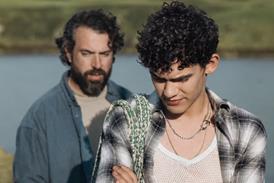
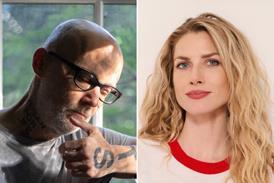
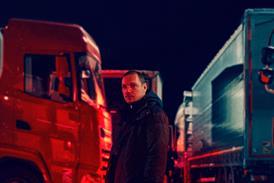
The Netflix-backed film marks the debut feature for both, as director (Winslet) and writer (Anders) respectively.

Kate Winslet and Joe Anders

Source: Phillip Faraone / Getty Images / Kimberley French / Netflix

Kate Winslet and Joe Anders

Actors used to be reticent about their children entering the film business, at best letting them forge a path for themselves. But this year has seen two examples of a more dynamic, supportive relationship between a famous parent and their child. In addition to Ronan and Daniel Day-Lewis’s Anemone, Kate Winslet directs and co-stars in Goodbye June, from a screenplay by her son, Joe Anders, who turns just 22 this month.

The bittersweet family drama represents a major career development for both. Some 33 years into her acclaimed acting career, Winslet makes a typically assured directing debut on the Netflix-backed film, which released in UK cinemas on December 12 and streams from Christmas Eve. Anders had barely started acting – with small roles in Lee and his father Sam Mendes’s 1917, and a leading role in romantic comedy Bonus Track – when he decided to take a step back and join a screenwriting course, little expecting his first ever feature script to actually be filmed.

The result features a rich ensemble of Winslet, Andrea Riseborough, Toni Collette and Johnny Flynn as chalk-and-cheese siblings, gathering around their dying mother, played by Helen Mirren, with Timothy Spall’s errant dad propped up in the corner. The question: can the dysfunctional clan settle their differences as Christmas approaches?

Winslet and Anders spoke to Screen shortly before a family outing to a Radiohead concert in London. And family, on screen and behind the camera, was very much the theme of the conversation.

Screen International: This time last year, you were enthusing about your first experience as a producer, with Lee. Did you know then that you were about to direct?

Kate Winslet: Yes, I did. I was in the throes of pre-pre-production, but not telling anyone about it. I was quite pleased to be under the radar. Contrary to possibly popular opinion, I don’t particularly like attention. I wish I could just do the work and disappear off again into the shadows and make a cup of tea. I was trying to prep a film that didn’t have a particularly big budget, with all these wonderful actors, and all these children, knowing I was shooting for the first time as a director and producing it and playing one of the characters, and we only had a 35-day shoot, and I only had Helen Mirren for 16 days. There was the pressure of feeling, “Oh my god, how am I going to do this?”

Was it this script that encouraged you to make the leap?

Winslet: It was. I suppose I had been thinking about directing, because other people kept telling me that I should. I remember Danny Boyle on the set of Steve Jobs sidling up to me one day and saying, “When are you going to do it? You know you think like a director.” And a couple of actors might say it, and crew members. Lydia Currie, who was the first AD on [HBO Max miniseries] The Regime, was like, “Come on, get on with it.”

I think being so hand in hand with [director] Ellen Kuras on Lee, as a producer, working so closely and collaboratively, gave me more of a feeling of possibility, for myself. But I didn’t know that a script was going to come to me through quite unusual channels, in the form of my son, and I was going to have the very personal reaction that I did.

Joe Anders: I was just wanting to share it with you. I didn’t hand it to you with the idea of it ever being made, so the fact that it actually has been made, and is a real piece of work that people are going to see soon, is insane to me, because the whole thing started with me going, “Hey mum, what do you think of this?”

Winslet: He did also say, “It’s a first draft, I don’t think it’s any good.” And he still had another 20 pages or so to hammer out. But I was taken by how real the story was, how relat­able all the characters were, also how he had somehow been able to weave in humour around a subject that so rarely has humour. It’s not a cancer film or a film about somebody who is dying, it’s a film about something that’s happening to an entire family. Joe had carved out very clear characters who were all experiencing their own version of the situation based on where they sit within this difficult family structure.

He also captured the sense of monotony in those [hospital] spaces that you do live through, which I have lived through, when you’re dealing with somebody who has a terminal illness. I said to him, “Well, we’re going to make this.” And he was like, “No, what are you talking about? Don’t do that mum thing.”

Were you always going to direct?

Winslet: I was going to produce and play one of the sisters, but we didn’t have the conversation about me directing, because I didn’t consider myself a candidate for that. But then, after about a year of giving notes to Joe, and him redrafting and shaping it, we got to a point of, “Okay, who do we go to first?” And I suddenly realised I couldn’t let it go.

Let’s go back a step. Joe, you’d been acting for a short while, but had writing always been on your mind?

Anders: Yeah, absolutely. I’ve always loved writing. It was probably more at the forefront of my mind, until the opportunity to act came along, and I started doing loads of auditions. And then I landed a job when I was 18 – Bonus Track for Sky. I had just left school, and suddenly I was a working actor in York. As much as I enjoyed doing the work, by the end of it, I realised I needed to take a moment and reevaluate what I actually wanted to do.

It was my sister Mia who said, “You’ve always written stories. Why don’t you try to write a script?” And then I talked to my dad about it, and he mentioned the National Film and Television School as a great institution, and how they do these shorter courses in London, and there was this one called Screenwriting: Finding Your Voice. And I got in. We were encouraged to write from the heart and this story just came tumbling.

The germ of the script was your grandmother’s – Kate’s mother’s – illness and death.

Anders: Yes, the period when my grandmother passed just really stuck with me. I must have been about 13, so I wasn’t quite the age of being able to have those kinds of conversations that you see in the movie. But the feeling of being in that hospital room with my family, and realising the only thing that mattered in that moment was that we were all there for my Nana, my grandmother, I remember that feeling really hitting me. And that became the emotional backdrop. 

Kate is one of three sisters and a brother, just like the siblings in the film. How close are the characters to the real thing?

Anders: The dynamic of the family does mirror the dynamic of mum’s family, but all those characters are totally fictional. I’d say that in each character, there are probably five or six people I’ve met in my life.

How did the Christmas setting come about?

Anders: It just came out in the dialogue when I first started writing. That line, “I saw the birds outside and I thought to myself, should we have goose for Christmas instead of turkey this year?” is something I felt June would say. And Christmas just ended up becoming a theme.

Goodbye June

Source: Netflix

‘Goodbye June’

It does mean you now have two Christmas films in the family. Kate, is The Holiday essential family viewing in your household?

Anders: I’ve never seen it.

Winslet: [laughing] I don’t encourage my children to watch my films. It’s like a judge saying to a child, “Why don’t you read this case law.” And I don’t sit and watch myself in films. I think that would be a strange thing to do. The only film of mine that we have all sat and watched together as a family, which is because Ned [Winslet’s husband, Edward Abel Smith] insisted on it, was Sense And Sensibility.

Anders: I also watched Heavenly Creatures with you and Mia.

Winslet: Oh yes.

More seriously, Kate, this seems to be a very mature and atypical script for a person of Joe’s age, dealing as it does with family, death, caregiving.

Winslet: Yes, it is, but Joe is a very mature young person, and he has always been very observant of other people. His capacity to really intuit the character of a person was apparent from very early on. Even when he was younger, he would be writing about people, about characters. I am bigging up my son here, but Joe is also a very empathetic person who’s good at looking after people. I’m extremely proud of that side of him.

Joe, had you ever been on Kate’s sets?

Anders: Yeah, when I was younger, I watched mum act in front of a camera. But not that often, to be honest. Mum was always keeping her head down at work and I think we were a bit of a distraction. She concentrates so hard.

So how was this a very different experience, being there as a colleague?

Anders: It took a moment to adjust, obviously. Our relationship is great, but it’s a mother-and-son relationship, so this was a new dynamic to figure out. We never had any clashing-head moments, I found it a lot easier than I thought I would. Getting notes from her and creatively being involved with the project together was amazing. And both of us doing this for the first time bonded us through how terrified we were. But mum totally smashed it out of the park with the directing. The kids’ performances are so believable. I don’t think anyone [else] would have been able to pull that off.

Winslet: I wanted to establish a working environment for those children that felt like an extended play date for 35 days. I said to Joe, “You have to understand, I’m not going to get the children to learn these lines.” The thing with kids, and I know this having worked with children a lot as an actress, is if you get them to learn something they can never unlearn it, and they say it the same way every single time. And that’s not what this film needed to feel like.

And Kate, how did you find directing yourself?

Winslet: Weird! I had pretty much learned the script like a play before we started shooting. I was just ready with my options up my sleeve and made sure I gave myself plenty of choice when I got into the edit. 

How many of your adult cast had you worked with before?

Winslet: I worked with Andrea on Lee and The Regime, so we’d been in each other’s rhythm of working for a while. Andrea read the same first, unfinished version of the script that I read. She immediately said, “Please, can I play Molly?”, which made me realise I’d love to play Julia, because then I’d be together with Andrea.

I had worked with Helen before, a very long time ago, on a film called Collateral Beauty, but we only shared one scene together. Asking her to play June was a very frightening moment, because I was aware she had significant work immediately before and after our shoot, so I had to manage our expectations. But Helen has a phenomenal reputation for being a mensch and a great supporter of other women in film… She was really happy for me that I was directing for the first time.

I approached Tim Spall and Helen almost simultaneously, because I couldn’t imagine Bernie and June apart. I’d worked with Tim in Ken Branagh’s Hamlet. I’m a huge admirer of his work and, in fact, when I thought about the tone of Goodbye June, I did keep thinking about Secrets & Lies. I was inspired by how Mike Leigh is utterly unafraid to stand back and let us observe the people in front of us, to let it all unfold. I knew with Goodbye June, I had to be unafraid to do that.

Any other inspirations?

Winslet: I also thought about Four Weddings And A Funeral – you know, the mess of it, the sometimes mad, odd humour that you find in moments of crisis that is very true to life. I know, because I have gone through some of that.

What’s next?

Winslet: A nice lie-down, I think.

And Joe, which is it to be, acting or writing?

Anders: After I wrote this, I ended up landing a couple more acting jobs [including Zoe Kazan’s Netflix adaptation of East Of Eden], which I enjoyed doing. So, you know, I adore both things. East Of Eden is an adaptation of the entire novel, and what Zoe did with it is singular and beautiful. I am just starting to try to write something else, but nothing concrete yet. I’m still dreaming.