














Scott Stuber has switched back and forth from producer to studio executive, and combines both roles at Amazon MGM Studios’ United Artists. The Oscar-nominated Frankenstein producer explains all to Screen.
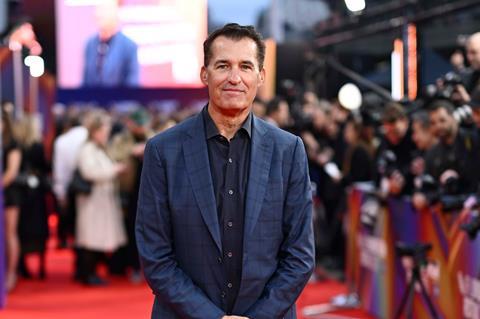
In his time, Scott Stuber has been a topline executive at both a legacy studio and a streaming giant. But being a hands-on producer is the role that gives him real job satisfaction. “I like doing script notes, I like working on cuts of films, I like the nitty-gritty of storytelling,” he says. “It’s something I think I’m pretty good at and I don’t like being too far away from it.”
It was as a producer that Stuber began his long journey with Guillermo del Toro’s Frankenstein. In the early 2000s, under the producing deal he had at the time at Universal Pictures, Stuber was working on The Wolfman, a remake of one of the titles in the studio’s library of classic monster films (which also includes the 1931 Dracula starring Bela Lugosi and James Whale’s Frankenstein with Boris Karloff from the same year). When the original director dropped out, Stuber wanted old friend and horror aficionado del Toro (who had his own deal at the studio) to step in, on The Wolfman and perhaps other monster remakes as well.
“I thought Guillermo could be the right person because I knew of his affinity for monsters,” says Stuber. “We had this big ambition that he and I would do all of them.”
That plan never got the greenlight (The Wolfman ended up being directed by Joe Johnston), but del Toro’s take on the Frankenstein tale was revived 15 years later at Netflix, where the Mexico-born filmmaker was already working on his animated Pinocchio and Stuber was serving as chairman of the streamer’s film division. And though Stuber moved on from Netflix just as Frankenstein began shooting, he remained on board the project at del Toro’s insistence. “Guillermo said, ‘This has been a 20-year journey for us and when this movie gets made you have to stay and produce it with me,’” recalls Stuber.
Getting the ambitious passion project — with a reported $120m budget — to the screen involved more than just patience, of course. Among the challenges for Stuber and fellow producer J Miles Dale was accommodating del Toro’s preference for practical production solutions, such as real sets and costumes rather than digital enhancements, during filming at studios in Toronto and on location in Canada and the UK.
There was also a late cast change to negotiate when Andrew Garfield, originally set to play the story’s tragic monster, dropped out because of a scheduling conflict. Recasting the part with Jacob Elordi “was a chance [ie risk] in some people’s minds”, admits Stuber, who knew the actor through his involvement in Netflix’s Kissing Booth romcom trilogy, “but it wasn’t, in my mind”.
The producing task was made easier by working with a filmmaker who values co-operation and accepts feedback. Del Toro, who has more credits as a producer than he does as a director or writer, “is a remarkably collaborative human being”, reports Stuber. “We went back and forth a lot with notes on the script and on the cut. It’s a very constructive, collaborative conversation which doesn’t have a lot of drama — which those conversations sometimes do have.”
Awards recognition
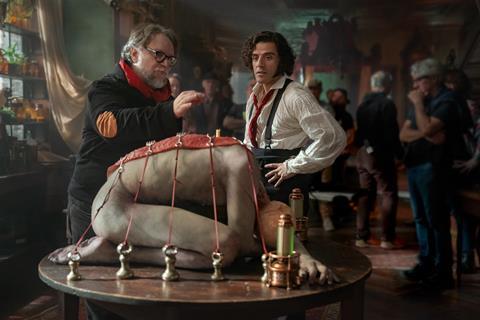
The Frankenstein journey has been rewarded with eight nominations at Bafta and nine at the Oscars, with del Toro, Dale and first-time nominee Stuber personally up for the best picture Academy Award and the Producers Guild of America’s live-action feature honour.
Since Frankenstein, Stuber has produced two other features under his Bluegrass Films banner: Bruce Springsteen: Deliver Me From Nowhere, last autumn’s rock biopic from Scott Cooper for Disney’s 20th Century Studios; and Sam Esmail’s thriller Panic Carefully, starring Julia Roberts, Eddie Redmayne and Elizabeth Olsen, now in post-production, for Warner Bros.
A big focus, however, has been the finance and distribution partnership the producer formed in the summer of 2024 to revive Amazon MGM Studios’ United Artists (UA). The partnership calls for Stuber’s new — yet to be named — company to make several films a year under the UA label, for release theatrically and through the studio’s Prime Video streaming service. Stuber will also be involved in all other projects released by UA.
After Netflix, which he exited in March 2024, Stuber’s goal was to find backing for a new production venture with its own development fund “so that I could choose and make the things I wanted to do”. Amazon MGM, he says, offered to build that element into the UA partnership. It also offered access to a global distribution network, thanks to its plan, already in place at the time, to build its own international theatrical infrastructure.
“In all of my meetings it was the one place that said they wanted to increase their output,” notes Stuber, “which was appealing in a business that’s kind of contracting. And it felt like a place that would support the kind of movies I wanted to make.”

Though nothing has yet been set for release under the revived UA label, a number of projects are in the works. Already in production in the UK is Highlander, a reboot of the 1986 fantasy adventure with John Wick director Chad Stahelski at the helm and Henry Cavill starring. And shooting could start later this year for Heat 2, Michael Mann’s follow-up to his 1995 crime classic, with Leonardo DiCaprio headlining.
In preparation are projects including family fantasy Lizard Music, from The Smashing Machine teaming of director Benny Safdie and star Dwayne Johnson; Tesseract, another Sam Esmail-directed thriller; and a political thriller about Evan Gershkovich, The Wall Street Journal reporter who spent a year in a Russian prison, to be directed by Edward Berger, whose All Quiet On The Western Front was one of Stuber’s notable successes at Netflix.
The partnership gives Stuber the flexibility to take projects elsewhere if they do not fit Amazon MGM’s needs, and to make films specifically aimed at the streaming market alongside those made for theatrical release. “I do believe certain stories are meant for the big screen,” he says, “but there are certain things I want to do in the streaming space — like comedies — that aren’t obviously theatrical movies right now.”
It also allows him to operate primarily as a producer while benefiting from the support of a studio framework. “One of the hardest things about running a big studio is the higher up you get in the hierarchy, the further away you sometimes get from the storytelling process. And that storytelling process is something I really enjoy,” he says.
“But I like that the company is structured like a studio, that we can work intimately with the filmmaker, we can protect the filmmaker, we have the final cut on the narratives. And Mike Hopkins [head of Prime Video and Amazon MGM Studios], Courtenay Valenti [the studio’s head of film, streaming and theatrical] and Sue Kroll [head of marketing] are great partners, so we talk about what we’re all trying to accomplish, and it feels like that’s the best way to get to the right endgame.”
The UA partnership is the latest chapter in a 35-year career that started in earnest at Universal, where Stuber worked his way up to become vice chairman of worldwide production with responsibility for films including A Beautiful Mind and Meet The Parents as well as the Fast & Furious and Bourne franchises.
During his stint as a Universal-based producer, he delivered hits such as Ted and Central Intelligence. Over his seven years at Netflix, latterly as chairman of Netflix Film, he grew the streamer’s feature reputation with awards contenders such as Martin Scorsese’s The Irishman, Noah Baumbach’s Marriage Story, Rian Johnson’s Glass Onion: A Knives Out Mystery and Alfonso Cuaron’s Roma.
Asked about reports that he parted ways with Netflix over theatrical strategy, Stuber responds: “I had a great time there and I have great admiration for [company co-CEO] Ted Sarandos. I did feel like there was not much else to do in some ways. We had been nominated for Academy Awards, we’d had big hits and I did want us to evolve into that space. It wasn’t every movie, but I did feel there was a place for some of those movies in the cinema, and a place to build long-term IP and a lot of things that come with those kind of films.”
Gold standard
Screen was speaking to Stuber before Paramount won the battle to acquire Warner Bros ahead of Netflix. As a Los Angeles native who got his first industry job in Richard Donner’s Warner Bros office, Stuber has a keen sense of Hollywood history and sees Warner Bros, together with its HBO small-screen arm, as “the gold standard of film and television. So whoever buys it, I want them to maintain it. The water tower, the legacy, the storytelling acumen — those are gardens that need watering and I hope whoever wins it recognises that.”
A sense of industry history is also behind Stuber’s involvement in the British Film Institute (BFI), of which he has been a board member for the past four years. The BFI’s funding of young filmmakers is, he suggests, “imperative”, and the institute’s archive “is such an important part of our heritage as storytellers”.
With his term on the main BFI board coming to an end, Stuber is now set to transition into a new role as a governor of BFI America, the institute’s newly launched Stateside non-profit with its own board including longtime James Bond producer Barbara Broccoli and filmmaker Terry Gilliam.
When it comes to issues facing the industry in the immediate future, Stuber is “always a glass-half-full person”. The threat of a summer strike by US actors and writers is a major concern, he concedes, “because we hurt ourselves with the last one. We’ve got to rebuild the habit of going to the movies and have a healthy release calendar so the consumer feels there is something there for them consistently. Another work stoppage and break in the flow of film and television is not something we need right now.”
AI, shortening attention spans and changing consumer habits are also real issues, he acknowledges. Yet to a large extent, he suggests, the fixes lie in the industry’s own hands. “There’s a lot of conversation about the consumer moving to the home and away from the theatre, and some of that is true,” he says. “But the consumer is looking to the theatre for the stories that he or she wants and it’s incumbent on us to continue to find those narratives, to engage different audiences — women, people of colour, young people — and make sure they feel like their stories are being told when they go to the cinema.”






No comments yet