












French filmmaker Nolwenn Hervé’s feature follows Carolina as she fights to support the mothers of Maracaibo
Dir: Nolwenn Hervé. France. 2026. 95mins
The healthcare system in Venezuela has all but collapsed. A heavily pregnant young woman will only be admitted to hospital for urgent care when she has blagged specific items from shops and black market suppliers; a scalpel, a bag of blood, fentanyl, gauze, an ID bracelet for a newborn infant. Against these challenges, one woman is fighting to secure maternity care for the poor and disenfranchised mothers in the city of Maracaibo. A former gang leader-turned-feminist activist, Carolina is a formidable, forthright, hilariously foul-mouthed guide to Venezuela’s broken infrastructure. The first feature-length documentary from French filmmaker Nolwenn Hervé, The Cord is a suitably gritty portrait of a remarkable woman.
Carolina’s combative personality and boundless energy inform Hervé’s filmmaking style
Carolina’s combative personality and boundless energy inform Hervé’s filmmaking style. It opens with a sequence that feels as breathless and urgent as a thriller and rarely lets up its propulsive pace. Shot largely undercover, the film casts light on the realities of life in a country that suffered a dramatic economic crash in the past decade or so, resulting in the mass exodus of over half of the country’s doctors. The whims of President Trump having already placed Venezuela in the headlines, this should be a title of considerable interest following its premiere in the main competition of CPH:DOX. Further festival exposure seems likely, and a theatrical or streaming release is possible.
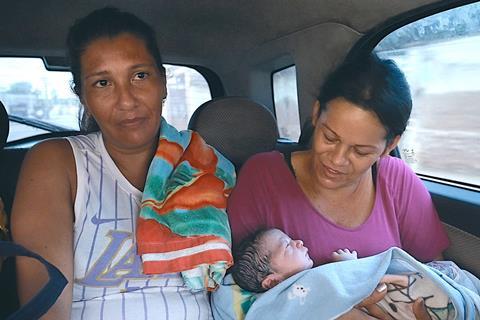
Charismatic and frequently terrifying – “Careful not to cheat on her or I’ll cut you into pieces,” she warns her daughter’s husband, who is currently working in the US – Carolina is a fascinating subject. She is also a woman of contradictions. Fervently religious, she regrets the mistakes of a teenage gang years, but she is also aggressively sexually candid and fond of a tipple. There’s an incredible scene in which Carolina and her right-hand woman, Yannis, both gleefully and uproariously drunk, hurtle around the nighttime streets of Maracaibo by car, collecting medical supplies and verbally harassing any men they encounter.
The intimacy of the material captured by Hervé, who shot the film as well as directed it, is a testament to the degree of trust that she built with both her subject and the women supported by Carolina. Much of the picture plays out in Yannis’ car; Hervé’s camera deftly negotiates the tight confines of the vehicle as it races from hospital to hospital and flings us into Carolina’s frontline conflict with the medical establishment.
Most of the time spent on the road is a matter of urgency, with crying women in full labour crammed onto the car’s back seat, and punchy music choices adding to the picture’s breathless momentum. But Carolina also advocates for preventative measures – following a baptism service for one of the children she helped into the world, she hauls the mother, plus four other women she pulls from the street, to get IUD contraceptives fitted. And when all else fails, she goes into battle, bringing a crew of vocal women and a picket line to protest at one of the most notorious hospitals. It’s there that the cost of the medical establishment’s callous treatment of mothers-to-be is brought into sharp and unforgiving focus.
A final section, in which Carolina visits an elderly indigenous woman to learn about traditional medicine, sits a little awkwardly with the rest of the picture, perhaps because it’s the only part of the film in which this dynamic force of nature takes a supporting role in her story. Still, Carolina’s plan to open a maternity clinic of her own leaves us with a note of optimism. If anyone can fix a chronically broken healthcare system, it will be Carolina – and a grassroots army of women like her.
Production companies: Grande Ourse Films
International sales: Grande Ourse Films
Producer: Estelle Robin You
Cinematography: Nolwenn Hervé
Editing: Rafael Torres Calderón
Music: La Chica


