
















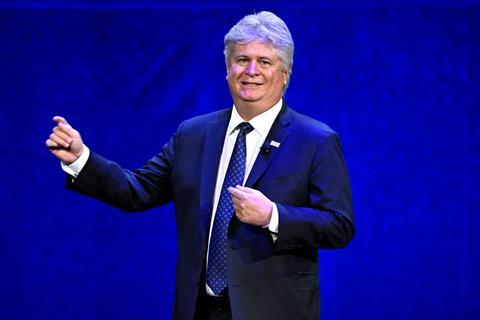
Cinema United president and CEO Michael O’Leary and Motion Picture Association CEO Charles Rivkin used CinemaCon’s state of the industry session on Tuesday to emphasise the promise of the film industry, while also addressing the challenges of consolidation, windows, and copyright theft.
Year-to-date North American box office currently leads 2025 at the same stage by 23% according to Comscore, and analysts Gower Street have forecast 2026 global box office will reach $34.7bn, down slightly from their initial $35bn estimate due to a slow first quarter in China.
“Theatre owners work every day to make their cinemas special, from reinvesting in technology and infrastructure to special events,” said O’Leary. “And not surprisingly, audiences are responding.” He cited the importance of unity, and hailed the recent Cinema United Filmmaker Leadership Council led by Jerry Bruckheimer and Emma Thomas.
Yet despite all this and an anticipated blockbuster summer, O’Leary directed his attention to consolidation in his annual speech at Dolby Colosseum in Caesars Palace, a subject he has addressed several times in recent months and one that reared its head on Monday when Hollywood luminaries signed an open letter protesting the proposed $110bn Paramount-WBD merger.
“Further concentrating marketplace power in the hands of a smaller group of distributors that dictate the terms, windows, scheduling, screen-placement, and access to historic film catalogues will have a real and lasting impact on Main Street and millions of movie fans around the world,” the cinema group lobbyist noted, adding that Cinema United continued to raise its concerns at state and federal level.
Earlier in the day O’Leary confirmed to press that he and cinema chain heads had held “positive” talks with Netflix co-CEO Ted Sarandos in Las Vegas as the parties continue to explore possible ways to work together.
The Cinema United head addressed theatrical exclusivity on stage, noting a sea change among distributors. Universal recently announced it is keeping films exclusively in cinemas for five weekends, rising to seven in 2027.

“After six-plus years of theories and experiments devoted to proving that theatrical’s days have passed,” O’Leary said, “there is a growing recognition of something we have always known – theatrical exhibition is the foundation upon which the entire entertainment industry rests, and that will never change.”
The Cinema United head pointed out that in 2025 the average theatrical window for the top 100 films was 37 days, representing a three-day increase over the previous year. He cited Disney as the leader in this regard, with an average theatrical window of 62 days in 2025, and urged the industry to adopt a minimum 45-day release, and longer if possible.
MPA chairman and CEO Charles Rivkin kicked off the speeches when he described the film industry a job creator (the timing was unfortunate – this week Disney began 1,000 lay-offs in marketing and brands), called for a federal production incentive, and noted archly in light of geopolitics: “I thought I’d bring some positive DC vibes to Vegas.”
Rivkin hailed the ratings system as a conduit of trust between the industry and film-goers, and pledged to continued safe-guarding copyright in the age of AI, which he said the industry should regard as a tool that can enhance human creativity and not replace it.
“No matter what, we will protect intellectual property … Upholding copyright is an economic necessity,” Rivkin said, noting that it contributed more than $2tn to US GDP.
Retiring Cineplex president and CEO Ellis Jacobs became the second person to receive the Legend Of Cinema Award after Martin Scorsese in 2023 and was honoured with a tribute reel of executive testimonies.
As previously reported, GKids brought Godzilla Minus Zero filmmaker Takashi Yamazaki to Las Vegas and the Oscar-winning director of Godzilla Minus One showed behind-the-scenes footage from the upcoming November 6 release and a world premiere teaser that culminated with Godzilla looming over the Statue of Liberty.






No comments yet