


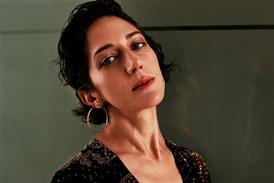






The Palestinian film community is working hard to reclaim its lost film archive, with the Palestine Film Institute’s Salma Abu Ayyash saying, “Where are our films, our images, our documents? They are all over the place. The story of our archives is the same story of our dispersion and violence that’s enacted on us.”
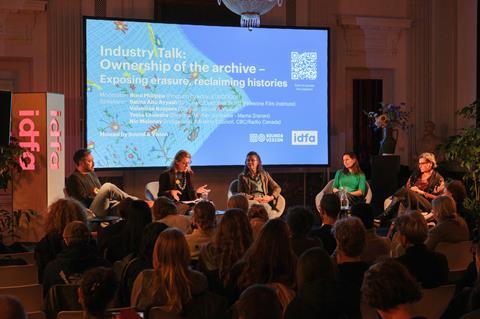
Abu Ayyash, who is co-chair of the Institute’s executive board, was speaking as part of a discussion at the International Documentary Film Festival Amsterdam (IDFA) this week on decolonisation of film archives. She noted that images and film footage of Palestine from the late 1800s and early 1900s exist in international governmental archives around the world.
“We have our own archive that was built in the 1960s, ’70s and ’80s,” she continued.
This collection – including films made in Palestine in the 1930s and 1940s – was housed in Jordan in the 1960s. When the Palestine Liberation Organisation moved to Lebanon in the early 1970s, the Palestine Cinema Institute was created in Beirut with the archive brought over. In the early 1980s, however, the archive was looted during Israel’s invasion of Lebanon and is still understood to be in the Israeli army’s archive.
“Imagine if you didn’t have any pictures? Imagine if you find yourself one day with nothing? There are Gazan families that don’t even have birth certificates,” said Abu Ayyash. “We know ourselves through how other people see us, it’s called spirit consciousness. We need to mediate these images. We need to relate to that so that we can restructure our memory of a place, restructure our memory of our histories.”
Abu Ayyash noted that there has been some support internationally to help Palestine to rebuild an archive. The Tokyo Reels is an archival film project of 20 film reels from 1964-1982 that were discovered in a house in Tokyo in 2015, chronicling Japanese solidarity activism with the Palestinian cause. They have since been restored by the cinema collective Subversive Film, founded by Palestinian filmmaker and Palestine Film Institute co-founder Mohanad Yaqubi and Belgian-Palestinian curator and artist Reem Shilleh, and have featured in Yaqubi’s documentary R21 Aka Restoring Solidarity, which played at IDFA in 2022.
Yaqubi is also the director of Revolutionaries Never Die, which is playing in IDFA’s international feature competition, and is based on the archive of Lebanese filmmaker Jocelyne Saab, with footage from Lebanon, Palestine, Egypt, Western Sahara and Iran.
Palestinian filmmaker Kamal Aljafari did manage to access some footage from Israel’s archives for his 2024 project A Fidai Film, which premiered at Visions du Réel. Through negotiations with Israeli academics, he was able to obtain the footage, although the academics’ concerns over copyright meant they only sent him very low resolution images and film rushes. “Some of the rushes that had the Zionist propaganda on it, he just erased it,” said Abu Ayyash. “I appreciate the courageousness of a man to do that and not think about copyright and other polite mechanisms of taking back our archive.”
The Palestine Film Institute is a network made up largely of volunteers, with a small film fund, a streaming platform and archival projects. “We want to be accountable to our community of Palestinian filmmakers, to our community of Palestinians in general. We don’t own them [the archives] – we want to digitalise them and make them available to filmmakers and people who want to access them.”
Abu Ayyash added: “Colonialism is not just about military and destroying villages. It’s about land, body, and memory – the three, we need to claim our sovereignty over.”
“We want to tell our own stories”
Abu Ayyash was speaking on the panel alongside EuroDoc programme director Nora Phillppe; Surinamese-Dutch filmmaker Tessa Leuwsha; Nic Meloney of Canada’s Indigenous Advisory Council; and Valentine Kuyper, curator of Netherland’s Sound & Vision institute.
Leuwsha spoke of her experience making IDFA 2023 selection Mother Suriname - Mama Sranan, which traces Surinamese history from the 1863 abolition of slavery to full independence in 1975, using archival footage and inspired by the life of Leuwsha’s grandmother, a washerwoman.
She had to rely on Dutch archives to tell the story. “My producer and I decided to embark on this journey of collecting images to see if we could derive a film from that. I was astonished that there was enough material. It took us about one-and-a-half years to gather material from the institutions, mainly in the Netherlands. This material was shot from the perspective of white journalists, and also missionaries who wanted to show back home in the Netherlands these people living in the wild, to be saved.”
A major challenge for Leuwsha was finding footage that showed “joy, pleasure, family life”, she revealed, adding that much of the material had been shot through a “bluntly racist” gaze.
Getting the rights to such archival footage, with copyright still mostly held by individuals or public service broadcasters in the coloniser countries, can be costly and a complicated process.
“If I would not have [Netherlands-based] Pieter van Huystee as a producer, I probably would not be able to make this film,” said Leuwsha. “It’s painful when I say this, because a lot of filmmakers in my country, they really want to make films, tell their own stories, and it’s hard for them to get funding but also to have connections to obtain material like this.”
There is also the question of consent of those featured in archival footage, and what impact that should have on the rights ownership of the films.
“The people who are in the films were never asked their consent,” said Leuwsha. “Some of them are still alive, or their children or grandchildren are.”



No comments yet