











Rezwan Shahriar Sumit’s second feature was named Rotterdam’s Big Screen competition winner
Dir: Rezwan Shahriar Sumit. Bangladesh. 2026. 126mins
Lord Acton’s famous quote “power tends to corrupt” is illustrated with textbook clarity in Bangladeshi filmmaker Rezwan Shahriar Sumit’s second feature, which tells the story of a principled high school teacher who goes into local politics believing he can make a difference. Anchored by Nasir Uddin Khan’s strong central performance, Master takes its time charting the way in which idealism and good intentions are put on hold by political gamesmanship, and how the latter can then ossify into out-and-out authoritarianism. Bringing an unhurried fidelity to an all too familiar story, Master has a cumulative, slow-burn impact.
Anchored by Nasir Uddin Khan’s strong central performance
The winner of Rotterdam’s Big Screen Competition, Master is the latest in a new wave of Bangladeshi films that are getting international attention. One such was Abdullah Mohammad Saad’s 2021 Cannes Un Certain Regard entry Rehana, whose lead actress Azmeri Haque Badhon returns here in a less intense but equally nuanced performance as a self-assured mid-level civil servant whose career is upended by Jahir’s populist manoeuvres.
Director Sumit made his debut at the BFI London Festival in 2020 with well-received drama The Salt In Our Waters, which secured streaming deals in several territories, and his latest is sure to generate at the very least further festival play. It remains to be seen whether Master can the leap to theatrical distribution outside of Bangladesh, but the arrival of Carmen Chaplin and Ashim Bhalla’s UK production company Kwanon Films as executive producers shortly before the film’s Rotterdam debut bodes well. The film certainly has the potential to tempt both diaspora audiences and anyone in the market for a stimulating slice of world cinema.
It’s also well-timed, politically. Bangladesh goes to the polls on 12 February, in the first general election since the regime of Shiekh Hasina was toppled by student protests in the summer of 2024. The action of the film is clearly set before this ‘July Revolution’, but local audiences are likely to take it as a very present parable rather than a record of past misdemeanours.
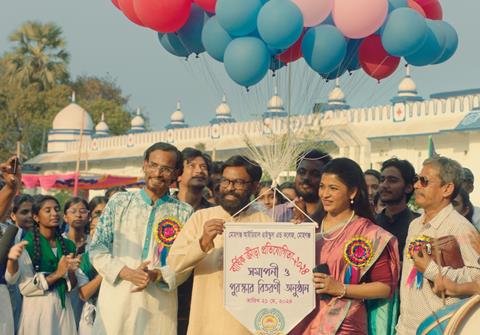
First seen teaching a school history lesson about the British colonial policy of ‘divide and rule’ as news reporters mill outside the classroom – a scene that will gather retrospective irony as the story progresses – Jahir (Khan) seems a good sort. Lked by his students, fair and apparently honourable, he is on the campaign trail for the post of ‘Chairman’ (a kind of area mayor) in the rural, heavily forested sub-district where he lives and works. Far from the capital, Dhaka, this is a place where cronyism and collusion between authorities, business interests and local crime bosses is rife. Ferried around on the back of a motorbike with the all-male inner circle of his campaign team, Jahir campaigns on a progressive, anti-corruption platform, addressing women’s meetings and standing up against illegal logging before returning to the modest house he shares with his wife and pre-adolescent son.
When Jahir wins the election, we know his problems are just beginning – not least because we witness him being threatened by the former incumbent’s swaggering crime-boss nephew soon after the victory. But Master also works on a deeper level to keep the audience guessing, and much of this hinges on Khan’s locked-down portrayal of Jahir. He seems to hide behind his black beard and highly reflective glasses and, while this initially feels like the result of modesty, it gradually takes on a more sinister valence as he becomes impenetrable, resistant to easy reading.
Once installed as the new sub-district Chairman, he’s quick to call out the police force’s lack of interest in keeping him safe from the local mafia, but he also turns out to be a clever weaver of alliances – chiefly with Nanziba (Badhon), the government official in charge of the district budget and strategic planning. A confident, well-navigated bureaucrat, she takes a shine to Jahir, thus provoking the jealousy of his wife Jharna (an affecting Zakia Bari Mamo).
It’s these two women who are the moral anchors of Master, as Jharna watches the upright guy she married turn into a kind of monster, and Nanziba is politically outplayed by a small local kingpin she thought she could handle. Tuhin Tamijul’s photography captures the hectic bustle of a crowded rural world where everyone is looking for an edge and even the banana plants feel invasive. Colour – such as a pink floral dress against a blue wall – is used to flag emotional turning points, but it’s also worth keeping an eye out for what’s happening in the background. While presenting a sports day at his former school, Jahir is talked into considering a slum clearance that would free up terrain for a luxury hotel project. Through the window behind, we watch a group of uniformed schoolgirls playing musical chairs.
Production companies: mypixelstory
International sales: mypixelstory mypixelstory.com
Producer: Rezwan Shahriar Sumit
Screenplay: Rezwan Shahriar Sumit, Sabbir Hossain Shovon
Cinematography: Tuhin Tamijul
Production design: Jonaki Bhattacharya
Editing: Kristan Sprague, Rezwan Shahriar Sumit
Music: Hao-Ting Shih
Main cast: Nasir Uddin Khan, Azmeri Haque Badhon, Zakia Bari Mamo, Fazlur Rahman Babu, Sharif Siraj, Tasnova Tamann