













![[L-R]: Amanda Villavieja, Laia Casanovas, Yasmina Praderas](https://d1nslcd7m2225b.cloudfront.net/Pictures/480xany/6/4/1/1471641_pxl_20251224_103354743_618426_crop.jpg)
Sound takes centre stage from the very start of Sirât, Oliver Laxe’s existential, Morocco-set road movie: loudspeakers are set in place for a desert rave, the black boxes standing out against the harsh rocky terrain as the music starts to pound.
“The aim was to have the music, the sound and image all woven together to power the emotional journey of the film, sustaining the tension throughout,” says Laia Casanovas, Sirât’s sound designer and supervising editor. Her work in collaboration with production sound mixer Amanda Villavieja and re-recording mixer Yasmina Praderas has earned the team an Oscar nomination for best sound alongside a quartet of Hollywood heavyweights: F1, Frankenstein, One Battle After Another and Sinners. Their recognition has already made Oscars history: this is the first all-female team to have been nominated for best sound at the Academy Awards.
Casanovas, Villavieja and Praderas are still processing the news. “It does feel as though one minute we were three friends playing music in a garage and the next we’re giving a concert at Coachella,” says Praderas, with a laugh.
They share careers spanning many years in Spain and several nominations at the Goya Awards. With the Oscar selection, they feel like winners already. “To be recognised for our job by fellow professionals is such an honour. Colleagues from all over the world are getting in touch”, says Casanovas. “We love our work and we have invested all our passion in Sirât. This film has helped put the spotlight on our work because of the way it relies on the role of the sound and music.”
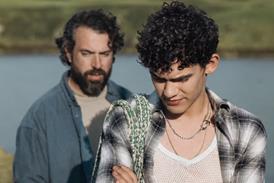
In Sirât — which is also Oscar-nominated for best international feature and Bafta’s equivalent category — a desperate father (Sergi Lopez) arrives at a desert rave searching for his missing daughter, accompanied by his young son. When the military shuts down the gathering, the pair join a convoy of ravers to continue their quest. They venture deep into hostile terrain, where the environment itself becomes their greatest adversary with devastating consequences.
Into the desert
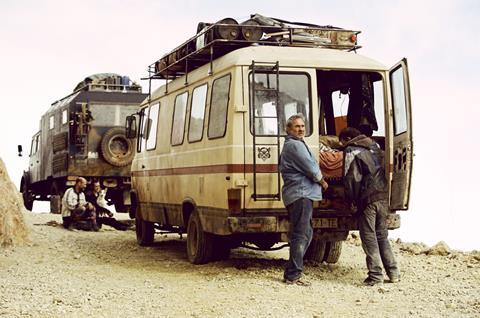
Production sound mixer Villavieja was the first to be involved in the project and the only one in the team who had previously worked with Spanish French director Laxe — initially on Mimosas, which won the top Critics’ Week prize at Cannes in 2016. “That’s when I first met Oliver. [It was] another film depicting a journey in the desert, both in the literal and figurative senses. I remember that, back then, he already mentioned he wanted to make a film about the raves in Morocco.”
Villavieja also worked on Laxe’s 2019 Un Certain Regard jury prize winner Fire Will Come. “One of the most challenging aspects was the road movie side of Sirât,” she says from Mexico, where she is working on a new film. “It is something I wasn’t used to doing, with dialogue inside the lorries tracking along the desert.
“As is often the case in Oliver’s films, the landscape was quite extreme, windy and hot, often working at temperatures over 40ºC [104ºF],” she continues. “But nothing compares to shooting in natural environments.”
Capturing the soundscape of a desert rave was no easy feat. “The rave was real, the documentary value was key for Oliver,” says Villavieja. “You can plan how you want to tackle the sound in the wide-angle shots, with two units to shoot both day and night. But the rave itself, that goes on for days. It’s not scripted, so you have to adapt to provide a rich canvas to the editor. I’d never been at a rave this big and it was fascinating to work in an environment with such an extraordinary amount of noise.”
Laxe placed music at the heart of the story from the writing stage. “The soundtrack is key for the film’s emotional drive,” confirms Casanovas, who says this was made clear from the first meeting with Laxe and the film’s composer, Berlin-based French electronic music producer David Letellier (aka Kangding Ray).
The sound team also intuited the genre references Laxe had in mind for Sirât’s visual and sound textures: 1970s films such as George Miller’s Mad Max, William Friedkin’s Sorcerer and Andrei Tarkovsky’s Stalker. With Laxe, they found themselves using the same terms to describe both images and sound: grain, texture, colour.
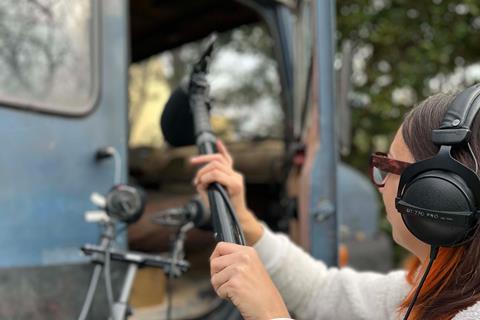
Casanovas had not worked with the director but knew Oriol Maymo from Uri Films, which produced alongside Filmes da Ermida, El Deseo, Los Desertores Films and 4A4 Productions. She had also worked with El Deseo on Pedro Almodovar’s Parallel Mothers (2021).
“For the rave sequences,” says the sound designer, “we studied the recordings Amanda made on site but also listened to how it merged into the landscape, not just where people were dancing. We decided it would be best to re-record the original soundtrack using the same type of sound system seen in the film.
“In post-production, we also recorded several actors speaking different languages to recreate the feeling of walking through the dance floor with this father who finds himself in a world that is alien to him, and taking the audience by the hand.”
The sound team relished the experience of working on Sirât, and Casanovas and Praderas — who already knew each other — continue to work in Barcelona on new projects while enjoying the film’s international success. “We work with different budgets, different styles, but we speak the same language,” says Villavieja.
On the significance of an all-female team, she notes the increase in the number of women in the film industry in Spain is linked to the parity policies promoted through public funding. “The growth has been exponential,” she says. “We have noticed it in the technical departments, not only with more women as heads of department but also with women handling bigger-budget features.”
Path finders
Sirât is named after the Arabic word meaning ‘way’ or ‘path’, to describe the characters’ arresting journey, a reflection on a desolate world and on loss. “Many people focus on the terrible accident that marks a dramatic turning point in the plot, but the idea of the journey is there from the start and the film is full of thresholds,” says Villavieja. “Talking about the film in interviews, we have become even more aware of the relevance of the title Sirât.”
Both the sound and music set the tempo of this transit. “We worked closely with composer Kangding Ray to achieve this,” explains Casanovas. “As the film develops, the music dissolves gradually and loses the beat, becoming more atmospheric, hand-in-hand with the sound, stressing the emotional journey.
“At the start, it’s a much more baroque sound, with plenty of layers — we hear the engines, the wheels of the trucks. Even the sound of the desert evolves, like it does visually; the desert we see at the end of the film is not the one we see earlier, where the sounds are more natural. We move gradually into a no-place, that belongs to the state of mind of the lead character.”
Villavieja recalls one of the most memorable moments of the shoot: “The scene in which Sergi Lopez’s character wanders alone in the desert — a sandstorm started right there and then, enveloping us in dust. Something you’re more used to seeing in an American film than in a production like ours because of the budgets we normally handle.”
Accordingly, when the team had a chance to share Sirât with audiences, “friends mentioned that they felt the sound got under their skin”, says Villavieja. “That’s not something you often hear as a sound technician.”



No comments yet