






Danielle Arbid’s latest feature confronts social prejudice and displacement in contemporary Lebanon
Dir/scr: Danielle Arbid. France/Lebanon/Qatar. 2026. 98mins
Only Rebels Win may not be quite the film that Danielle Arbid originally intended, but the Lebanese-born French writer-director certainly scores on inventiveness in factoring production challenges into her feature’s texture. Prevented from shooting in Beirut because of Israeli air strikes, Arbid (A Lost Man, Parisienne) instead used rear projection, directing remotely from Paris as a Lebanese team filmed backdrops in the empty street of Beirut and projecting this footage onto action filmed in a French studio. This results in an extra level of artifice that chimes appropriately, if somewhat unevenly, with the film’s echoing of classic melodrama.
Schematic in its denunciation of bigotry
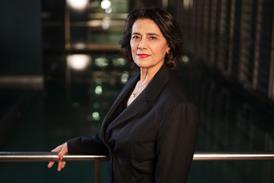
Otherwise, there are few major surprises in a film that comes across as schematic in its denunciation of bigotry. But this tale of love defying social disapproval benefits enormously from a typically charismatic performance by Hiam Abbass (also currently to be seen in Leyla Bouzid’s Berlin competition title In a Whisper), which could help its onward travel following its debut as the opening film of Berlin’s Panorama strand.
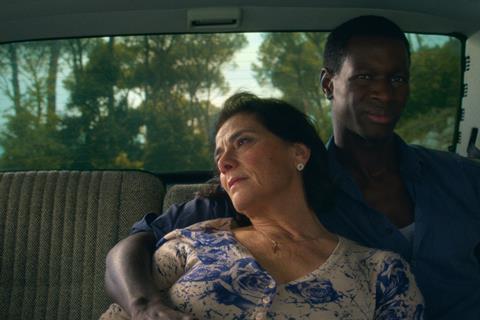
Set in contemporary Beirut, the film begins with Suzanne (Abbass), a woman in her 60s, intervening to prevent a young African man being beaten up by racists (a beautiful slow-motion opener, unsettling for its balletic execution). She takes him to her apartment to tend to his injuries, and they get to know each other. She is a Palestinian widower after her unhappy marriage; the man, in his 20s, is Osmane (Amine Benrachid) from South Sudan, who hopes to migrate to Europe. They become friends, then contented lovers.
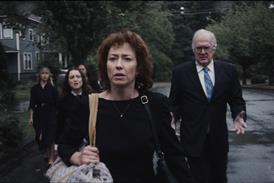
Once Osmane moves in with Suzanne, the couple face nothing but prejudice. The women she works with at a fabric shop are biased towards migrants and shocked at the relationship’s 40-year age gap. Suzanne’s neighbours go from nosiness to aggression, while her adult children show little understanding (“Sex – at your age!” exclaims her horrified son). Eventually Suzanne, who is Christian, explores the possibility of marriage and consults two priests, who give her the brush off. Nevertheless, she and Osmane celebrate their union at their local bar among other outsiders or social rebels, notably trans bohemian Layal (Alexandre Paulikevitch).
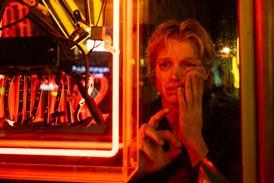
Meanwhile, Osmane finds work in a sleazy gambling den; it’s there that this young Muslim, who has never drunk alcohol, is first tempted by the bottle, placing him on a slide into disarray and despair. A gun is also brought into play early on, a less than convincing Chekhovian plant.
Such formulaic devices add to a general sense of dramatic awkwardness, with some character depictions verging on the cartoonish. Most jarring in this respect are the sequences featuring Shaden Fakih as Suzanne’s daughter Sana, whose torrential jeremiads about her own domestic discontents are played with undeniable comic vim but are over-emphatic and over-extended.
Arbid handled emotional intensity confidently in her Annie Ernaux adaptation Simple Passion (2020), but here she plays off realism and melodrama against each other – the latter often winning out, not always comfortably. Arbid has invited comparisons with Douglas Sirk’s All That Heaven Allows and Rainer Werner Fassbinder’s Ali: Fear Eats the Soul – but her most significant variation on these precedents is to set her story against the specific backdrop of contemporary Lebanon, with the social climate (shortages, crime and anxiety) economically sketched.
Most successful overall is the interplay between Benrachid and Abbass. He has a warm, gentle demeanour, affectingly portraying an easy-going, tender-hearted but fallible young man, while Abbass gives a characteristically authoritative performance. Her Suzanne comes across not as deluded by infatuation, rather as decisive and determined in her late discovery of all-consuming passion – someone who at last knows what she wants from life and won’t let the world take it away.
Elsewhere, the manifest back projections can be both distracting and highly effective – the latter notably when Suzanne and Osmane sit on a seaside promenade that oddly looks a universe away from them, highlighting their isolation in the world
Production companies: Easy Riders Films, Abbout Productions
International sales: Fandango Sales, sales@fandango.it
Producers: Nadia Turincev, Omar El Kadi, Georges Schocair
Cinematography: Céline Bozon
Editor: Clément Pinteaux
Production design: Izaac Lacoue-Labarthe
Music: Bachar Mar Khalifé
Main cast: Hiam Abbass, Amine Benrachid, Shaden Fakih, Alexandre Paulikevitch