




Gyllenhaal’s audacious remake of 1935’s ‘Bride Of Frankenstein’ also stars Jake Gyllenhaal, Peter Sarsgaard and Penelope Cruz
Dir/scr: Maggie Gyllenhaal. US. 2026. 126mins
You may think you know this story, but writer/director Maggie Gyllenhaal is betting you have never experienced it this way before. Gyllenhaal’s second directorial feature is not so much a remake of 1935 Universal monster movie Bride Of Frankenstein as it is a grab-it-by-the-throat shakedown, which puts the eponymous protagonist firmly back at the centre of the narrative.
A bold, brash and thoroughly modern Prometheus
Gyllenhaal sets her tale in 1936, and takes as inspiration her ideas of what Frankenstein author Mary Shelley may have written if she weren’t bound by 19th-century cultural mores. It’s a similar avant-garde approach to the one taken by Emerald Fennell for her recent Wuthering Heights – and may be just as divisive – but here proves far more potent. The result is a bold, brash and thoroughly modern Prometheus that, even at its most messy and overtly excessive, is never less than interesting.
Opening worldwide through Warner Bros from March 4, The Bride!’s iconic source material and the presence of stars Jessie Buckley – who appeared in Gyllenhaal’s debut The Lost Daughter and is fresh off her multiple award-winning turn in Hamnet – and Christian Bale should attract solid crowds. Its uncompromising tone and breakneck swerves from horror to humour to romance could prove a hurdle, and viewers expecting a straightforward adaptation in the style of Guillermo del Toro’s Netflix Frankenstein may feel bamboozled. But those willing to embrace Gyllenhaal’s singular vision are in for quite a ride.
Just as Elsa Lanchester did in James Whale’s original feature, Buckley plays multiple roles – Frankenstein author Mary Shelley and 1930s Chicago socialite Ida, who, after her death, is destined to become the eponymous Bride. While the original film saw Lanchester’s Shelley introduce the film as a continuation of her 1818 novel, here the audacious, meta-conceit is that all three characters exist in the same head. The film kicks off with Ida seemingly possessed by the manic spirit of Shelley, who is determined to use this firecracker of a woman as a vessel tell her version of this story.
When Ida dies in a fall, she is swiftly exhumed by lonely Frankenstein’s Monster, who goes by Frank (Bale), and self-proclaimed “mad scientist” Doctor Euphronius (a brilliant Annette Bening), and brought back to life as a companion for Frank. The Bride is, however, unwilling to accept traditional domestic trappings and strikes out on her own – with a besotted Frank in tow. After a series of unfortunate and violent events, the pair embark on a road trip of sorts, visiting cinemas showing musicals starring Frank’s favourite vaudeville actor Ronnie Reed (Jake Gyllenhaal) and pursued by murder detectives Jake Wiles (Peter Sarsgaard) and Myrna Mallow (Penelope Cruz).
Unlike Lanchester’s original character, who only appeared in the 1935 version for a few scant minutes, this film belongs entirely to The Bride. This is not the story of the men who made her but of the woman Gyllenhaal imagines her to be, one whose primal creation frees her from the shackles of patriarchal conformity and gives her a sharp, 21st-century outlook. This is a feminist fairy story, punched through with rage – that exclamation point in the title is not there by accident. If Gyllenhaal’s script hammers its points too hard – nearly every man on screen (aside, of course, from Frank himself) is a misogynistic beast; at one point the Bride screams ‘Me Too!’ – there is power and catharsis in their making.
Buckley is committed and commanding as Mary/Ida/The Bride, switching between drawling American and clipped English accents as the trio speak through her, often at the same time. As Frank, Bale is very much a supporting player, recalling original star Boris Karloff’s melancholy and childlike naivety but also propelling the character to moments of intense, shocking violence. Both give very physical performances, including several choreographed musical numbers that emulate the glossy Hollywood perfection to which Frank aspires.
This is big-swing filmmaking, and it largely works. Working with production designer Karen Murphy, writer/director Gyllenhaal has created a vivid steampunk period universe which bends to the will of her storytelling. She imagines the pre-war, late Depression-era cities of Chicago and New York as anonymous playgrounds for the young, the wild and the weird. (A standout sequence takes place in an underground Chicago club, where Bride and monster blend in with an outré crowd who don’t blink an eye at their appearance.)
Gyllenhaal also draws into this carefully curated world elements of classic 1930s cinema – there’s a masochistic mob boss, a gumshoe detective and his fast-talking female sidekick – and films set in the period, with The Bride and Frank’s journey taking on a punky Bonnie And Clyde vibe. But its closest allies are, perhaps obviously, Yorgos Lanthimos’s Poor Things, with which it shares a heroine coming to understand and liberate her own feminine identity; and, more surprisingly, Cruella, in its iconisation of a female character who becomes an ideological and style figurehead for an entire movement.
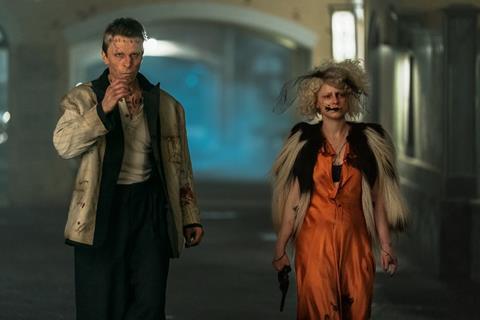
Visual similarities with the latter also come through Nadia Stacey’s excellent make-up and prosthetics design, which – much like her vision for Emma Stone’s Cruella – gives The Bride a monochromatic palette, her face, neck and hands stained black from the dye used in the reanimation process. (Her hair is a striking blonde updating of Lanchester’s iconic 1935 do.) Bale’s Frank is coming apart at the seams, his missing staples and oozing flesh representative not only of the amount of time he has lived in this stitched-together body, but his fracturing mental state. It’s sticky and fleshy and grotesquely mesmerising, and a world away from the poetic, Goth-hunk version of the Monster played by Jacob Elordi in Del Toro’s film.
Costume design, from Sandy Powell, is equally as evocative, contrasting The Bride’s silky, fluid, slit-to-the knee orange slip dress and eye-catching bright red boots with Frank’s shabby, dark, well-worn suit; her easy confidence with his tortured, lumbering shyness. Hildur Gudnadottir’s expressive score also takes in these conflicting notes, which converge in a strange, almost otherworldly harmony.
There are undeniably moments at which Gyllenhaal is in danger of losing her grip on proceedings, when all this style threatens to overwhelm the story – dream sequences involving Gyllenhaal’s character are perhaps one idea too many. But, ultimately, The Bride! stays the course as a piece of exhilarating filmmaking, a bracing example of creators throwing convention aside and pushing their vision to the absolute limit. Mary Shelley would no doubt approve.
Production companies: First Love Films, In The Current Company
Worldwide distribution: Warner Bros
Producers: Maggie Gyllenhaal, Osnat Handelsman-Keren, Talia Kleinhendler, Emma Tillinger Koskoff
Cinematography: Lawrence Sher
Production design: Karen Murphy
Editing: Dylan Tichenor
Music: Hildur Gudnadottir
Main cast: Jessie Buckley, Christian Bale, Annette Bening, Jake Gyllenhaal, Penelope Cruz, Peter Sarsgaard