














Joao Nicolau’s fourth feature is based on a work by Robert Louis Stevenson
Dir: Joao Nicolau. Portugal. 2026. 125mins
This quirky, engaging period comedy is based on one of the few works by Scottish writer Robert Louis Stevenson not to have been previously adapted for the cinema. Published in 1890, Stevenson’s short story is a playfully arch defence of the artistic vocation, couched in a picaresque tale of a tough day in the life of a couple of itinerant singers in some unnamed southern European country. Nicolau’s film preserves the substance, the mock-epic tone and the ‘somewhere in the past’ time and place. But it also interleaves a present-day story focusing on tensions between members of a modern Lisbon indie band.
Saved from excessive stylisation by its delicate human touch
While this thread doesn’t distract too much from the main story, it stretches out a film that has no real need for time travel. A final-act reveal of the connection between the past and present narratives has a certain mad verve to it, but there’s a better argument for the contemporary relevance of Stevenson’s short story embedded in the period scenes themselves. Gradually, we realise that many of the tribulations of Leon (Pedro Ines) and Elvira (Clara Ridenstein), the struggling entertainers at the heart of the story, are ones that still plague artists today – issues like being badly paid or not paid at all for creative content, copyright theft, legal and fiscal persecution.
It helps that Providence and the Guitar’s deft control of its mannered comic tone and delightful performances have genuine appeal. As a result, if carefully targeted at music-loving urban audiences with a taste for whimsy, this could be the first of the director’s four features to achieve a healthy level of international arthouse distribution outside the festival circuit following its bow as Rotterdam’s opening film.
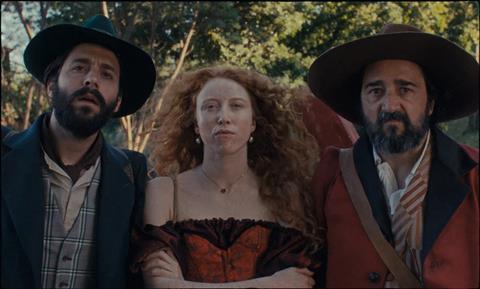
We first see partners in life and art Leon and Elvira in the shabby room they’ve secured in a village inn that could have existed anytime between the 18th century and the 1920s. They’re rehearsing a florid chivalric play she’s in the process of writing. Leon hams it up for all he’s worth; this, it will soon become clear, is his default mode. He’s a bad actor but a good husband, Elvira will later confide to the wife of another hard-up artist. Beneath her soignée manner, Elvira is clearly the smart one of the couple – her powers of persuasion being amply demonstrated in a gently seductive exchange with an innkeeper in a tavern that she has earmarked as the venue for that evening’s show.
She’s constantly having to defuse the irascible Leon, who has been trying to locate the only man who can give the official go ahead for the performance – the village’s boorish police commissioner. Later, Portuguese singer (and 2017 Eurovision Song Contest winner) Salvador Sobral puts in an appearance as a cash-strapped English student on a walking tour, who falls in with Leon and Elvira. Leon is shocked to discover he plans to be a banker – a wry dig at the inverted snobbery of the penniless artist.
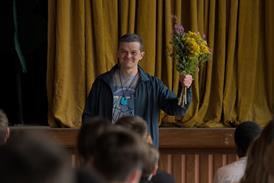
A little over 20 minutes in, we’re suddenly in modern-day Lisbon, witnessing a punk-oriented band called Desgraca (‘disgrace’) give a radio interview that reveals serious differences of opinion between the members – in particular the frontman and bassist, who bear more than a passing resemblance to Leon and Elvira. We will return to this contemporary skein a few more times – briefly enough for curiosity to outweigh annoyance.
Jazz drummer and composer Joao Lobo’s soundtrack plays inventively with the film’s timeslips (Elvira’s distribution of flyers around the village is accompanied by a kind of troubador prog-rock). Providence and the Guitar has a real affection for a rural past time and place which, like Cervantes’ La Mancha, may never have existed, but nevertheless is instantly recognizable as a romantic topos. Leon’s jaunty red military jacket, the over-amplified clacks of Elvira’s heels as she walks through a tavern, frontal framings and night scenes with an old-school Technicolor aesthetic foreground the theatricality of the exercise, but this winsome film is saved from excessive stylisation by its delicate human touch.
Production company: O Som e a Furia
International sales: Shellac sales@shellacfilm.com
Producers: Luís Urbano, Sandro Aguilar
Screenplay: Joao Nicolau, Mariana Ricardo
Cinematography: Mario Castanheira
Production design: Artur Pinheiro
Editing: Alessandro Comodin
Music: Joao Lobo
Main cast: Pedro Ines, Clara Riedenstein, Salvador Sobral, Isaac Graca, Jenna Thiam, Americo Silva, Beatriz Bras, Leonardo Garibaldi, Joao Pereira, Jose Raposo, Miguel Lobo Antunes