












Anaïs Demoustier and Gilles Lellouche star in retro romcom set against bohemian Paris
Dir. Pierre Salvadori. France. 2026. 122mins
A slyly crafted retro romcom, Cannes opening film The Electric Kiss promises snap, crackle and pop – but the sparks fizzle out before it reaches its unapologetically contrived climax. Literate and certainly not without class in its nostalgic drollery, this 1920s-set bohemian Parisian jeu d’esprit is the latest from Pierre Salvadori, a dependable purveyor of upmarket comic entertainment, including such briskly approachable numbers as 2006 Audrey Tautou vehicle Pricelessand 2018 comedy-thriller The Trouble With You, starring this film’s male lead Pio Marmaï.
A certain theatrical stiffness politely chokes the film’s bolder possibilities
Salvadori’s profile – and a cast also featuring art-house stalwart Anaïs Demoustier (The New Girlfriend, Anais in Love) and the very audience-friendly Gilles Lellouche – should bode well for the film’s May 12 domestic release. But a certain theatrical stiffness, politely choking the film’s bolder possibilities, is likely to restrict appeal to outlets catering to traditional Francophile constituency.
A boisterous opening shows a Paris fairground in the late 1920s, where we see heroine Suzanne (Demoustier) doing her act as ‘Venus Electrificata’. Poised between two Van Der Graaff generators, her body conducts a huge charge of electricity as men queue to kiss her, eager to receive a dynamic bolt from her lips.
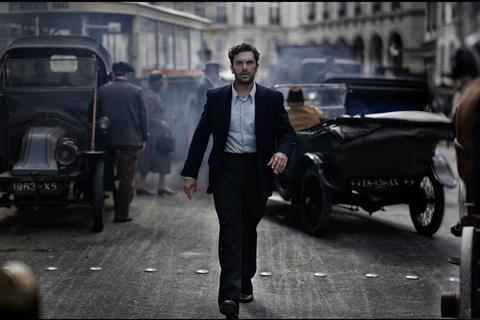
The world-weary Suzanne is essentially a slave of exploitative, predatory fairground boss Titus (actor and director Gustave Kervern, playing up his ogre side). While nosing around the caravan of the fair’s resident medium, Suzanne is mistaken for her by a drunken visitor, painter Antoine (Marmaï), who is desperate to make contact with his dead wife Irène. Seeing the money on offer, Suzanne impersonates her colleague, then visits Antoine’s house to channel Irène once more. When art dealer Armand (Lellouche) realises that Suzanne’s imposture has helped the blocked painter take up his brushes again, he pays her to continue the sessions.
Then Suzanne discovers Irène’s journal, which opens up a thread of flashbacks: the dead woman, played by Vimala Pons, records how she, an artists’ model, encountered aspiring dauber Armand and unlocked his talents. As is so often the case in muse stories, it seems as if the real genius is Irène’s, as if Antoine were simply channelling it, just as Suzanne channels Irène.
As the action slips between the stories of these two women, roughly a decade apart, the romantic complexities develop teasingly – although Salvadori doesn’t quite maximise their ironic interplay. Based on an original idea by directors Rebecca Zlotowksi and Robin Campillo, the film shows undeniable complexity and mischief, echoing a vintage tradition of French comedies (Renoir, Sacha Guitry, René Clair). But it is rather hampered by pedestrian execution, dominated by claustrophobically stagey interior-bound dialogues, the more effusive crowd scenes tending to stand out as production numbers rather than feeling part of an organic whole.
Demoustier and Marmaï clicked persuasively as a young outlaw couple in 2010 film Living On Love Alone, but this reunion never quite attains full voltage, especially with Marmaï overplaying the manic confusion. Demoustier makes Suzanne poignantly jaded as well as impish, while Lellouche wholeheartedly uses his talents as a farceur, albeit a touch stiltedly. The show is, however, very much stolen by Vimala Pons, a vigorously eccentric presence in films including The Rendez-Vous of Déjà Vu and 2023’s Vincent Must Die. Sporting long coppery locks, she makes juicy work of an ostensibly clichéd role, the uncrushable free spirit, confidently radiating echoes of Jeanne Moreau in Truffaut’s Jules et Jim.
While never quite predictable, The Electric Kiss lacks the knowing brio of recent French period pastiches such as François Ozon’s The Crime is Mine or Cédric Klapisch’s 2025 Colours of Time, similarly set in Paris bohemia. Even so, Angelo Zamparutti’s vividly cluttered design can’t be faulted. And regular Salvadori scorer Camille Bazbaz provides a jovial upbeat score – although in terms of electricity, both music and visuals are outdone by the closing credits and their use of the bouncy Shocking Blue oldie ‘Venus’.
Production company: Les Films Pelléas
International sales: Playtime, info@playtime.group
Producers: Philippe Martin
Screenplay: Benjamin Charbit, Benoît Graffin, Pierre Salvadori, from an original idea by Rebecca Zlotowski, Robin Campillo
Cinematography: Julien Poupard
Production design: Angelo Zamparutti
Editing: Anne-Sophie Bion
Music: Camille Bazbaz
Main cast: Pio Marmaï, Anaïs Demoustier, Gilles Lellouche, Vimala Pons