










Kohei Kadowaki’s debut feature heads to Annecy after a Cannes premiere
Dir/scr: Kohei Kadowaki. Japan, France. 2026. 117mins
The debut animated feature from writer-director Kohei Kadowaki – already known for his music videos for pop outfit YOASOBI and other Japanese musicians – explores teenage angst and the intensity of school life via an intriguing dual perspective and delicately observed imagery. Two boys become fast friends after spotting each other across the classroom in the third year of school in early 2000s rural small-town Japan. But adolescence is on the horizon, and their easy innocence can’t last. We Are Aliens a playful and humane film that shows how small events can be seismic in the emotional life of teenagers, lingering long beyond childhood.
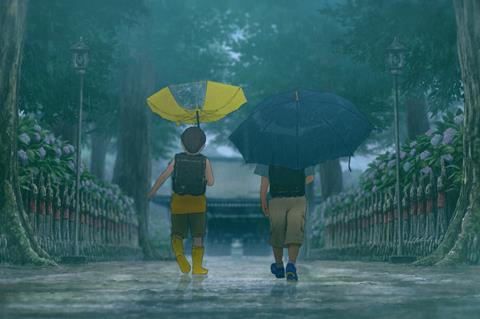
The character animation is tenderly observed
We Are Aliens had its world premiere in Cannes’ Directors’ Fortnight and next plays in competition at Annecy. Beyond festivals, the Japanese-language film is likely to find a solid berth among specialist audiences worldwide. The grounded, universally relatable coming-of-age subject matter should work in its favour, as should the warm appeal of Kadowaki’s animation style which mixes near-photoreal imagery, sometimes using rotoscoping techniques, with gentler, more painterly digital animation.
A mysterious prologue presents a taxi driver sitting silently in his cab in a desolate corner of Tokyo. We hear a young boy asking an adult to explain the meaning of the “blood moon” in the sky. It’s a brief, enigmatic glimpse of a grown-up world before the film winds back roughly 20 years to timid, withdrawn young schoolboy Tsubasa (voiced by Ryota Bando) being woken by his alarm clock. At school, a fast friendship emerges between the uneasy Tsubasa – who admits to a classmate that he lies about liking football and actually likes ‘nothing’ – and the more lively, assured Gyotaro (voiced by Amane Okayama).
But cracks appear in the summer of their fourth year. Adults call Gyotaro ‘a problem’, and Tsubasa’s imagination latches on to wild playground rumours that his friend is ‘an alien’, ‘a zombie’ or ‘not even human’. On a visit to Gyotaro’s family home, Tsubasa even imagines a spaceship landing. The growing gap between them widens to a gulf when Tsubasa acts rashly and his avenging impulse gets Gyotaro into serious trouble. Gyotaro becomes more of an outsider, and by the time the pair are in their ninth year of school the cool kids are sneering at him and calling him ‘gross’.
For a moment, it looks like the film is going to make a sharp turn from poetic realism into sci-fi. But Kadowaki’s idea of aliens is more relatable than that: they represent the unknowable in all of us, especially in children whose personalities are still being shaped. To stress the point, Kadowaki splits his film into two long chapters to show us Tsubasa and Gyotaro’s conflicting views of the same events across eight years of school. That feels both exciting and structurally overdetermined. It asks us to engage deeply: to play detective, judge and jury. It’s an intriguing storytelling puzzle, but a demanding one too.
The character animation of the two boys is tenderly observed and simple, as if to stress how they are still being moulded. In contrast, Kadowaki lends a lot of detail to their surroundings. Electricity pylons, concrete water channels, stark industrial pipes, blocks of flats, even the dull light fitting above Tsubasa’s bed – Kadowaki is strong at fleshing out the worlds these two boys come from. Seasons, sunsets, clouds and flowers offer moments of awe. He’s attuned to their family backgrounds too. Gyotaro comes from a busy, loving home, with grandparents and an encouraging dad. Tsubasa’s household is just him and his mum: there’s little room for fun and warmth as his mum does her best just to keep the household running.
For the film’s final act, we return to the timeline of the prologue and again meet the lonely taxi driver. The tensions of childhood boil over. Repressed feelings explode. Nuanced observation and the belief that there are two sides to every story give way to melodrama. It’s unsatisfying given the subtlety of all that has come before. But We Are Aliens remains visually engrossing and, as storytelling, it’s mostly sophisticated and intelligent.
Production companies: Nothing New, Miyu Productions
International sales: Charades, sales@charades.eu
Producers: Kentaro Hayashi, Yuuri Shimojo
Cinematography: Kohei Kadowaki
Editing: Kenichiro Tachikawa
Music: Yaffle
Main cast: Ryota Bando, Amane Okayama