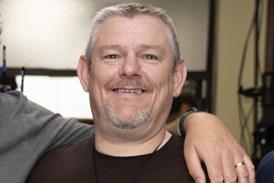
Alberto Iglesias has been collaborating with Pedro Almodovar for more than three decades and is currently working on the director’s latest, Bitter Christmas, which shot in Spain over the summer. Born in San Sebastián in 1955, Iglesias composed ballets and released electronic music with fellow composer Javier Navarrete, before beginning his film career in the early 80s.
A four-time Oscar nominee for The Constant Gardener, The Kite Runner, Tinker Tailor Soldier Spy, and Almodovar’s Parallel Mothers, Iglesias is nominated for Film Composer of the Year at the 2025 World Soundtrack Awards for his work on Almodovar’s The Room Next Door, which won the Golden Lion at Venice in 2024.
You have been working with Pedro Almodovar since The Flower Of My Secret, in 1995. How would you describe your creative process?
In terms of how we organise ourselves, he just sends me the script before shooting and, at that stage, he only asks my thoughts about the story. “Did you really like it?” he says. But we don’t go into the music at that point. It’s when production starts that I get more and more involved into the world of each film, going deeper into the process. We are currently working on his latest feature, Bitter Christmas. In fact, he’s coming round this afternoon to my studio, in the outskirts of Madrid. I normally start working on his films once they have finished shooting. Pedro has them almost ready when shooting ends, with the editing process running parallel to the production one. And in terms of composing the music, I start sitting at the piano, playing, writing and trying to imagine the sound of a full orchestra.
What was the inspiration for The Room Next Door?
I remember going to the shoot one day — a scene that took place in a set where they recreated a flat in New York — and being really impressed. The delicacy with which the space was created fascinated me, it was very relevant in a story like this. The music was conceived as another instrument to get closer to the transcendency of a film dealing with a character that accepts her own death. I think a composer is almost like an actor: you have to put yourself in the character’s place. The voices of [stars] Tilda Swinton and Julianne Moore also had a deep impact, so beautiful! I listened to them as if they were music.

How different was it to work on Almodóvar’s first feature in English?
In English, sound gets to me faster than the meaning of the words. In Spanish they come more intertwined. In the case of The Room Next Door, I felt I could focus on the tonal inflections of the voice better, the rhythm, the silences.
Did you think or listen to particular types of music while working on the score for the film?
One thing I recall is that I was interested in antique music and the sober tranquillity it conveys. Thirteenth and fourteenth century composers such as Perótin; also, Mahler’s Fourth Symphony, his adagios. In the film there are also some very subtle echoes of Alex North’s music for The Dead, because of the references made to John Huston’s film. The film within the film, so to speak.
Did you take the film’s New York setting into consideration?
To me, The Room Next Door is more a Pedro Almodovar film than a film set in the United States. If you show New York and resort to Gershwin or Thelonious Monk, it’s a bit of a cliché. Geography is not in the mix in the creative process, although it’s something that unfortunately we tend to do with stories set in a more distant country, or in the Third World. We all have made mistakes in this sense, me included.
What do you enjoy most working with Almodovar?
He is a master. On one hand, he is able to explore the new and on the other, pursue his commitment to his deeply rooted visual and storytelling style. I admire his ability to face challenges. I love his latest films because I think there’s a depth of thought and risk that fascinates me. We have tackled each process with delicacy, patience. We understand each other about the way music has to serve a film. I have always defended the film over my work, my compositions, getting rid of the superfluous if necessary. I think this is something directors appreciate.
When accepting the Goya in 2019 for Almodovar’s Pain & Glory, you said that he had “made you free”. How different is it working on an Almodovar film to a Hollywood production?
I was referring to the creative freedom, being able to explore our intuition and push boundaries. He is a director-producer and he makes auteur cinema. You could pinpoint pros and cons of that, but to me they are all pros. I love being able to focus on the work, to go to the point straight away.


No comments yet