











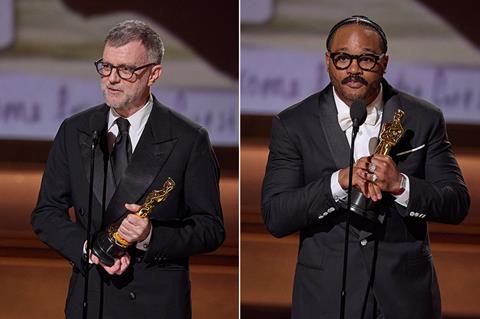
After one of the closest awards contests of recent years, One Battle After Another emerged as the biggest winner at the 98th Academy Awards on Sunday (March 15), taking the best picture Oscar as well as honours in five other categories.
Paul Thomas Anderson’s political thriller had gone into the ceremony with 13 nominations, as well as this year’s top Bafta Film award and the highly predictive Producers Guild of America feature prize.
This year’s other big contender, Sinners, which had notched a record-breaking 16 nominations, ended up with four Oscars.
As well as the ceremony’s top prize, One Battle After Another also took the Oscars for directing, adapted screenplay, supporting actor, casting and editing.
Anderson’s individual Oscars as writer, director and producer were his first awards from the Academy after 14 nominations (including his three from this year).
Sinners, Ryan Coogler’s acclaimed horror drama, won in the lead actor, original screenplay, original score and cinematography categories.
After his wins at the Baftas and the Directors Guild of America awards, Anderson received the best director hat-trick with the Oscar for One Battle After Another.
Michael B Jordan won the lead actor Oscar for his performance as identical twin brothers in Sinners. Timothée Chalamet had been the category favourite for Marty Supreme until Jordan won the Actor Awards male lead prize.
The best actress honour went, as widely predicted, to Ireland’s Jessie Buckley for her performance in Shakespeare family drama Hamnet, which had already earned her a Bafta.
Sean Penn, who did not attend the ceremony, was named best supporting actor for his One Battle After Another role as a brutal military man. It was the third Oscar for Penn, who also won the Bafta and the Actor Award for his performance.
Veteran performer Amy Madigan, from the hit supernatural horror tale Weapons, was the popular winner of the supporting actress Oscar. Madigan, who won in the same category at the Actor Awards, had previously been nominated 40 years ago for Twice In A Lifetime.
In the original screenplay category, Ryan Coogler won the evening’s first Oscar for his Sinners. Coogler had recently won the Writers Guild and Bafta honours in the category.
The adapted screenplay award went to Anderson, also the winner of the Writers Guild and Bafta awards in the category, for One Battle After Another.
Studio wins
Warner Bros, the company behind both Sinners and One Battle, was the evening’s biggest winner among studios, seeing its films take 11 Oscars out of 30 nominations.
The haul was also a boost for the studio’s motion picture group co-chairs Michael De Luca and Pamela Abdy, and for studio employees concerned about job security under the incoming new Warner Bros Discovery owner Paramount Skydance.
Neon, the US distributor of films with 18 nominations, came out of the ceremony with just one win, while Netflix claimed seven wins out of 16 nominations.
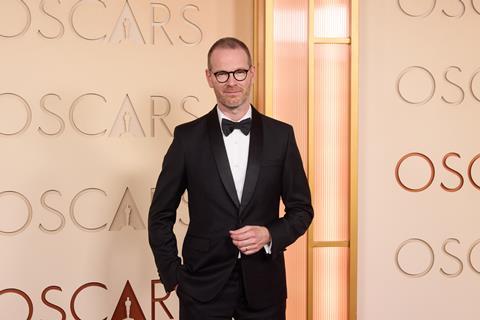
Sentimental Value, which received nine nominations overall, followed up on its Bafta non-English language film award with the international feature Oscar. Joachim Trier’s family drama was the first winner in the category for Norway. Norwegian films have been nominated six times previously.
It was a second win in the category for Neon, distributor of four of the category’s five nominees, after Parasite’s win in 2020.
As widely predicted, the award for animated feature went to KPop Demon Hunters, the Sony Pictures Animation musical fantasy for Netflix, directed by Maggie Kang and Chris Appelhans, that recently swept the Annie Awards.
Mr Nobody Against Putin was named best documentary feature. David Borenstein and Pavel Talankin’s film about a Russian primary school during the war with Ukraine beat out favourite The Perfect Neighbor after winning the Bafta in the category.
The first-ever Oscar for casting went to Cassandra Kulukundis for One Battle After Another, a regular Paul Thomas Anderson collaborator who thanked the Academy “for even adding this category” and dedicated the award “to the casting directors who fought tirelessly to make it happen.”
Among other films with multiple nominations going into the ceremony, Guillermo del Toro’s version of Frankenstein, with nine nods, won three Oscars; Josh Safdie’s edgy comedy-drama Marty Supreme, also with nine nods, came away empty-handed; and Chloe Zhao’s Shakespeare family drama Hamnet, up for eight awards, ended up with a single Oscar for Buckley.
Among other individual award winners during this year’s ceremony, Autumn Durald Arkapaw became the first woman to win the cinematography Oscar for her work on Sinners.
Craft stars
Frankenstein was strongly represented in the craft categories, with Tamara Deverell and Shane Vieau winning for production design, New Zealander Kare Hawley winning for costume design, and Mike Hill, Jordan Samuel and Cliona Furey winning for makeup and hairstyling.
The editing Oscar went to One Battle After Another’s Andy Jurgensen.
Car racing drama F1 won its sole Oscar for sound, with Gareth John, Al Nelson, Gwendolyn Yates Whittle, Gary A Rizzo and Juan Peralta accepting the honours.
In the visual effects category, Joe Letteri, Richard Baneham, Eric Saindon and Daniel Barrett took the award for Avatar: Fire And Ash, whose two previous franchise instalments had also won in the category.
‘Golden’, written by EJAE, Mark Sonnenblick, Joong Gyu Kwak, Yu Han Lee, Hee Dong Nam, Jeong Hoon Seon and Teddy Park for KPop Demon Hunters, was named best original song.
Sinners earned Swedish composer Ludwig Goransson a third Oscar for original score.
The live-action short category produced a rare Oscar tie (reportedly only the seventh in Academy history), with statuettes going to both The Singers and Two People Exchanging Saliva.
All The Empty Rooms won the documentary short award, and The Girl Who Cried Pearls the animated short prize.
Amid tightened security because of the war with Iran, Conan O’Brien hosted the Oscar ceremony at Hollywood’s Dolby Theatre for the second consecutive year.
Opening the show with a spoof on Weapons, O’Brien aimed jokes at AI, Timothy Chalamet’s recent comments about opera and ballet, and Netflix CEO Ted Sarandos, whose presence, the host said, was “his first time in a theatre”.
On a serious note, O’Brien said that during troubled times, “the Oscars are particularly resonant.” Noting that work from 31 countries across six continents was represented in the nominations list, O’Brien said: “We pay tribute tonight to the ideals of global artistry, collaboration, resilience and, that rarest of qualities today, optimism.”



No comments yet