
















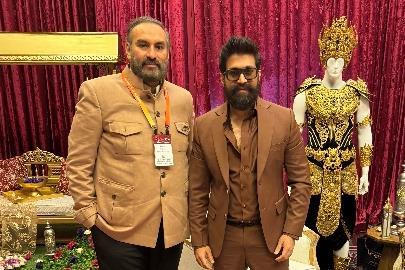
Indian superstar Yash from the smash K.G.F. crime franchise has joined producer and CEO Namit Malhotra of effects house titan DNEG to promote the upcoming two-part epic ‘Ramayana’ adaptation, and provide an update on June release Toxic.
The pair are in post on the first instalment of the 5,000-year-old Sanskrit saga and are in physical production on the second chapter in India. Part One opens in November to coincide with the Diwali festival of lights and Part Two arrives in November 2027.
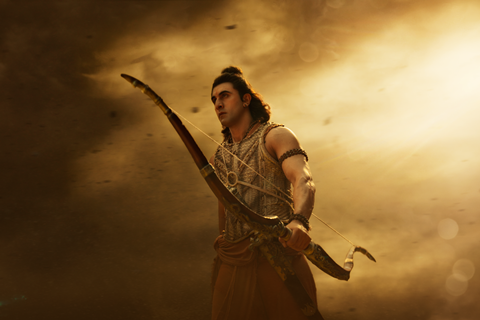
Arguably the most closely-watched release of all time in the eyes of Indian audiences, the Ramayana tells of Rama (Ranbir Kapoor), the young prince and avatar of the god Vishnu who descends to earth to restore order in the universe. When a twist of fate disrupts his quiet life with Sita, Rama is driven into exile and must confront the demon king Ravana, played by Yash. Nitesh Tiwari (Dangal) directs.
Yash and Malhotra spoke to Screen from CinemaCon in Las Vegas last week, where The Fithian Group executives John Fithian, Patrick Corcoran and Jackie Brenneman met with exhibitors and distributors from around the world on behalf of the filmmakers. Malhotra’s Prime Focus Studios will distribute in India. DNEG (Dune, Interstellar, upcoming The Odyssey) oversees the effects, and Oscar winners A.R. Rahman and Hans Zimmer are collaborating on the score.
Yash, the superstar of the Kannada industry from the south of India who broke out as a pan-Indian star through the K.G.F. films, is producing through his Monster Mind Creations alongside Malhotra’s Prime Focus Studios.
Yash is also producing the gangster feature Toxic: A Fairytale For Grown-Ups, which opens on June 4 day-and-date in India and the US, after it was postponed from March due to the conflict in the Middle East and a date clash with current Indian smash Dhurandhar: The Revenge.
Goa-set Toxic shot in English and Kannada and spans the late 1940s to the 1970s. Prime Media will distribute the Indian-languages version in the US on around 3,000 screens in 1,000-1,200 theatres. Talks are ongoing with potential distributors of the English-language version.
How did Ramayana come together?
Namit Malhotra: We started developing the script almost 10 years ago. Because Ramayana is such a well-known piece of text, it took a few years to get the right take and work out how we could compress it into two films. We brought on the director, Nitesh Tiwari, and he took it in a direction that maintained a lot of the heart and the emotion. Once we had the script, we developed the visuals and the pre-vis during the pandemic with everybody working from home.
What is the look and feel of the film?
NH: It’s Avatar meets Gladiator. It’s got the humanity of Gladiator and the visual spectacle of Avatar.
What is the budget?
NH: I’d say it’s the largest independent production in the world.
When did you and Yash meet?
NH: [After we] brought on the lead character Rama with Ranbir Kapoor, I met Yash in LA following his massive breakout success K.G.F. Chapter 1 and Chapter 2. Neither of us knew each other. I was living abroad in America and London, and Yash was from this upcoming film industry in India [Kannada]. We actually didn’t know each other. He had had this nationwide success from this not very accomplished industry and I had begun my start-up [Prime Focus Studios] in a garage in Mumbai and had built it out into Hollywood. So we connected almost immediately because we were both underdogs.
Yash, tell us about the characters Ravana and Rama
Yash: Ravana is a very complex character. The story is relevant today and looks at what happens to a man who is talented in all aspects and driven by ego, greed, and power. It can bring you down. Millions of people have the name Rama, but nobody will name anybody Ravana. That’s the kind of impact he had. The character is not completely negative – there are people who really appreciate his skills. He was a great warrior, poet, dancer, musician, and a beloved king, and yet he goes down.
[On the other hand] Rama conducted himself with such grace. It’s an ideology, an idea of how a human can make the best out of even the worst situation, and in the end what endures are those values and that belief system that keeps you grounded and sane, which is very important today. Rama is born to a royal family and he loses everything for love. Ravana fights and attains his position from the bottom. He uses all his skill and becomes king. When they come together, life comes full circle.
Where and when did you start physical production?
NH: We started physical production almost two years ago on Part One. We’re already filming Part Two [primarily in India] as we speak and we just came over here for a few days.
Where are you with the project now?
NH: The running joke in visual effects is visual effects are never done. You just run out of money and time. So we’re obviously on that journey right now. We continue to plough through it. I’m feeling pretty good.
You carry a big responsibility adapting this revered saga. How do you think about it?
Yash: People are watching with such curiosity. They want it to happen, but they also want it to happen in the right manner. So the ownership is considerable. Our intention is very clear: we want to tell the story with global exposure with the best technology available and stay true to the essence. We have two choices: to be scared and not do it, or take on that responsibility and make everyone proud. We have chosen the latter course.
NH: I always say this [story] is the heartbeat of India. My mother worships Rama. I have to make sure that my mother does not lose faith in me. It’s that level of pressure.
Yash, tell us about Toxic
Yash: It’s a father-and-son revenge saga that starts after India gained independence and the British had left, but Goa was still under Portuguese control [until 1961]. There was so much mystery around that place. It’s gangster era, so it’s about greed, power, and politics, but we go deeper. We explore emotions. It’s a love story.
It’s a very layered, deep film, a different take on a gangster film and we have a female director, Geethu Mohandas. Her first film Liar’s Dice was India’s 2015 Oscar submission and then she made [2019 TIFF selection] The Elder One (Moothon), which won the [2016] Sundance Global Filmmaking Award for its script. She comes from a different world of international film festivals and I was doing a lot of tentpole action films. So this is an amalgamation of both worlds and we wanted to find that sweet spot where it looks familiar for the global audience and at the same time it’s refreshing.
There are huge expectation in India and at the same time we wanted to make this a crossover, cross-cultural film. The world is waiting for new content and this should be the answer. With both Ramayana and Toxic the goal is to bring these worlds together where people can see different cultures and also be entertained.
When can we expect K.G.F. 3?
Yash: We aren’t planning anything soon because I have Toxic and Ramayana 1 and 2. Me and the director Prashanth Neel will keep talking. We need to come up with the right script and then we’ll definitely make it happen.
Have you ever made a movie with a Western director?
Yash: No, but I’ve worked with action directors a lot like J.J. Perry and Guy Norris. We’re bringing in a lot of technicians from the West, using their expertise and bringing our writers. So it’s a collaboration. Hopefully we’ll do something if any Western directors can come up with a concept that appeals to both worlds. Why not?






No comments yet