














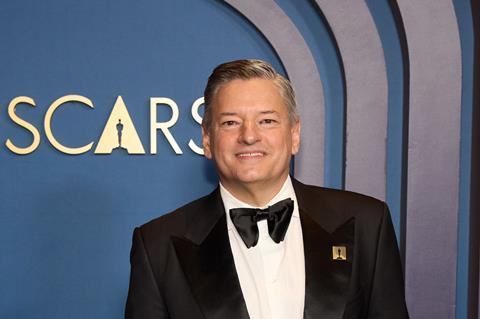
Netflix executives sought to reassure the entertainment community on Monday after last week’s bombshell $82.7bn offer for the studio and streaming assets of Warner Bros Discovery (WBD), telling a conference on Monday that they were “deeply committed” to theatrical distribution.
Co-CEOs Ted Sarandos and Greg Peters were speaking at the UBS Conference, when the former addressed Paramount’s $108.4bn all-cash hostile bid, saying: “Today’s move was entirely expected. We have a deal done, and we are incredibly happy with the deal.”
Sarandos said Netflix intended to keep running the film and television studios, theatrical distribution operation, and HBO and HBO Max, noting: ”We didn’t buy this company to destroy that value.”
On the contentious subject of theatrical distribution – a model that Netflix has never formally engaged with besides orchestrating limited awards-qualifying runs or rare experimental releases to appease filmmakers, like next year’s Narnia roll-out– Sarandos referenced the Warner Bros films that have grossed $4bn at the global box office in 2025.
“We’re deeply committed to releasing those movies exactly the way they’ve released those movies today,” he said. “If we did this deal 24 months ago, all of those movies we saw this year do so well at the box office for Warner Bros. would have been released in the same way in theatres. I’m talking about Minecraft. I’m talking about Superman. I’m talking about Weapons, all those movies – and Sinners.”
His comments struck a very different note from a webcast to analysts last Friday (December 5) that alarmed the exhibition community. On that occasion Sarandos said Netflix intended to honour theatrical agreements on existing Warner Bros films but was vague about the future. ”Over time, the windows will evolve to become much more consumer-friendly and meet the audience where they are quicker.”
On Monday Sarandos told the conference that Warner Bros Television will continue to be a third-party supplier and said of chairperson Channing Dungey and her team: “We want them to continue doing that phenomenal job.”
Turning to HBO, which is run by Casey Bloys, he noted: “We want HBO to double down on the things that people have loved for 50 years about HBO – the prestige television and movies and the various pay-TV windows. These are things we’re going to keep going in this business.”
Sarandos and Peters stressed they were in favour of creating jobs. “If you think about the core business units that exist inside Warner’s that we would be acquiring, we don’t have those units right now,” Peters said. “So we don’t have the redundancy issue. We’re not trying to consolidate.”
Sarandos met US president Donald Trump at the White House last week and said US president Donald Trump understood what Netflix does. ”Our original productions have employed 140,000 people from 2020 to 2024. Our economic contribution to the US economy in that production is about $125bn,” he said. “In the offer that Paramount was talking about today, the Ellisons [CEO David Ellison and father and backer Larry Ellison] were talking about $6bn of synergies. Where do you think synergies come from? Cutting jobs. So we’re not cutting jobs. We’re making jobs.”
Trump said on Sunday that the proposed Netflix bid would create ”a big market share […] and that could be a problem”. Trump heaped praise on Sarandos, however the president is a wild card and sounded cooler when he appraised Netflix and Paramount on Monday. ”None of them are particularly great friends of mine,” he said. ”I want to do what’s right. It’s very important to do what’s right.”
Bids will need to clear regulatory hurdles including the Department of Justice, which scrutinises potential anti-trust transactions. “It’s not our position to tell the regulators how to think about this,” Peters told the conference, later telling regulators how to think. “We are very confident that regulators should and will approve it. At the end of the day, it’s pro-consumer, delivers more value to those folks, pro-creator.”
It emerged on the call that Netflix’s projected content spend in 2026 is $18bn, while a combined company including the WBD assets would be spending in the region of $30bn a year.






No comments yet