




Meryem Benm’Barek’s second feature makes its debut in Marrakech competition
Dir: Meryem Benm’Barek. France/Morocco/Belgium/UK. 2025. 100mins
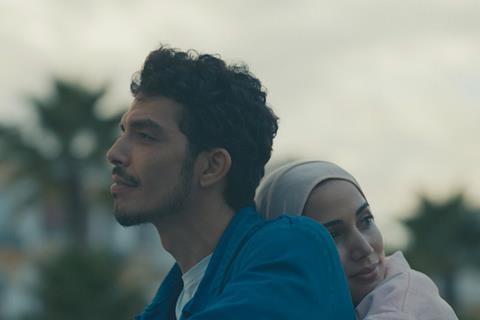
Decisions and their consequences drive the drama of Meryem Benm’Barek’s second feature, which focuses on young Moroccan Mehdi (Driss Ramdi) and the impact of his social aspirations on his romantic entanglements. As with Benm’Barek’ debut Sofia (2019), about an unmarried young woman unexpectedly giving birth, Behind The Palm Trees offers commentary on class, equality and cultural expectations within Morocco, while also setting its sights on the country’s postcolonial relationship with France.
Offers commentary on class, equality and cultural expectations
Sofia won the Best Screenplay award in Cannes’ Un Certain Regard and while Benm’Barek’s follow-up – co-written with Fyzal Boulifa (The Damned Don’t Cry), Emma Benestan (Animale) and Agnès Feuvre – is more formulaic, its strong performances should help propel it around the festival circuit after its world premiere in competition at Marrakech. Francophone countries are likely to be the strongest market for distribution, although the film’s frank nature could lead to cuts ahead of distribution in some MENA countries,
Mehdi has a comfortable middle-class background, living in Tangier with his teacher mother (Soumaya Akaaboune) and father (Amine Ennaji), for whose building firm Mehdi works after failing to fulfil his architectural aspirations after college. The young man’s chaste courtship of Selma (Nadia Kounda), who works in the local bakery, shows signs of being taken to the next physical level thanks to talk of wedding bells – despite sex before marriage being illegal for Moroccan nationals. These early scenes are full of the sweet, warm chemistry of longing, and a montage in which their relationship develops through selfies and videos Selma shoots is breezily economical and immersive.
But when Mehdi meets Marie (Sara Gireaudeau), the daughter of a wealthy French couple whose house he and his father are working on in the kasbah, his head begins to turn. Marie has a much more liberal attitude to sex and, beyond that, she also offers Mehdi access to other areas of her social sphere. Benm’Barek shows a keen awareness of detail, from the way that Marie’s household has large sums of ready cash laying about the place to the family’s entitled attitude towards the hired help and the swift fashion with which the welcoming facade towards Mehdi begins to crack.
Marie is nearing 40 but has an air of arrested development, apparently enjoying the freedom to do as she pleases without earning money – so long as her parents don’t disagree with her choices. Blind to her privilege, she tells Mehdi the main reason he isn’t getting where he wants to be is because he needs to “visualise” his success. As Mehdi tries to keep his relationships with both women on an even keel, camerawork from Belgian cinematographer Son Doan – returning from Sofia – also emphasises the different tenor of the encounters, with those shared with Selma having a warmer, more romantic palette than the more sexually explicit liaisons with Marie, which are shot in cooler hues.
The insidious attraction of social climbing is well articulated, but the relentless focus on Mehdi and his actions means that the female characters suffer. We find out very little about Selma beyond her dates with him, even as we know that his stringing her along is liable to end in tears; the result is that she becomes marginalised not just by Mehdi’s actions, but the film itself. Marie is also only seen from Mehdi’s perspective, so there’s little indication of her inner life.
While Benm’Barek generates tension as the trap Mehdi has made for himself slowly begins to close, the predictability of the final act works against it. The sorts of decisions Mehdi makes may inevitably lead to only one conclusion, but some fresher screenplay choices along the way would have been welcome.
Production companies: Tessalit Productions, Furyo Films, Agora Films
International sales: Pyramide International, sales@pyramidefilms.com
Producers: Jean Bréhat, Emma Binet, Souad Lamriki, Olivier Dubois, Tristan Goligher
Screenplay: Meryem Benm’Barek, Fyzal Boulifa, Emma Benestan, Agnès Feuvre
Cinematography: Son Doan
Production design: Itaf Benjelloun
Editing: Christel Dewynter
Music: Jim Williams
Main cast: Sara Giraudeau, Driss Ramdi, Nadia Kounda, Carole Bouquet, Olivier Rabourdin, Soumaya Akaaboune